
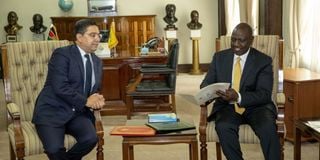
Morocco’s Foreign Minister Nasser Bourita (left) and Kenya’s Foreign and Diaspora Affairs Cabinet Secretary Musalia Mudavadi inaugurate the Kenyan Embassy in Rabat.

Kenya is starting to harvest a set of wins from Morocco, coming a year after Nairobi formally endorsed the autonomy plan on Western Sahara.
Last week, the two countries held the first Joint Commission for Cooperation (JCC), the highest bureaucratic organ between the two countries meant to address mutual issues.
The result was11 bilateral instruments, marking a major step in strengthening their partnership. The Kenyan Ministry of Foreign and Diaspora Affairs said the move signals intent to “deliver tangible outcomes for our two nations.”
The agreements span key sectors including agriculture, health, higher education, blue economy, fisheries and aquaculture, justice, gender and women’s empowerment, culture, scholarships and internships, sports, immigration, wildlife management and skills exchange, according to a dispatch provided to the media on Thursday.
“We also agreed to accelerate collaboration in trade, investment, industrial development and air connectivity, unlocking new opportunities for growth and shared prosperity,” Musalia Mudavadi, Kenya’s Foreign and Diaspora Affairs Cabinet Secretary said.
“Kenya remains committed to building a strong, results-driven partnership with the Kingdom of Morocco, and I emphasised the need for effective implementation and monitoring to ensure these agreements translate into real impact.”
Under President William Ruto’s government, Kenya and Morocco have been getting closer by year, departing from an adversarial arrangement they had in the past, and which had initially influenced Morocco to quit the Organization of African Unity (OAU) in the 1980s. Morocco has since, in 2017, returned to the African Union, the successor organisation of the OAU. But the elephant in the room had always been the fate of Western Sahara.

Morocco’s Foreign Minister Nasser Bourita.
As late as 2021, Kenya was among African countries pushing for the self-determination of Western Sahara, a portion of the north-western part of the continent claimed by Morocco as its territory. In 2022, Morocco sent its special envoy, Minister for Foreign of Morocco Nasser Bourita, to attend President Ruto’s inauguration.
State House later that day tweeted that it would “gradually wind down” the embassy of the Sahrawi Arab Democratic Republic (SADR) before deleting the post.
However, it later emerged Kenya and Morocco had actually signed commitment to pursue autonomy: Pushing Western Sahara as an autonomous, not independent region, of Morocco.
The inaugural JCC session held in Kenya on Thursday between delegations led by Mr Mudavadi and Mr Bourita were supposed to elevate the bilateral relations between the two countries. They wouldn’t happen if Nairobi didn’t change stance on Western Sahara. In the 80s, it was Kenya who pushed for admission of SADR as a member of the OAU. Morocco quit the bloc in protest.
On Thursday, Kenya said, as it did in May 2025, that it is supporting the United Nations framework as an exclusive mechanism to finding a lasting and durable political solution to the dispute over the Sahara issue, with the relevant UNSC resolutions on the matter. It means Kenya has departed from any parallel efforts by the African Union to solve the matter. As decisions are taken by consensus at the AU, SADR will remain a member, for now, until all members support its exclusion.
“The exclusivity of the United Nations in this political process remains pivotal and we reaffirm support to the UN Security Council resolutions, particularly Resolution 2756 (2024).
“We recognise Morocco’s ongoing cooperation with the UN Secretary-General and his Personal Envoy to advance the political process on the basis of relevant Security Council resolutions,” Mudavadi said.
Kenya says it welcomes the growing international consensus and momentum led by King Mohammed VI in favour of the autonomy plan presented by the Kingdom of Morocco as the “only credible and realistic solution to resolve the dispute over the Sahara.” Mr Mudavadi said that the autonomy plan is a sustainable approach to the resolution of the Saharawi issue and intend to cooperate with like-minded States to foster its realisation.
Also Read: AU sides with Western Sahara on autonomy
Kenya also endorsed the efforts of the UN Secretary-General and his Personal Envoy to facilitate and conduct negotiations based on the autonomy plan, with a view to achieving a just, lasting, and mutually acceptable solution.
Morocco, however, will need to work harder at convincing the rest of Africa, especially Algeria which supports independence of SADR.
The Western Sahara region is a disputed territory where Morocco controls about 80 percent of the territory, while the Polisario Liberation Front claims independence for the Sahrawi Arab Democratic Republic (SADR), running it from exile in Algeria.
President William Ruto with Morrocan Foreign Minister Nasser Bourita at State House Nairobi on September 14, 2022. The meeting resulted into a diplomatic gaffe. PHOTO | PSCU
The UN established a peacekeeping mission in 1991 to monitor the ceasefire between Morocco and the Polisario, which its mandate will be ending in October this year with Morocco pushing got autonomy.
In 2025, Kenya opened its embassy in Rabat after 60 years of bilateral diplomatic ties with Morocco, where it backed Moroccan initiative offering landlocked Sahel states access to global trade through Morocco’s Atlantic ports.
Mr Mudavadi said that the new bilateral instruments build on the five Memoranda of Understanding that was signed last year in Arabat during his official working visit.
“In recognition of the strategic importance of transport and connectivity, we agreed to prioritise the resumption of direct flights between Kenya and Morocco under the Bilateral Air Services Agreement (BASA) to enhance trade, tourism, and people-to-people exchanges,” Mr Mudavadi said.
The two leaders said that Kenya and Morocco will strengthen partnership on specialised medical treatment, capacity building, and healthcare infrastructure support.
Morocco’s Princess Lalla Asmaa of Morocco, the sister to the current monarch, has recently supported various health initiatives in Kenya including donating cochlear implants and surgical kits to support the medical mission where 60 children received hearing implants. In addition, Morocco has also continued to support free eye clinics where hundreds of patients have benefited from life changing surgical interventions.”
The agreement on culture and people-to-people relations is meant enhance cultural exchanges and youth engagements between the two countries, hence reflecting a shared desire to foster friendship and mutual respect.
Nonetheless, the two countries say they will continue to strengthen cooperation on common African positions, promoting peace and security, and supporting sustainable development.
Follow our WhatsApp channel for breaking news updates and more stories like this.
Additional reporting by Aggrey Mutambo


