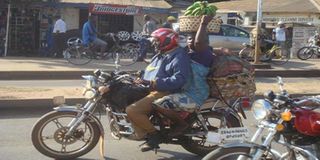
A motorbike carries a passenger and some trade items in Morogoro. Inset is Mr Nicholaus Ching’enya. PHOTO | MICHAEL MATEMANGA
What you need to know:
It was a frustrating life. “Gone are the days when driving a taxi was considered a serious business,” he tells BusinessWeek. “It is probably the worst trade that one can do in town.”
Dar es Salaam. A few months ago, he would wake up at dawn and go to bed at midnight. His 16-hour job earned Nicholaus Ching’enya a maximum of Sh20,000.
It was a frustrating life. “Gone are the days when driving a taxi was considered a serious business,” he tells BusinessWeek. “It is probably the worst trade that one can do in town.”
Mr Ching’enya was just one of the many taxi drivers in Dar es Salaam and other major cities in Tanzania who find it difficult to make both ends meet due to competition from the new modes of transport—the motorcycles popularly known as bodaboda and the Bajaj.
Ten years ago, taxi drivers commanded a lucrative transport business in Dar es Salaam and other major cities. The coming of the two-wheel and three-wheel modes of transport—which now dominate a city that is famous for traffic jams—has ruined their business. “I have friends who park their taxis at Julius Nyerere International Airport,” Mr Ching’enya says. “I am told that they can stay there all day and earn just Sh10,000—which is peanuts.”
Taxi drivers no longer demand waiting charges. They cannot do so at a time when the business is declining at a pace never witnessed before. “You tell a taxi driver to wait for you for one hour and he will do that without charging you for the time as they used to in the past,” Mr Ching’enya adds. “Even if he were to leave, he would still have done no business within that hour.”
The chairman for the association of bodaboda drivers based at Tabata-Kimanga area, Mr Omari Mvungi, shares these sentiments. “People who want to save time and money when doing business usually opt for either bajaj or bodaboda. This has hit taxi drivers, who spend most of their working hours sleeping in their vehicles, Mr Mvungi says.
According to him, the lowest a bodaboda operator can earn per day is Sh20,000. This translates into weekly earnings of Sh120,000—of which only Sh45,000 goes to the owner of the bodaboda, leaving the driver with at least Sh75,000 per week or a minimum of Sh300,000 per month. Bodaboda drivers will charge between Sh1,000 and Sh10,000, depending on distance and waiting time. Safety may be a concern with bodaboda but you can always ask the driver to stick to the speed you are comfortable with.
Taxis are generally expensive. Within the city centre, you can expect to pay between Sh3000 and Sh7,000 while you will cough up Sh20,000 to Sh30,000 from the city centre to the airport. If you choose to go the bodaboda way, it will cost you a maximum of Sh10,000.
A BusinessWeek survey indicates that from the city centre to Mikocheni, you will need between Sh10,000 and Sh15,000 by taxi while the same trip will cost between Sh5,000 and Sh7,000 by bodaboda. From the city centre to Sea Cliff, you will likely spend between Sh12,000 to Sh15,000 by taxi as opposed to between Sh5,000 and Sh6,000 by bodaboda.
Going to Kawe by taxi from the city centre will cost you between Sh15,000 and Sh25,000 while the same trip will cost a maximum of Sh10,000 by bodaboda.
According to Transport Economics Consultant Gilbert Komba, the rush for bodaboda, especially during peak hours, can be put down to the chronic problem of congestion in the city. “It is very painful to take daladala during peak hours because they are overcrowded and they spend hours in traffic jams,” says Mr Komba. “People have been rushing for bodaboda, though they are unsafe, because of traffic jams and the notorious daladala.”
The city has three modes of public transport, including the commuter buses popularly known as daladala and two-wheel and three-wheel vehicles, but the last two modes are not well regulated by the Surface and Marine Transport Regulatory Authority (Sumatra), according to Mr Komba.
Moreover, he adds, the Dar Rapid Transit project along Morogoro road to connect the city centre will not reduce congestion because there are no flyovers. The feeder roads are not well built so congestion will simply shift from one point to another.
A 2011 the World Bank study shows that daladalas have operational problems related to speeding, overloading and abusive language targeting passengers.
Drivers have also been known to refuse to reimburse fare when passengers are dropped off short of their final destination while some drivers do not have valid driving licences.
The bajaj is perceived more positively and cargo versions are replacing hand-carts. Passenger versions work mainly in suburban and peri-urban areas, according the study. But there are still challenges to be sorted out, including difficulty in controlling on-street public transport activities and relying almost entirely on overwhelmed traffic police officers to check the condition of vehicles.
Motorcycle transport is affected generally by the same issues as the bajaj. They are more numerous and are seen as more invasive, more dangerous to other road users and unsafe. Drivers are untrained, allegedly often unlicensed and generally unpredictable.
Dar es Salaam’s traffic jams reportedly cost the economy some Sh4 billion a day in terms of wasted man hours and excessive fuel use. This translates into monthly loss of Sh120 billion and yearly loss of Sh1.44 trillion—more than the yearly budgets of some key ministries.