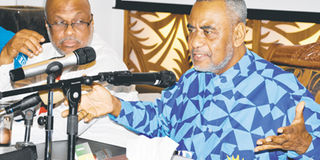
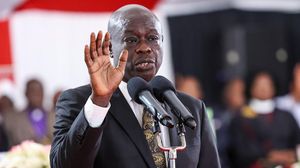
CUF presidential candidate and secretary general Seif Sharif Hamad stresses a point while addressing a press conference. LEFT: Zanzibar President Ali Mohammed Shein swears in his Cabinet. The two have engaged in war of words over the legality of the Zanzibar government. PHOTOS | FILE
What you need to know:
In 2009, major political changes took place in Zanzibar. After 14 years of animosity, and three troubled elections pitting the ruling CCM and opposition CUF, the rival parties finally agreed to a power sharing deal, which was constitutionalised in 2010.
Zanzibar. Some 167 years ago, French journalist and novelist Jean-Baptiste Alphonse Karr made a famous saying: ‘Plus les choses changent, plus elles restent les mêmes’ -- literally meaning ‘the more things change, the more they stay the same.’
In 2009, major political changes took place in Zanzibar. After 14 years of animosity, and three troubled elections pitting the ruling CCM and opposition CUF, the rival parties finally agreed to a power sharing deal, which was constitutionalised in 2010.
After many years, Zanzibaris witnessed a relatively peaceful General Election in 2010. The event booked its place in the history manuscripts as the most peaceful poll since the re-establishment of multiparty elections in 1995.
As a result of the election, CUF and CCM formed a Government of National Unity (GNU) in which the former accepted the post of First Vice President plus several ministerial posts.
Although it was not clear from the beginning whose policies would shape operations of the government, CCM accepted to have the CUF as part of the government. It later transpired that because it was the one which won the presidency, CCM policies would be used as the basis of government operations.
However, with all the changes which gave many people hope that the politics of hatred was about to be buried, it didn’t cross anyone’s mind that nothing much had changed, until October 28, 2015.
Three days after last year’s General Election, Zanzibar Electoral Commission (ZEC) Chairman Jecha Salum Jecha annulled the results, citing massive irregularities. Jecha ordered a rerun which the CUF boycotted, maintaining that it won the polls.
Political tensions have returned and clouded Zanzibar since. Zanzibaris have generally remained calm, but there has been massive deployment of security forces ahead of the election rerun held on March 20.
The CUF opposed the annulment of the results, stressing that they won in the first round of elections. Reconciliation talks between presidential candidates on the CCM and CUF tickets Ali Mohammed Shein and Seif Sharif Hamad, respectively, hit a snag after eight meetings attended by former Zanzibar presidents.
As a result, the CUF went ahead and boycotted the polls rerun, allowing Dr Shein to win the second term in office by 91.4 per cent. CCM also won the House of Representatives in all 54 constituencies.
That, however, was not the end of the of the tension. The opposition has said it devised an elaborate strategy to deflate a seemingly energised CCM government led by Dr Shein, who since his controersial re-election, has been condemning CUF over its decision to boycott the re-run.
Mr Hamad, who served as Zanzibar’s First Vice President for five years in the GNU, has maintained that his party will not recognise Dr Shein and his government. He has also vowed to not cooperate with the new administration in any way.
Recently, the opposition leader said the party would launch a plan to reclaim lost ground. He didn’t say much on the specific actions, but there are indications from insiders that the plot is to portray Dr Shein as unqualified to stand on a moral high ground on matters of public interest.
Mr Hamad has already urged his supporters in the Indian Ocean archipelago to engage in “passive resistance” against the government led by Dr Shein.
And lately, on Sunday, he told reporters in Zanzibar that CUF leaders were drafting plans on how its supporters would engage in the resistance.
“We’ll democratically continue resisting the authority of the so-called Zanzibar government and ensure fruitful plans to organise and mobilise our people are underway.
“We’re not going to use any force, but we’ll make this government surrender, for in this time and era no one can rule a country against the wish and the mandate of the people,” said Mr Hamad without giving details on how they are going to pull down Dr Shein’s government.
On the other hand, Dr Shein has also not minced his words on the matter. Delivering his inaugural speech to the House of Representatives a week ago, he said he was neither shaken nor denied of sleep by the CUF stand.
In addition, he sent a stern warning to those who were planning to oppose his government and disrupt peace that he would fight them off head-on and ensure peace and order prevailed in Zanzibar.
The election time was gone and that Zanzibaris and their government must now shift their focus on building the Isles’ economy, he said.
On Saturday, as he was unveiling his Cabinet, Dr Shein also downplayed Mr Hamad, saying it was not the first time he denounced the government, vowing not to cooperate with it.
“He has been doing that since 1995, and nothing happened. As long as God recognises me and the government He gave me the mandate to govern the Isles, no one bothers me. I’m used to what they are saying,” said Dr Shein when announcing his Cabinet.
The Isles leader picked three members from opposition parties that participated in the poll re-run. He went on to blame CUF for boycotting the election rerun, admitting, however, that had they participated, all requirements for the power sharing arrangement stipulated in the Constitution would have been met.
The current war of words is but a fresh repeat of heated politics in the Isles, as Mr Hamad conceded that in no time it would trickle down to the people supporting the rival parties.
In 1990s, the animosity between CUF and CCM supporters was so high that the CUF supporters did not attend funeral ceremonies of CCM supporters and vice versa.
The worst of the tug-of-war happened in 2001 when 26 CUF supporters were shot dead by police in Pemba in violent post-election confrontations.
Many others sought refuge in Mombasa, Kenya, and Somalia. Protesters were calling for fresh elections after the disputed October 2000 polls.
The Political Science lecturer from the University of Dar es Salaam, Mr Richard Mbunda, said what was going on in Zanzibar was a clear manifestation that not all, especially CCM bigwigs, were happy with the formation of the GNU in 2015.
Since the then presidents of Zanzibar and the Union government, Mr Amani Karume, and Mr Jakaya Kikwete, had approved it, no one else would go against their wishes.
He argued that although reconciliation deal seemed impossible to reach at the moment, the GNU was still the best solution on the table for the Zanzibar political environment, and that all what was needed was to address and amend shortcomings observed between 2010 and 2015.
“CCM might be running the government and the House of Representative alones, but the situation is not going to remain that way forever.
“A deeply rooted inclusive government is what is needed in Zanzibar, and that means the wrangling CUF and CCM will have to go back to the drawing table and chart the agreeable way forward,” he said.
What will CUF do?
In its governing council held earlier in the month, the CUF came up with 13 resolutions as part of its way forward on how they will ensure Dr Shein does not extend his rule to 2020.
However, apart from asking the people to engage in passive resistance, the resolutions do not give details on what wananchi should do to support the party’s stand.
The party also shied away from outlining what it planned to realise its pipedream of pulling down the government.
But during the Sunday press conference, Mr Hamad called upon foreign powers to support its stance by introducing travel ban on Zanzibar government leaders.
He also asked the foreign powers to also freeze overseas assets and accounts belonging to members of the Isles government. Analysts doubted the call; nonetheless, saying it relied on the mercy of foreign powers, as neither imposing a ban nor freezing assents and accounts was in the hands of the CUF.
But Mr Hamad added that the party was still “drafting a plan on how to organise and mobilise the people (to rally behind its call not to recognise the government and to stop cooperating with it.)
If this is so, the party has not hatched its plan on how it is going to roll out its resolve not to cooperate with the government.
How long it will take the party to devise its strategies before it starts to implement them, it remains to be seen?