Farmers need to be valued and protected, stakeholders say
Agriculture also controls inflation, since food contributes about 50 per cent of the inflation basket.
What you need to know:
Agriculture also controls inflation, since food contributes about 50 per cent of the inflation basket. Agricultural development therefore remains crucial to the country’s economic and social development, at least in the foreseeable future.
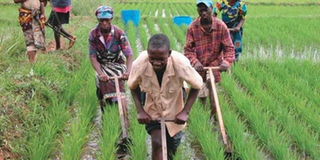
Dar es Salaam. The agricultural sector provides a livelihood to more than 70 per cent of the population, accounts for 26 per cent of Gross Domestic Product (GDP) yet it is the most struggling sector in Tanzania.
Agriculture also controls inflation, since food contributes about 50 per cent of the inflation basket. Agricultural development therefore remains crucial to the country’s economic and social development, at least in the foreseeable future.
However the agriculture sector faces serious challenges that hinder its growth. Some of these hurdles include poor access and low use of improved seeds and fertilizers. The poor access is caused by peasants’ low income. There is also limited access to capital for sustainability of the sector.
Farmers depend on rain, which is mostly unreliable. The irrigation infrastructure is underdeveloped. There is a shortage of markets for farmers produce especially in years of bumper harvests.
Mr Steven Ruvuga the Executive Director of the coalition of farmers groups Tanzania says the fourth phase government came up with various strategies and initiatives to improve agriculture. One of these is the Kilimo Kwanza that have to a great extent helped the sector grow.
“Every new implementation must incur difficulties, Kilimo Kwanza (Agriculture First) has not exactly reached out to small scale producers, but as the new government gets in power there are still chances to reach them and improve their agricultural productivity.” Added Mr Ruvuga.
He summarises what farmers want from the new administration that is expected to start in November.
What farmers want is basic necessities for farming including agricultural inputs, market availability and land. But farmers need financial assistance to purchase inputs considering that most small scale producers have low incomes.
Farmers also need to be valued and protected. They need ownership of land and so the coming government should implement policies that will protect their land and this will help to solve land dispute.
“Government should also improve local markets so that the produce should benefit farmers” he noted.
The coming administration has an obligation to continue with what was initiated by the past administrations and introduce new ways to achieve more productivity in the sector of agriculture hence growth of nation’s economy.
The board chairperson of Tanzania Agricultural Development Bank Ms Rosebud Kurwijila also praises the outgoing government saying it was committed to agricultural transformation and improvement.
“The best example is the implementation of pillar number two of “Kilimo Kwanza” on financing agriculture. The Government implemented this by establishing the Tanzania Agricultural Development Bank which was launched by President Kikwete, who is also the initiator of KILIMO KWANZA,” said Ms Kurwijila.
But she says what farmers still need is access to extension services which have deteriorated in recent years and extension officers are unable to reach most farmers as required.
There is evidence to show that productivity and income of farmers regularly reached by extension service providers is much higher than those who do not.
They also need access to value adding facilities and markets are important to reduce post-harvest losses and create jobs and more income. It is high time we stopped exporting raw produce only to import the same as finished products.
In this year’s campaigns just like in the past, candidates have brought forth the topic of agriculture, elaborating their strategies to upgrade the sector for the nation’s economy if elected in October polls.
The ACT’s presidential candidate Ms Anna Mghwira on the party’s presidential campaign launch in Dar in August promised to boost agriculture and agro-processing so as to create more jobs.
The party’s manifesto states that it will reposses land offered by big investors and give it to farmers who do not own land. Its government will introduce policies that will assure price stability and smooth commodity exchange which will minimize chances of middlemen denying farmers their fair share.
ACT will also formulate the agricultural regulatory authority that will regulate and supervise all agriculture activities and ensure the sector’s sustainability. But ACT also says it will provide pension to farmers to ensure them good life when they are aged and do not have energy to continue tilling the land.
On other hand the Chadema’s presidential candidate Mr. Edward Lowassa on his campaigns at Kiomboi in Singida, promised to construct ago-processing industries to help the sunflower growers benefit from their hard work.
“Our priority will be on adding value to agricultural products before they are exported to make sure that farmers reap maximum profit from their sweat,” said Mr Lowassa.
The Chadema’s manifesto over agriculture states that its government will work on upgrading modern agriculture from six to eight per cent. To ensure farmers get long term loans ranging from 5 to 15 years on affordable interest.
The CCM presidential candidate Dr John Magufuli on his side promised to boost irrigation to facilitate modern farming that will allow for all year round production. This was during campaigning in Songea in September.
He assured the farmers that his government will pay farmers promptly for their produce and supply them with subsidized agricultural inputs.