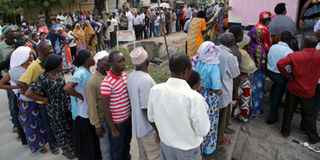
Voters queue in Manzese, Kinondoni District in Dar es Salaam yesterday to elect local government leaders. PHOTO | EMMANUEL HERMAN
What you need to know:
It is a day of high drama and confusion as candidates’ names are mixed up on ballot papers and scores of people are unable to vote after their names are no where to be found in registers
Local government elections usually take place about a year before the General Election and are usually seen as a pointer to parties’ fortunes in presidential, parliamentary and civic elections. The next General Election is provisionally scheduled to take place in October 2015. Some 11 million voters registered for this year’s local government elections, according to official statistics.
Dar es Salaam. The local government elections were marred by irregularities in many parts of the country yesterday, leading to the postponement of the exercise in some areas. Lack or shortage of voting materials as well as the mixing up of the names of candidates and voters forced many returning officers to call off the election at some polling centres.
Reports gathered by The Citizen showed that no region was unaffected and there was chaos in some areas, prompting riot and intervention by regular police.
Police fired tear gas to disperse angry voters at a number of centres and arrested party officials, candidates and voters who were accused of violating electoral rules. The Prime Minister’s Office (Regional Administration and Local Governments) blamed district councils, noting that they were responsible for most of the preparations, including distribution of voting materials and printing of ballot papers.
Contacted for comment, the local government elections national coordinator, Mr Dennis Bandisa, confirmed that the polls were marred by irregularities due to local authorities’ failure to complete preparations in time.
He said problems with ballot papers were widespread, adding that local authorities were solely to blame as they were the ones who were tasked with printing and distributing them to all polling centres well ahead of yesterday’s elections.
“We at the national level are waiting for official explanations from councils as to why some polling centres did not receive materials on time because we provided them with all they needed well in advance. Obviously, the delays have been caused by them,” he said.
Mr Bandisa added that ballot boxes were distributed to councils, but the printing polling papers was left to the local authorities themselves.
“I have reports from Ilala and Ulanga districts highlighting mistakes on ballot papers. The ballots were apparently returned to printers twice to be corrected, but voters still noticed errors on election day,” he said, adding that some details were not easy to deal with at the national level.
“That is why it was left to councils to handle the ballots, including selecting printers of their choices.”
Mr Bandisa noted that they were waiting for reports from district executive officers, who were the returning officers, because they were the ones who postponed elections to next week after consulting with assistant returning officers and party agents.
But the opposition Chadema cried foul, and charged that the elections were deliberately sabotaged by those tasked with supervising the exercise.
A Chadema statement posted online listed a number of irregularities at many voting stations and blamed the authorities for what happened.
Briefing the media, Chadema Deputy Secretary General John Mnyika accused the Prime Minister’s Office of failing to organise free and fair elections.
He said reports from across the country showed that there were widespread irregularities and logistical hitches, casting doubt on whether the elections were free and fair.
Mr Mnyika appealed to Prime Minister Mizengo Pinda to immediately intervene and address problems that were threatening the credibility of the elections.
Civic United Front (CUF) Director of Elections Shaweji Mketo said there were indications that the problems that marred the elections were planned.
“For instance, in Kilimahewa Street in Temeke District, some voters could not find their names in the register despite the names being pasted on notice boards...this appears to be deliberate,” he said.
Mr Mketo, who is also the party’s acting deputy secretary-general in Tanzania Mainland, said they had received reports that many of their members could not vote because their names were not in the register.
CCM also complained about irregularities in the elections.
The party’s ideology and publicity secretary, Mr Nape Nnauye, told The Citizen that they appealed to returning officers to call off the elections after widespread anomalies became apparent.
“It is true that there are a lot of irregularities which we noted. There are poling centres which had not received important voting materials such as indelible ink. How can you prevent people from voting more than once if there is no way of identifying those who have already voted?” he queried.
Tanzania Labour Party (TLP) national chairman Augustine Mrema doubted if the nation would get good leaders from elections which had been marred by such irregularities.
“We asked that our candidates be allowed to act as their own agents since we are a small party that has no money. This request was accepted, but yesterday our candidates were chased away from some polling centres,” he said.