Environment the loser in Gabon capital's rush for growth
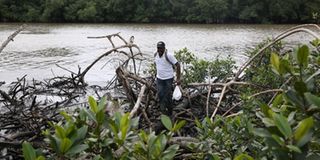
Magloire-Desire Mounganga, an expert from Gabon's National Agency for National Parks (ANPN), walks over mangroves in the Angondje Nton district of Libreville on May 17, 2018. It's an environmental disaster," said Magloir-Desire Mounganga, an expert from Gabon's National Agency for National Parks (ANPN), as he strode across the soggy, spongy soil. "Here the mangrove trees have been completely razed, you can even see the marks left by the bulldozer," he said. The path in the district of Angondje Nton leads to a section of large homes owned by the wealthy. The svelte buildings rise on muddy terrain where mangroves once flourished. According to Medard Obiang Ebanega, a geographer at Libreville's Omar Bongo University, "Mangroves have the capacity to retain water and to combat coastal erosion with their (extensive) root systems, which also act as nurseries for marine species" .
STEVE JORDAN / AFP
What you need to know:
Gabon, an oil-rich, small equatorial African country of about 270,000 square kilometres (104,000 square miles), has won plaudits for some of its ecological work.