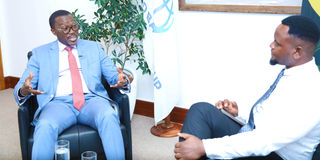
Dar es salaam. World Bank Regional Vice President Ndiamé Diop says Tanzania must now connect public infrastructure with private investment, predictable regulation and employment, before trade and capital move to competing routes.
If Ndiamé Diop were to write a book about Tanzania’s economic transformation, he would call it “Now or Never.”
The three-word title, offered at the end of an interview with The Citizen, captured the World Bank executive’s central message: Tanzania has invested heavily in the foundations of growth, but the next test is to turn those assets into productive businesses, higher incomes and jobs.
Diop is the World Bank’s Regional Vice President for Eastern and Southern Africa, overseeing almost 400 projects worth more than $76 billion across 26 countries. In Tanzania, he said, the Bank has 34 projects under implementation with a combined value of nearly $9 billion.
During his visit, Diop inspected projects in Zanzibar and the Port of Dar es Salaam, whose modernisation has received World Bank support since 2018. He said Tanzania is building assets capable of reshaping regional trade, but their value will depend on the economic activity created around them.
Beyond concrete, steel and rails
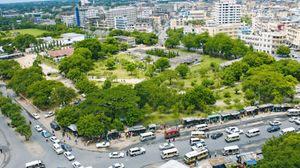
The Port of Dar es Salaam is central to Tanzania’s ambition to become a stronger trade and logistics gateway for land-linked neighbours, including Burundi, Rwanda, the Democratic Republic of Congo and Zambia. Yet its location inside a rapidly growing city creates a paradox: greater port capacity can attract more trucks and worsen congestion unless freight is integrated with rail and bypass roads.
Diop said discussions on possible future support include further port modernisation, a standard gauge railway terminal within the port and road links to move freight around heavily congested areas of Dar es Salaam. “Tanzania, like most African countries, faces a huge infrastructure gap, so not investing in infrastructure is not an option,” he said.
“You can build the infrastructure, but then you need to create activities around it so that the infrastructure is used.”
A railway delivers wider gains when farms, warehouses, factories, mines and service businesses generate cargo. For Tanzania, this could mean agricultural hubs, agro-processing, mineral processing and investment in secondary cities along the Central Corridor. Such activity would raise use of the railway and improve the return on public spending.
“Public investment alone may be insufficient,” Diop said. “You really need to think comprehensively about public investment plus private investment.”
The Central Corridor dream deferred
The Central Corridor is not a new ambition. Tanzania has discussed its potential for decades, but many of its projected gains remain unrealised. Thomson asked why, after years of plans and large transport investments, the corridor’s full promise had taken so long to materialise. The delay has an economic cost. Underused port and railway capacity reduces returns, while Tanzania can lose processing plants, logistics businesses and agricultural value chains that might otherwise create jobs along the route.
“The risk of investing massively in transport networks and not having the full return on that investment is associated with what you do as complementary investment, and how much effort you put into attracting private investment along the corridor,” Diop said.
Waiting also matters because Tanzania does not have a captive regional market. Competing routes, including the Lobito Corridor linking Central Africa to the Atlantic, are seeking investment and access to some of the same inland economies, particularly the DRC. As alternatives improve, freight operators and investors gain choices.
Tanzania’s geography remains an advantage, but it cannot guarantee that cargo, factories or distribution hubs will use the Central Corridor. Cargo diverted elsewhere means less traffic through Dar es Salaam port and the standard gauge railway. It can also slow growth in the secondary cities and production zones the corridor is intended to stimulate, turning a strategic advantage into a missed opportunity for industrialisation and employment.
Diop acknowledged that earlier corridor models had limitations because they often focused on transport links without sufficiently planning for the farms, factories and cities needed to generate activity.
“In the past, there were some limitations in the way those corridors were conceived,” he said. “But I think there is a paradigm shift, and now it is very clear that there is a new way of developing these corridors.”
The new approach would plan roads, railways and ports together with mapped opportunities in agriculture, mining, logistics, processing and urban development. Policymakers would seek investors and remove business barriers while construction proceeds, rather than wait for commercial activity to emerge later. “If you see one opportunity for transformation, just jump on it,” Diop said. “In the case of Tanzania, it could be the Central Corridor.”
Capital, confidence and reform
Tanzania’s Development Vision 2050 expects the private sector to supply 70 percent of the required investment, according to the National Planning Commission. Diop called that sensible, but said it would require removing obstacles facing domestic and foreign investors. Businesses have repeatedly raised taxation, permits, licensing and regulatory uncertainty as constraints. Diop added that established firms benefiting from limited competition and sections of the bureaucracy comfortable with the status quo can resist reform. “If you want a tidal wave of investment, then you have to remove those barriers,” he said. For major projects, financing is only part of the equation. Governments can combine development finance, private capital and guarantees to lower risk and borrowing costs. However, investors committing money for years need confidence that rules will remain stable.
“There is plenty of capital out there. Money is really not the problem,” Diop said. “What you need is a framework and visibility on the return on the investment, and mechanisms to mitigate risk.”
Tanzania’s debt and the cost of repayment
The interview also addressed Tanzania’s national debt, which is currently over $51 billion. With this figure, the country’s debt stock is about 45 percent of gross domestic product and roughly one-third of its external public debt was owed to the World Bank.
Diop was asked whether Tanzania still had room to borrow for capital-intensive projects. He responded that the share of debt owed to a creditor does not, by itself, reveal the pressure on the national budget. The more revealing measure is debt service: the interest and principal repayments due each year. “The debt stock - one third is from the World Bank,” he said. “But what is interesting is that, if you look at the servicing of that debt, you will see how much is going to the World Bank and how much is going to the domestic bond market.”
He said World Bank concessional loans generally carry far lower repayment costs than short-term commercial or domestic borrowing. Using illustrative terms, Diop compared borrowing at about one percent with a long grace period against a loan charging eight percent and repayable within five years.
“If you are paying one percent interest and, at the same time, for eight years you are not paying the principal, the amount coming out of your budget to service that debt is very minimal,” he said. “If you take a loan of eight percent and you have to repay it in five years, what you are paying back is much higher.”
His argument was that debt should be assessed by its terms, repayment profile and economic use, not only by its headline size. Expensive short-term borrowing can strain the budget even when it represents a smaller share of the debt stock.
Corruption and accountability
Asked about corruption, project delays and public concern over the responsible use of loans, Diop acknowledged that accountability remains essential.
“Weeding out corruption is really important,” he said. Diop said World Bank-financed projects are ring-fenced with fiduciary controls intended to ensure that money serves approved purposes. But development partners finance only a minority of total spending in many sectors. Even if externally financed projects meet strict safeguards, gaps in national systems can still produce waste or misuse elsewhere.
“If we get everything right in the projects that we are financing, and the rest is subject to systems that have gaps, then you get the result that you’re talking about,” he said. Diop said the longer-term answer is to strengthen public financial-management systems. Digital tools throughout the budget cycle can improve traceability and oversight. He nevertheless cautioned that corruption remains “a difficult subject” and “an important issue to tackle.”
Jobs as the final measure
For Diop, Tanzania’s larger challenge is ensuring that economic growth reaches households. Manufacturing, tourism, agro-processing and mineral processing all have potential to create employment, but they will not expand fast enough if private investment continues to lag behind public construction.
“Jobs are created by the private sector, most of them, 90 percent,” he said. “If the private sector doesn’t come in, you really don’t get enough jobs in the market.” The same logic applies to young entrepreneurs. Access to finance is a major obstacle, particularly when founders lack collateral. Venture capital, equity and impact financing can help, but licensing, permits and taxation must also allow young firms to survive and expand.
“My metric is employment, especially for the young people,” Diop said. “If you address that challenge of young people getting higher income, gainful employment or starting up their own enterprises, then you solve many problems. It will transform this country.”
Diop said his meetings with Tanzania’s president, finance minister and other officials left him convinced that the government understands the urgency. The opportunity remains considerable, but the window cannot be treated as unlimited.
Tanzania must coordinate projects, maintain predictable rules, use public resources transparently and enable private businesses to grow before capital and trade flows settle on competing routes.
The country has begun building the hardware of transformation. Its success will ultimately be measured not by kilometres of railway or the value of loans secured, but by the businesses those investments enable and the number of Tanzanians who obtain better work because of them.
Register to begin your journey to our premium contentSubscribe for full access to premium content