Tanzania enters Global AI network to drive digital transformation
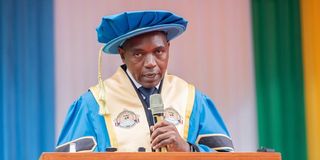
The Nelson Mandela African Institution of Science and Technology (NM-AIST) Vice-Chancellor, Prof Maulilio Kipanyula, speaks during the institution’s 12th graduation ceremony in Arusha on Saturday, August 22, 2026, explaining the significance of the Global AI Capacity Development Network (AICDN). PHOTO | BERTHA ISMAIL
Arusha. Tanzania, through the Nelson Mandela African Institution of Science and Technology (NM-AIST), has been selected to join a global artificial intelligence (AI) platform aimed at narrowing the worldwide gaps in AI skills, research and technological infrastructure.
Known as the Global AI Capacity Development Network (AICDN), the initiative is supported by the United Nations Office for Digital and Emerging Technologies (UN-ODET), which was established by the UN General Assembly and launched in Switzerland in July 2026.
NM-AIST is the only institution in Tanzania selected to join the network, positioning the country to strengthen its pipeline of AI researchers, engineers and innovators capable of applying the technology to national priorities including agriculture, healthcare, education, climate change, manufacturing and public services.
Speaking during the institution’s 12th graduation ceremony, NM-AIST Vice Chancellor, Prof Maulilio Kipanyula, said the institution’s inclusion in the network represented an important international recognition and an opportunity to expand its collaboration with institutions around the world.
He said the development would open new avenues for international partnerships while strengthening NM-AIST’s contribution to the advancement of AI.
Prof Kipanyula said the network focuses on four key areas, AI foundations, AI enablers, capacity development and open science.
“Under capacity development, the network seeks to facilitate university-level training, curriculum alignment, student and researcher exchanges, summer schools, competitions and hands-on training,” he said.
“It also promotes collaboration in the use of open data, open-source software, open AI systems and joint approaches to evaluating AI systems,” added Prof Kipanyula.
For Tanzania, he said, the opportunity would expand access to international expertise, collaborative research, specialised training and student and researcher exchange programmes.
“This can also help Tanzania build the capacity to develop AI solutions that respond to local needs, rather than relying heavily on technologies developed outside the country,” he said.
Prof Kipanyula said the initiative could help position Tanzania to use AI not only as a consumer of imported technologies, but also as a developer of home-grown solutions addressing the country’s development priorities.
A total of 138 graduates were awarded postgraduate degrees during the 12th graduation ceremony, including 127 Tanzanians and 11 international graduates from Uganda, Kenya, Rwanda, Cameroon and South Sudan.
Speaking to the graduates, NM-AIST Council Chairperson, Ambassador Maimuna Tarishi, urged them to apply their academic knowledge, skills and expertise to solving challenges facing society.
“Use your education to provide solutions to challenges facing society, particularly those that drive industrial development and the implementation of our national development vision. Do not become part of the challenges you are expected to solve,” she said.
NM-AIST Chancellor Omari Issa urged heads of schools and departments to ensure that innovations developed at the institution are taken beyond research laboratories and commercialised to generate wider social and economic benefits.
“Innovations should not remain on paper or in institutional cabinets. They must be translated into practical solutions that contribute to the development of various sectors, including the economy, business, agriculture, livestock and the environment,” he said.
He also challenged the graduates to acquire and apply AI skills to add value to their innovations and improve the efficiency of their research and technology development.
Register to begin your journey to our premium contentSubscribe for full access to premium content