How BRAC Maendeleo Tanzania prepares next generation to lead changes
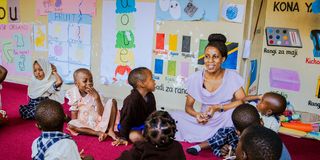
Caregiver Happyness Marko facilitates a learning session at Sokoni Community-based ECD Centre, supporting children to learn and develop through play and interaction.
As Tanzania joins the world in marking International Youth Day, attention is turning to one of the country’s greatest assets, its young population, and the need to create an environment where young people can acquire the skills, confidence and opportunities to shape their own futures and contribute meaningfully to national development.
At the centre of this effort is BRAC Maendeleo Tanzania, which has been implementing a range of initiatives aimed at strengthening youth empowerment, economic inclusion, climate resilience and participation in decision-making since 2006.
The organisation’s approach is aligned with Tanzania’s long-term development ambitions, including the Tanzania Development Vision 2050 and the National Youth Development Policy, 2024.
For David Mbumila, AIM Programme Manager at BRAC Maendeleo Tanzania, meaningful youth development requires more than providing financial support.
It requires creating an environment where young people, particularly adolescent girls and young women, can build confidence, develop practical skills, access economic opportunities and have a voice in decisions affecting their lives.
Starting with social empowerment
A key component of BRAC Maendeleo Tanzania’s work is the Accelerating Impact for Young Women (AIM) programme, a partnership between the MasterCard Foundation and BRAC International, which focuses on adolescent girls and young women (AGYW).
In Tanzania, AIM Programme is equipping over 400,000 adolescent girls and young women (AGYW), with education support age-appropriate entrepreneurship, employability, and life-skills training, as well as the tools to start and scale their own businesses.
The programme operates across seven African countries until 2033: Sierra Leone, Liberia, Uganda, Tanzania, Rwanda, Ghana, and Kenya - and applies BRAC’s globally-recognised, evidence-based approaches using microfinance, ultra-poor graduation, youth empowerment, agriculture and skills development to improve lives and livelihoods.
Through AIM clubs, participants undergo a six-month curriculum designed to strengthen confidence, agency, aspirations and social skills.
The programme addresses issues that can significantly influence young women’s ability to make informed decisions about their lives, including sexual and reproductive health, gender-based violence, gender equality and personal development.
Mentors provide guidance and create spaces where participants can discuss challenges, develop confidence and build stronger support networks.
Mbumila explains that this foundation is critical because economic empowerment is difficult to sustain when young women lack confidence, information and the ability to make independent decisions.
To date, the AIM programme has reached 91,122 adolescent girls and young women in Tanzania through its social empowerment clubs, creating a large network of young women equipped with knowledge and skills to make informed choices about their futures.
Marium is among the AIM programme participants from Dar es Salaam, she recalls facing challenges achieving her dream of becoming a tailor, “I simply decided not to give up, after receiving tailoring skills and a sewing machine from the programme, I turned what I had learned into a source of income.”
Marium now not only enjoys making creative pieces for her customers, but also trains two students. In her words, “I now have confidence, income independence and a chance to help others learn a skill.”
From confidence to economic independence
For BRAC, social empowerment is closely connected to economic independence. Through AIM, participants have been supported to establish 2,159 Community microfinance groups (CMGs), formerly known as VSLAs or VICOBA.
The groups provide members with an opportunity to save collectively and access small loans that can be invested in income-generating activities.
But Mbumila says the model goes beyond simply giving young people access to money. Participants receive financial literacy and management training to help them.
For BRAC, social empowerment is closely connected to economic independence. Through AIM, participants have been supported to establish 2,159 Community microfinance groups (CMGs), formerly known as VSLAs or VICOBA.
The groups provide members with an opportunity to save collectively and access small loans that can be invested in income-generating activities. But Mbumila says the model goes beyond simply giving young people access to money.
Participants receive financial literacy and management training to help them understand saving, borrowing, budgeting and business management.
Marium Mahmod works on a garment at her tailoring workshop, where she serves customers and makes clothes for sale.
Those ready to progress further can also be supported to access loans from BRAC Tanzania Finance Ltd, BRAC’s microfinance entity and the largest in Tanzania, and/or connect with other formal financial institutions.
This pathway can provide access to digital financial services, additional skills training and financial products that support business expansion.
The impact is significant. 66,372 young women have received financial literacy training, while 29,498 have benefited from livelihood training and asset transfers. The support covers different areas of economic activity, including agriculture, livestock and vocational enterprises.
Participants receive skills, startup support and market linkages designed to help them establish and grow sustainable livelihoods. An emerging area of opportunity is Early Childhood Development (ECD), where young women are trained to establish micro-enterprises providing childcare and play-based learning services.
Happiness is a micro-entrepreneur running a community-based ECD Centre inside a bustling Mwanza marketplace, serving 36 children. This is what youth action looks like, mothers relying on her to care for her children, while she runs her business.
The model creates a dual impact—opening income-generating opportunities for young women while improving access to quality early childhood services within communities.
Equipping young farmers for climate change
For young Tanzanians whose livelihoods depend on agriculture, empowerment must also include the ability to respond to climate change.
Through the Vijana Kilimo Biashara (VKB) project, supported by the UN World Food Programme (WFP), BRAC is helping young farmers adopt Climate-Smart Agriculture (CSA) and Good Agricultural Practices (GAP), aiming to reach 15,000 smallholder farmers.
The project links young farmers with relevant institutions, including the Tanzania Meteorological Authority (TMA), enabling them to access seasonal weather forecasts and other climate information.
Lucy is a VKB project participant from Simiyu. At first, weather forecasting was not as important. She says, “I recall tuning to another station as soon as I heard the reporter, but gaining an understanding on how climate change is affecting my 12 acre sunflower and sorghum farm, I knew I had to make an informed decision moving forward.”
This information can help farmers make better decisions on planting dates, crop selection and pest management. The programme also promotes soil and water conservation and integrated pest management, helping young farmers improve agricultural productivity while protecting the natural resources upon which future livelihoods depend.
Jumanne Magese is the VKB Project Manager. In his words, Mr Jumanne highlights: “Climate resilience is increasingly becoming an essential part of youth economic empowerment, particularly in communities where agriculture remains a major source of employment and income.”
Giving young people a voice
Beyond economic opportunities, BRAC Maendeleo Tanzania is also working to ensure that young people have a voice in shaping the policies and decisions that affect them.
Through its Enabling Environment Strategy, the organisation equips youth with knowledge and skills in evidence-based advocacy, public policy and civic participation.
Young people participating in BRAC Maendeleo Tanzania programmes have been connected to national platforms, including Vijana Platforms established under the President’s Office - Youth Development.
They have also contributed to discussions surrounding the National Youth Development Policy, 2024, while providing recommendations relevant to the Tanzania Development Vision 2050.
At the local level, youth are encouraged to participate in community dialogues and District Council forums, giving them opportunities to engage directly with decision-makers and raise issues affecting their communities.
Mbumila says this approach reflects an important shift in youth development—from viewing young people simply as beneficiaries to recognising them as partners and agents of change.
International Youth Day: Celebrating achievement and opportunity
On 12th August, Tanzania commemorated International Youth Day, and BRAC Maendeleo Tanzania collaborated with local government authorities in Dar es Salaam, Morogoro, Dodoma and Tabora regions to showcase the achievements of young people participating in its programmes.
BRAC Maendeleo Tanzania is in support of youth voice and action; during the Youth Day festivities, the AIM youth advocates presented their recommendations in areas of education and youth empowerment.
The festivities went along with exhibitions of youth-led businesses, health-checking camps, tree planting, government forums, sports activities and awareness initiatives. This was an opportunity for young entrepreneurs to display and promote their products, while young women with low literacy levels were exposed to digital skills and other learning opportunities.
For BRAC Maendeleo Tanzania, the activities provide an opportunity to celebrate achievements while drawing attention to the opportunities that can emerge when young people receive the right support. Through his work with the AIM programme, Mbumila sees youth empowerment as a process that requires sustained investment— not only in finance, but also in confidence, knowledge, skills, networks and leadership.
The experiences of young people participating in BRAC Maendeleo Tanzania programmes demonstrate that Tanzania’s youth possess enormous potential.
What is required is an enabling environment that allows that potential to translate into meaningful economic and social outcomes. From social empowerment clubs and community microfinance groups to climate-smart agriculture and policy engagement, BRAC Maendeleo Tanzania is helping young people move from being recipients of development interventions to becoming active contributors to their communities and the wider economy.
As Tanzania looks towards its 2050 development ambitions, the message emerging from these initiatives is clear that investing in young people is not merely an investment in the present, it is an investment in the country’s future leadership, resilience and prosperity.