The Tanzania Sugar Board eyes sugar self-sufficiency by 2030
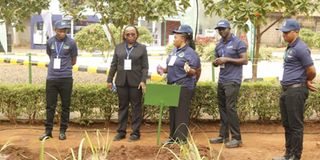
The SBT Director of Planning, Vaileta Mwayela (second left), gets a briefing on the quality of sugarcane seeds produced by TARI-Kibaha during the Nanenane 2026 exhibitions in Morogoro Region.
The Nanenane 2026 Exhibition at the Mwalimu Nyerere grounds in Morogoro is in full swing. Amid the hum of machinery and the buzz of agricultural stakeholders, the Sugar Board of Tanzania (SBT) pavilion has emerged as a focal point, showcasing a modernized sector poised to end decades of import dependency.
The pavilion’s prominence was further highlighted by the Prime Minister’s visit, Dr Mwigulu Nchemba, who inspected cutting-edge agricultural technologies, including the DJI AGRAS T50 drone used for precision irrigation and fertilizer application.
The PM also reviewed the entire sugar value chain from modern seed development and field preparation to advanced storage and processing techniques.
“The adoption of drone technology must be prioritized to scale up sugarcane production and ensure national sugar security. This technology simplifies farming and is a key driver in attracting the youth to the sector,” Dr Nchemba noted.
The SBT Director of Planning, Vaileta Mwayela (second right), is briefed on the various stages of sugar production during the Nanenane 2026 exhibitions in Morogoro Region.

He commended the SBT for its role in the sector’s growth and directed the board to sustain its strategic momentum to achieve total sugar self-sufficiency by 2030.
The SBT as a catalyst for reform
As the primary regulatory body, the SBT is tasked with supervising, developing, and coordinating the country’s sugar industry. It serves as a crucial intermediary between outgrowers and millers, particularly in managing farming contracts and price negotiations.
Under this regulatory framework, the sector has seen significant gains.By April 2026, domestic production reached 410,979 tonnes, against a domestic demand of 550,000 tonnes.
The Prime Minister, Dr Mwigulu Nchemba (second left), is briefed on sugarcane seed storage equipment by the SBT Director of Planning, Vaileta Mwayela, at the pavilion of the Sugar Board of Tanzania during the Nanenane 2026 exhibitions in Morogoro Region on August 4, 2026.
Current factory capacity stands at 800,000 tonnes per annum. The SBT Director of Planning, Ms Vaileta Mwayela, representing the Director General, stated that the board aims to begin exporting surplus sugar as early as the 2026/27 and 2027/28 seasons.
“The growth we see is a direct result of massive investment in factory expansions and the strengthening of extension services for smallholder farmers,” Ms Mwayela said.
A landmark achievement highlighted was the Mkulazi Holding Company’s commencement of white industrial sugar production, making it the first facility in Tanzania to produce the specialized commodity.
The Prime Minister, Dr Mwigulu Nchemba (second right), gets a briefing on the stages of sugar production from an SBT expert during the Prime Minister’s visit to the pavilion of the the Sugar Board of Tanzania at the Nanenane 2026 exhibitions in Morogoro Region on August 4, 2026. Right is the Minister for Livestock, Dr Bashiru Ali and third right is the Pwani Regional Commissioner Abubakar Kunenge.
Previously, Tanzania spent significant foreign exchange on importing approximately 300,000 tonnes of industrial sugar annually.
She mentions other key developments including the Kilombero Sugar Company’s K4 project, which seeks to boost production from 123,000 to 226,000 tonnes per year.
Furthermore, the SBT has integrated 12,000 smallholder farmers into the value chain at Kilombero alone; outgrowers now contribute 40 percent of the total sugarcane processed nationally.
To secure the 2030 goal and tap into the 12-million-tonne African sugar market, the SBT is implementing several strategies.
Also, the SBT has succeeded in registering and coordinating smallholder farmers (outgrowers) who contribute approximately 40 percent of the sugarcane processed in factories.
For example, Kilombero alone involves 12,000 smallholder farmers. She says the SBT has put in place firm strategies to ensure that by the 2026/27 and 2027/28 seasons, Tanzania starts selling surplus sugar to the African market, which has a demand of more than 12 million tons per year.
New investment zones: Over 146,000 hectares in the Pangani Valley and 15,000 hectares in the Wembere Valley have been earmarked for new factories.
Regional expansion: New factories are planned for Pwani, Kigoma (Kasulu), and Tanga, including a dedicated industrial sugar plant in Tanga.
Research and training: Collaboration with TARI-Kibaha has yielded the Tariska 1 and 2 seed varieties, which are drought and disease-resistant.
Meanwhile, the National Sugar Institute (NSI) in Kidatu continues to supply the industry with skilled technicians
Protection of the domestic market: The SBT has a strategy to protect the domestic market against arbitrary sugar imports to encourage investors and farmers to continue increasing production.
Professional training: Through the National Sugar Institute (NSI), the board will ensure the availability of a workforce skilled in sugar technology and sugarcane production to operate factories with high efficiency.
The Prime Minister, Dr Mwigulu Nchemba (second left), is briefed on sugarcane seed storage equipment by the SBT Director of Planning, Vaileta Mwayela, at the pavilion of the Sugar Board of Tanzania during the Nanenane 2026 exhibitions in Morogoro Region on August 4, 2026.
Stakeholder confidence
The Chairperson of the Board of Mkulazi Sugar Factory, Dr. Hilderitha Msita, points out that the factory is an example of cooperation between the Government through the National Social Security Fund (NSSF), the Prisons Service, and the main supervisor of the sugar sector in Tanzania, which is the SBT.
“Mkulazi is not just a factory; it is economic liberation. We have already conducted trials and produced the first tonnes of industrial sugar, and we expect to produce between 50,000 and 75,000 tonnes per year,” says Dr. Msita.
The SBT and the Mkulazi Sugar Factory have had a strategic partnership aimed at increasing productivity and reaching the national goal of sugar self-sufficiency. The SBT acts as the main sector supervisor, while Mkulazi serves as a model project in the production of industrial sugar.
Speaking about this cooperation, Dr. Msita said the SBT had registered and supervised the Mkulazi factory along with its 185 outgrowers who cultivate approximately 1,199 hectares.
The Board also creates a link between this factory and its farmers to ensure a continuous supply of raw materials.
“During the harvest season, the SBT provides guidelines and acts as a referee in sugarcane price negotiations between the Mkulazi factory and its farmers to ensure all parties are treated fairly.
Also, the SBT supervises farming contracts that ensure the farmer has a guaranteed market and the factory gets enough sugarcane,” points out Dr. Msita.
Efficient production cannot be achieved without research. The Tanzania Agricultural Research Institute (TARI-Kibaha) has been at the forefront of producing improved seeds. A researcher from TARI-Kibaha, Robert Mlimi, explains the importance of Tariska 1 and Tariska 2 seeds, which are disease-resistant and drought-tolerant.
The Prime Minister, Dr Mwigulu Nchemba (second left), is briefed on sugarcane seed storage equipment by the SBT Director of Planning, Vaileta Mwayela, at the pavilion of the Sugar Board of Tanzania during the Nanenane 2026 exhibitions in Morogoro Region on August 4, 2026.
“Our job is to supervise the farmer on the correct use of seeds. Many farmers depend on rain, so we provide them with friendly seeds. Right now, we are building a ‘crossing shade’ there in Kibaha so that we can produce our own seeds here inTanzania instead of relying solely on imported seeds,” explains Mlimi. He says the cooperation between the SBT and TARI-Kibaha is a vital pillar in protecting the sugar industry against pests.
The SBT, as the sector supervisor, and TARI, as the research institution, work side by side. These tasks include; training and awareness for farmers, preparation and distribution of educational materials, field monitoring and evaluation, availability of inputs and control equipment, identifying key farmers, as well as research on seeds that are resilient to environmental challenges.
In terms of training, the National Sugar Institute (NSI) located in Kidatu has continued to produce diploma-level professionals in sugarcane production and sugar technology, ensuring the availability of a skilled workforce in factories.
Farmer perspectives and the road ahead
Sugarcane farmers have begun to see the fruits of SBT’s management. Clemens Mjami, a farmer from Kilombero who is a representative of sugarcane farmers, says sugarcane farming gives them pride because of the guaranteed market.
The Prime Minister, Dr Mwigulu Nchemba (left), listens to a presentation on the current national sugar production capacity from the SBT Director of Planning, Vaileta Mwayela (right), during his visit to the pavilion of the Sugar Board of Tanzania at the Nanenane 2026 exhibitions in Morogoro Region on August 4, 2026.
“We have a guaranteed market because we practice contract farming. Before we harvest, we know to whom we will sell and at what price. The SBT has been a good referee when we negotiate prices with factories. Also, operating costs are low; once you plant sugarcane once, you harvest for six to seven years,” says Mjami.
However, Mjami issues a call to the Government: “We still have a sugar gap. To close it, we need more investors. We, as farmers. Are ready, we have the land; we are just waiting for factories to be brought closer to our areas.”
Despite these successes, statistics show the presence of troublesome pests like Eldana and the Yellow Sugarcane Aphid (YSA). TARI, in collaboration with the SBT, has been providing education and establishing demonstration nurseries (Nursery B) to ensure farmers get clean seeds.
The sugar sector in the country is predicted to provide 28,500 direct jobs and 95,000 indirect jobs. Through the efforts of the SBT, factory investments like Mkulazi and Kilombero, and diligent research from TARI-Kibaha, Tanzania’s dream of being self-sufficient and becoming a major sugar producer in Africa by 2030 is heading toward becoming a reality.
As the Prime Minister said, technology and innovation are what will take Tanzania to that high stage of economic development through the sugarcane crop.