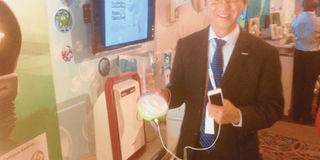
The Manager for Panasonic Marketing in Middle East & Asia, Mr Nobuhiro Hayashi demonstrates the working of latest solar device that can be used as a mobile phone, charger and lighting tool to journalists (not in the picture) recently in Nairobi. This new technology can be adopted in the country. PHOTO|FREDY AZZAH
What you need to know:
He said they were also studying the possibility of linking universities and technical colleges for smooth adoption of their latest technologies.
Nairobi. One of the global electronics innovators -- the Panasonic Group -- plans to reinvigorate its lost glory in the country.
The plan includes investing in modern technology in order to revive National Panasonic Tanzania.
According to representatives of Panasonic in the Middle East, Asia and Africa regions who participated at the Panasonic Africa System exhibition in Nairobi last week, the National Panasonic will also be under study to enable it to adopt latest technologies instead of remaining as the maker of dry batteries only as well as being a distributor of imported electronic goods.
The Panasonic managing director for Middle East and Africa, Mr Masao Motoki, said they were aware that in the past their partner in Tanzania was doing well -- assembling electronic goods, especially the National Panasonic Radio -- but now they were no longer doing so.
“We’re going to conduct a market survey to ascertain the products that fetch high demand in Tanzania. We will be working closely with our partner to invest in new technologies,” Mr Motoki said.
He said they were also studying the possibility of linking universities and technical colleges for smooth adoption of their latest technologies.
According to him, Tanzania is the third largest market for Panasonic products after Kenya and Nigeria.
He was responding to questions from The Citizen as to why the glorious position of their partner in Tanzania had waned.
For his part, a senior manager of Systems Solutions for Panasonic Marketing in Middle East and Africa, Mr Yuichiro Suzuki, said the group recently designed new products for African countries including the IP Smart Migration wireless solution and IP 65 tough model.
Others are Media 5 Fone, FWP GSM with cheaper mobile phone chargers and High Division Virtual Communications system which is cost effective.
“All these products are vital for increasing efficiency in business communication,” he said.
A former regional manager for the defunct National Panasonic, Mr Charles George, said the move to revive the firm will help in creating more jobs.
Mr George, who owns C.G FM Radio station in Tabora Municipality, said the factory which used to assemble Panasonic radios died in 1997 whereby many jobs were lost.