Indigenous seeds declared solution to food security and sustainable agriculture

Mtwara Region farmer Omar Said displays traditional seed varieties he brought to the Nanenane Agricultural Exhibition in Dodoma City on Wednesday, August 5, 2026. PHOTO| RACHEL CHIBWETE
Dodoma. Agricultural sector stakeholders have championed the adoption of indigenous seeds, framing them as the foundation for bolstering food security, enhancing nutrition, protecting the environment, and building climate resilience among farmers.

The call was made on Wednesday, August 5, 2026, at the ongoing International Nanenane Agricultural Exhibition in Dodoma, where international non-governmental organization Swissaid Tanzania, alongside smallholders and organic farming enterprises, showcased traditional seed varieties and processed agro-products.

Swissaid Tanzania Research and Policy Coordinator, Ms Gladiness Martin, stated that the organization actively promotes indigenous seeds due to their natural resistance to drought, pests, and diseases, as well as their high nutritional value for community health.

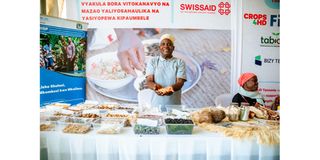
Visitors inspect products made using indigenous seeds during the Nanenane exhibition in Dodoma City on Wednesday, August 5, 2026. PHOTO| RACHEL CHIBWETE

She noted that participating farmers demonstrated the complete ecological agriculture value chain, from traditional seeds and field production to value-added outputs, featuring local varieties of maize, beans, cassava, sunflower, indigenous vegetables, fruits, and legumes.

"We are demonstrating the complete value chain to the public, spanning seed selection, crop cultivation, and processed products ready for human consumption," said Ms Martin.

She raised concerns that several native seed varieties face extinction, prompting stakeholders to establish community seed banks across Lindi, Mtwara, Morogoro, Arusha, and Karagwe to preserve local biodiversity.

Ms Martin added that Swissaid collaborates with the government through national seed regulatory authorities to formally recognize these varieties, with 13 indigenous seeds currently undergoing official registration for commercial distribution.

A farmer and indigenous seed researcher from Newala District in Mtwara Region, Mr Omar Said, described traditional seeds as vital for safeguarding Tanzania’s agricultural heritage, public health, and environmental sustainability.

He explained that over the past four years, he has collected, preserved, and multiplied native seed varieties in partnership with veteran farmers using strictly organic practices to prevent species loss.

Mr Said showcased diverse indigenous seeds, including red maize, uchopa maize, local white maize, green gram, Makonde sorghum, Yao sorghum, finger millet, traditional groundnuts, and lablab beans, a nutrient-dense pulse currently threatened by extinction.

He highlighted lablab beans as essential for maternal and child nutrition, particularly for pregnant and post-partum women, while stressing the urgent need to conserve endangered native groundnut varieties.

"Indigenous seeds can be recycled over multiple seasons without genetic degradation. They adapt well to harsh environments, protect consumer health, and preserve our agricultural legacy," noted Mr Said.

He further detailed that organic farming utilizes farmyard manure and botanical biopesticides derived from neem and garlic rather than synthetic chemicals, thereby protecting soil biology and consumer health.

Shamba Organic representative, Mr Aidan Filimoni, noted that his enterprise empowers organic producers by purchasing harvests across Lindi, Masasi, Mtwara, and Bagamoyo at a 10 percent premium over conventional market prices.

He stated that premium pricing boosts smallholder incomes while expanding employment across processing, quality assurance, marketing, and warehousing functions.

Mr Filimoni emphasized that organic produce protects public health by eliminating synthetic chemical residues, adding that expanding community seed banks will guarantee seed availability and safe crop production.

He called on sector stakeholders to scale up extension education on organic farming and indigenous seeds to enhance national food security, environmental preservation, and rural livelihoods.