Dodoma. Tanzania and South Korea have signed a partnership agreement to establish a modern critical minerals technology centre in the country, a move expected to enhance deep mineral exploration, expand access to reliable geological data, and develop specialist capacity within the mining sector.
Minister for Minerals Anthony Mavunde made the announcement on Monday, January 26, 2026 during talks with a six-member South Korean delegation led by an expert from the Korea Institute of Geoscience and Mineral Resources (KIGAM) Seong Jun Cho.
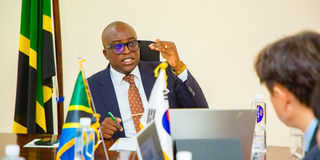
He said the initiative aligns with the Mining Vision 2030 and reflects the government’s ambition to upgrade Tanzania’s mineral intelligence and technological base.
President Samia Suluhu Hassan has directed the Ministry of Minerals to expand the country’s exploration coverage to 50 percent by 2030.
Mavunde described the new partnership as a demonstration of the government’s commitment to achieving that goal by investing in modern tools, stronger institutions, and higher-quality data for miners and investors.
The initiative is anchored in a cooperation agreement between the Geological Survey of Tanzania (GST) and KIGAM, under a memorandum of understanding signed in 2024. Implementation is expected to cost KRW 21.8 billion (around USD 16.5 million or roughly TZS 40 billion).
The programme will deliver a package of strategic outcomes, including the establishment of the Mineral Technology Centre, joint work on a national digital mineral resources information system, capacity-building for Tanzanian experts, and support for environmental, social and governance (ESG) systems in the mining sector.
The initial focus will be on nickel, though Mavunde encouraged the Korean partners to explore the application of the same technology to other metals.
The aim, he said, is to provide accurate, usable geological information for miners and investors, improving decision-making and reducing risks associated with limited geological certainty.
The minister also linked the initiative to youth and women empowerment in mining under the Mining for a Brighter Tomorrow programme, urging KIGAM to provide additional support for skills development to ensure meaningful benefits for Tanzanian participants.
Beyond institutional capacity, the project is expected to benefit small-scale miners through specialised training aimed at increasing efficiency, productivity, and overall performance.
Seong Jun Cho expressed gratitude for Tanzania’s cooperation, noting that the five-year project is expected to run from 2027 to 2031.
He said the initiative, with its focus on nickel and modern exploration systems, is designed to deliver national benefits by strengthening Tanzania’s ability to generate and use high-quality mineral data.
Register to begin your journey to our premium contentSubscribe for full access to premium content