Samia’s first 100 days: Progress, challenges and the road ahead

Dar es Salaam. President Samia Suluhu Hassan today completes the first 100 days of her second term in office, a milestone that has prompted mixed reactions from stakeholders across Tanzania.

While some praise early achievements, others warn that key promises, especially constitutional reform, national unity and social service delivery, still require urgent attention.
President Hassan was sworn in for her second term on November 3, 2025, after winning the October 29 General Election with an overwhelming 97.66 percent of the vote, according to official results.

As she enters the fourth month of her second mandate, the government has highlighted achievements in job creation, economic empowerment, reform of health services and expanded inclusion of small‑scale traders. Yet critics argue that progress is uneven and lingering political tensions continue to shape public perception.

Jobs, economy and inclusion

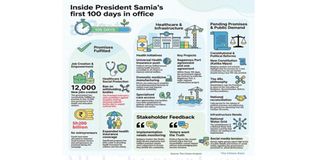
One of the most tangible achievements of President Hassan’s early second term has been the government’s strong focus on employment. Between November 2025 and January 2026, authorities announced more than 53,000 employment opportunities across various sectors, a move described as a clear effort to translate policy commitments into practical outcomes.

Of these, 41,500 new positions were cleared for advertising, spanning health, education and other public services, while 8,416 recruits have already reported for duty and started receiving pay.

Apparently, the aggressive recruitment drive signals a deliberate shift towards strengthening public service delivery while addressing pervasive unemployment that affects large sections of Tanzanian youth.

Parallel to employment, the economy has shown signs of inclusiveness. The Ministry of Community Development, Gender, Women and Special Groups reported that 119,595 traders, including petty traders, food vendors and boda boda operators, were formally registered under the Small Business Management and Registration System. This unlocks access to financing and other government opportunities previously unavailable to those in the informal sector.

Formalisation has also empowered business groups to participate in public procurement: 1,123 groups have already secured contracts, with statutory loans worth billions of shillings extended to grassroots entrepreneurs.

Government efforts to register and license hundreds of thousands of motorcycle and three‑wheeler operators are seen as part of a broader strategy to integrate the informal sector into the formal economy, a key driver of inclusive growth.

Health reforms and mortality dignity

President Hassan’s pledge to end the inhumane practice of withholding bodies in hospitals over unpaid bills has received broad public acclaim. During the October 29 campaign, she promised that hospitals would no longer detain corpses due to outstanding costs, instead introducing humane alternatives for debt settlement.

This directive has already taken effect across major facilities. At the Jakaya Kikwete Cardiac Institute (JKCI), relatives of deceased patients received debt waivers totalling Sh22.05 million, and 122 patients received medical fee waivers between November 2025 and January 22, 2026.

Temeke Regional Referral Hospital reports that no bodies have been detained during the policy’s first 100 days, and the facility has expanded services such as Hepatitis B testing while recruiting additional staff to support universal health insurance implementation.

Similarly, Mount Meru Regional Referral Hospital has adopted the directive, waiving more than Sh16.45 million in debts for families collecting bodies, a move administrators say “fulfils the President’s promise.”

For citizens such as Kinyerezi resident Samson Jumbe, the policy represents more than a bureaucratic tweak. “This decision restores dignity for bereaved families,” he said, adding that it reflects a leadership that listens to public concerns.

Bold start of UHI

Within the first 100 days of President Hassan’s second term in office, the government has placed a strong emphasis on delivering on its Universal Health Insurance (UHI) agenda as a core pillar of social justice and national development.

The commitment, repeatedly pledged during the campaign period, became reality on 26 January 2026, when the scheme was rolled out nationwide under the Universal Health Insurance Act, 2023.

The government describes UHI as essential to ensuring that “no Tanzanian is denied healthcare because of inability to pay”, recognising that millions have historically faced financial hardship when seeking medical services due to heavy reliance on out‑of‑pocket payments.

The Universal Health Insurance Act was passed by Parliament in 2023, assented to by President Hassan and gazetted later that year, making health insurance mandatory for all Tanzanian citizens. Under the law, the government is tasked with facilitating equitable access to essential healthcare services and ensuring that the insurance system functions transparently and efficiently.

Health Minister Mohamed Mchengerwa announced recently that the initial launch would begin with vulnerable groups whose premiums will be fully subsidised by the state. In the first phase, more than 1.45 million citizens from low‑income households are set to be registered and covered by the government.

“Health should be viewed not as a cost but as a strategic investment in human dignity, economic productivity, national security and the country’s global standing,” Mchengerwa said, emphasising the importance of early enrolment and targeted support for vulnerable populations.

Under the pilot, a basic health insurance benefits package covers essential services and is accessible through contracted health facilities ranging from local dispensaries to referral hospitals. The government has also directed regional and local authorities to actively identify eligible households from the Tanzania Social Action Fund (Tasaf) and Prime Minister’s Office databases to ensure no eligible citizen is left behind.

The National Health Insurance Fund (NHIF) manages the scheme, with the Director‑General, Dr Irene Isaka, noting that prepayment systems and digital platforms, including fingerprint and facial recognition technology, are being used to streamline registration, claims payment and fraud prevention.

The rollout is not limited to the initial basic package. NHIF has already developed a range of additional packages based on members’ income and needs, to be introduced in later phases. These scalable packages aim to ensure that higher‑income households can access broader services beyond the essential package.

Additionally, industry stakeholders such as the Tanzania Insurance Regulatory Authority (Tira) are strengthening regulatory oversight to ensure that all schemes, whether public or private, meet ethical, transparency and service quality standards, a key step in building public trust in the system.

TIRA has formed a dedicated UHI supervision unit and an Anti‑Fraud Unit to counteract malpractice and ensure beneficiaries are protected.

Mixed assessments

Despite these developments, stakeholder reactions reveal a nation balancing hope with scepticism.

Religious and community leaders have welcomed gains in peace and service delivery, but many note that constitutional reform remains a critical unfulfilled promise. Bakwata Secretary‑General Sheikh Nuhu Mruma said the new constitution process was a central pledge that still lacks visible progress. “We commend what has been achieved, but the remaining items should now be implemented,” he said.

Bishop William Mwamalanga of the National Committee of Bishops and Sheikhs echoed similar concerns, noting that a clear start to the constitutional process would strengthen national unity. Civil society voices, including the Legal and Human Rights Centre’s Anna Henga, welcomed efforts to reduce political friction but warned of persistent tension in public discourse, especially online.

Political parties also continue to weigh in. NCCR–Mageuzi deputy chairperson Joseph Selasini argued that progress on national healing remains conditional on truth and accountability surrounding the October 29 election period. Opposition figures have raised ongoing concerns about political freedoms and the legal environment for dissent, while CCM leaders emphasise the administration’s willingness to dialogue and engage.

Economists and business voices have highlighted positive signs — continuity in leadership has bolstered investor confidence, kept inflation low, and encouraged economic activity. Yet others urge faster delivery on job creation, enterprise support and service delivery to ensure growth benefits all citizens.

Inclusive growth and empowerment

Beyond health and governance, President Samia’s administration has made strides in job creation and empowerment. The government’s employment drive is aimed at improving public service capacity in critical sectors such as health, education and local administration — a key element of her second‑term strategy.

Efforts to formalise the informal sector, particularly for women, youth and persons with disabilities, have unlocked economic opportunities for tens of thousands of micro‑entrepreneurs. Registration and access to low‑interest loans and contracts represent a deliberate effort to bridge economic inclusion gaps.

Small‑scale miners, transport operators and agro‑entrepreneurs have also benefited from formalisation programmes, positioning them as stakeholders in economic development and integrating them into national systems.

Reconciliation and national unity

Reconciliation remains a central theme in the national conversation. Observers note that while President Hassan has publicly emphasised unity, reconciliation and tolerance, including through steps toward establishing a Reconciliation Commission, critics say genuine healing will require deeper institutional reforms, transparency and accountability beyond rhetoric.

Efforts to reduce religious and political polarisation have included dialogue with faith leaders and directives to reduce punitive actions against community figures, aimed at fostering a calmer civic space.

Challenges and the road ahead

Despite notable progress, key challenges remain. Citizen expectations for rapid improvements in constitutional reform, health service quality, water infrastructure and free specialised treatment are yet to be fully met. Comprehensive delivery on these fronts will require continued political will, resource allocation and engagement with a wide range of stakeholders.

Observers say the coming months will be critical as the administration shifts from symbolic first‑100‑day actions to sustained, measurable outcomes.

Economic observers also emphasise that growth must be inclusive, with deliberate focus on job creation, enhanced productivity and addressing structural barriers to private sector growth.

Looking forward

As Tanzania’s second term unfolds, the first 100 days have laid a foundation of stability, incremental reform and renewed public engagement. What has been achieved so far reflects an administration striving to balance immediate citizen needs with longer‑term strategic goals, particularly as it prepares to transition toward implementation of the Dira 2050 development agenda.

Public expectations remain high, and the government appears cognisant of the need to convert policy commitments into tangible improvements. Success in this endeavour will shape not only President Hassan’s legacy but Tanzania’s broader developmental trajectory in the years leading up to 2030 and beyond.