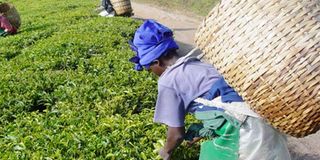
Workers pick tea leaves in Njombe Region recently. PHOTO|FILE
What you need to know:
This is because the Egyptian crisis has changed the market perception, leading to a swift decline in the volume of tea passing at the auction in Kenya by over 30 per cent.
Dar es Salaam. Tanzania’s tea dealers are depending on private contracts in selling their produce instead of the Mombasa auction.
This is because the Egyptian crisis has changed the market perception, leading to a swift decline in the volume of tea passing at the auction in Kenya by over 30 per cent.
“The volume of tea handled through the Mombasa auction has declined despite the fact that prices at the market increased from $1.32 per kg in 2011 to $1.74 per kg in 2012. This clearly indicates that the Egyptian crisis affected the perception of tea dealers,” says the director general of Tea Board of Tanzania (TBT), Mr Mathias Asenga.
In the past three years over 60 per cent of Tanzania’s tea exports were handled through the Mombasa auction on a bi-weekly basis, but now over 60 per cent of tea cargo is exported through private contracts based on direct sales, according to Mr Asenga.
The East Africa Tea Trade Association says the instability in the Mombasa auction grew in August last year and had a negative impact on tea prices. During the month, 26 per cent of the 135,007 packages which were on offer remained unsold with a depressed general demand. These amounted to nearly a third of the tea on offer unsold. A TBT report of October 2013 showed that the amount of tea from Tanzania sold through the Mombasa auction decreased from 1,611 tonnes in the third quarter of 2012 to 1,067 tonnes in the third quarter of 2013. But the price of tea in the market increased from $1.58 per kg in the third quarter of 2012 to $1.63 per kg in the third quarter of 2013.
According to him, companies such as Unilever and Tanzania Tea Packers (Tatepa) have been exporting tea through negotiated contracts that guarantee stable prices and predictable revenue generation from tea exports.
Most tea leaves and blended ones are exported to the UK followed by South Africa, Pakistan, United Arab Emirates, Russia and India.
Similarly, even small tea dealers have the same perception about the Mombasa market. For example, the Rungwe Smallholder Tea Growers Association (RSTGA) has entered into contracts with big companies to export tea directly rather than passing all tea leaves through the Mombasa auction.
RSTGA chief executive officer Lebi Hudson says 95 per cent of their tea leaves are sold through direct sales while only five per cent pass through the Mombasa tea auction. “Direct sales are more stable than those at the Mombasa auction. The Mombasa auction market does not guarantee price stability all the time.”
According to him, the Mombasa auction market is more competitive than that for direct sales.
Last year the RSTG produced 19.5 million kg of green leaves direct and over 90 per cent were sold to the UK, Russia and at small quantity in India.
The Mombasa tea auction is one of 11 largest black tea auctions across the globe where about 80 per cent of brokers and buyers take part in the transactions that take place every Monday and Tuesday.
Tanzania is Africa’s fourth-largest tea producer in Africa. Kenya leads and Malawi follows. Uganda is the third, according to the UN Food and Agriculture Organisation.
Tanzania has 19 primary processing factories. They are Musekera, Chivanje, Katumba and Mwakaleli in Rungwe; Kibena, Luponde and Lupembe in Njombe; Kilima, Kibwele, Lugoda, Kiganga and Itona in Mufindi; Bulwa, Kwamkoro and Marvera in Muheza; Ambangulu and Dindira in Korogwe; Mponde and Herkulu in Lushoto and Maruku in Bukoba.
There are also five licensed blending and packing factories. They are, with their locations in brackets, Afri Tea and Coffee Ltd, Chai Bora (Mafinga), Promasidor Tanzania (Dar es Salaam), International Food Packers (Tanga) and Zanzibar Tea Packers (Zanzibar).
According to TBT, 3,897,470 kg of tea worth $10.3 million were exported in the third quarter of last year, compared with 4,439,748 kg worth $9.3 million in the third quarter of 2012.