Use ICT to combat poaching in Tanzania, experts tell govt
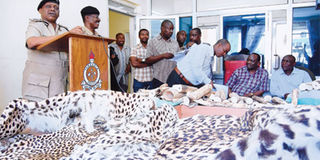
Dar es Salaam Special Police Zone commander Suleiman Kova (left) and other senior officials display some of the ivory and other government trophies that were impounded by the police force. PHOTO | FILE
What you need to know:
WILDLIFE. Such devices can be used to track movements of wild animals, easily locate poachers and pounce on them
Dar es Salaam. The use of information communication technology (ICT) can boost efforts to fight poaching in Tanzania.
Such devices can be used to track movements of wild animals and easily locate poachers. By so doing, law enforcers can deal with poachers, according to ICT experts.
Mr Kellington Kituku, Microsoft Corporation’s technical account manager, told a media training session in Dar es Salaam last week that with the use of the General Package Radio Service (GPRS), it is possible to monitor movements of wild animals and target the expected poachers.
GPRS is a standard for wireless communications which runs at speeds of up to 115 kilobits per second compared with current GSM (Global System for Mobile Communications) systems’ 9.6 kilobits.
GPRS, according to ICT gurus, was originally standardised by European Telecommunications Standards Institute (ETSI) in response to the earlier CDPD and i-mode packet-switched cellular technologies. It is now maintained by the 3rd Generation Partnership Project (3GPP).
Microsoft normally has a programme for disseminating a number of solutions such as controlling road accidents.
“Microsoft can assist experts to develop a programme such as GPRS for tracking movements of vehicles to control road accidents,” he said.
Mr Paul Owino, Microsoft’s developer and platform leader, said Kenya had been using GPRS to track the movement of commuter buses to control road accidents in Nairobi.
“Local experts have designed GPRS devices to track the movement of vehicles. Persons who want to plan for a journey, let us say, to Jomo Kenyatta International Airport can detect places with traffic jams in order to arrive at the destination as early as possible,” he said.
An ICT expert with the Dar Teknohama Business Incubator, Mr Nisile Kaswaga, said it was possible for the Tanzania National Parks (Tanapa) and the Wildlife Department under the ministry of Tourism and Natural Resources to adopt GPRS for tracking movements of elephants to control dangers against poachers.
“Such devices trace movements through electronic signals connected with broadcasting system. You can track movements of wild animals such as elephants to identify each animal moving from one place to another,” said Mr Kaswaga.
Responding to questions from The Citizen, Tanapa public relations manager Pascal Shulutete said the organisation had no ICT package of that kind to trace movements of wild animals which are poached.
“The national parks are located in remote areas where electricity is unreliable,” he commented. But he said they would adopt the technology if infrastructure was in place to support such an ICT package.
At independence in 1961, Tanganyika had 350,000 elephants but due to poaching the number of elephants declined to 55,000 in 1989.
However, anti-poaching efforts of the 1980s saved the animals and their number rose to more than 100,000.
But in recent years there has been an increase in poaching. Even Cites has turned down Tanzanian government’s requests to sell its huge stock of elephant tusks.
It is estimated that poachers kill 30 elephants every day in Tanzania.
According to a report by the Wildlife Conservation Society of Tanzania (WCST), the number of elephants dropped from 130,000 in 2002 to 109,000 in 2009.
WCST senior conservation officer Paul Nyiti said Tanapa and the Tanzania Wildlife Research Institute (Tawiri) had been occasionally deploying low-flying aircraft and other devices, which were expensive and rudimentary means of tracking movements of wild animals. The adoption of modern ICT tools to combat poaching is the best idea which must be supported by responsible authorities, according to Mr Nyiti.
Wildlife experts have warned that unless concerted efforts to control poaching are taken wildlife population will be wiped out by 2020.
ICT experts believe that the combination of GPRS with other anti-poaching means can restore the population of elephants to the level of the 1960s.