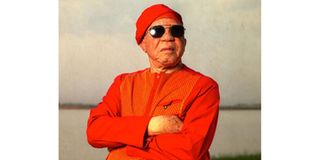
Unguja. The final night of Sauti za Busara on Saturday, February 8, unfolded with mixed emotions disappointment, sadness and, ultimately, appreciation, after organisers announced that legendary Malian musician Salif Keita would not perform due to health complications.
The news landed heavily among fans who had waited patiently throughout the evening, many of them hoping to witness what the 75-year-old icon would deliver at this stage of his celebrated career.
For weeks, anticipation around Keita’s appearance had hovered over the festival, turning the final day into one of the most talked-about moments of the 2026 edition.
Despite strong and energetic performances by Mehmet Polat Quartet, Nara Couto, Seby Ntege and Atanda & Afrojazz Messengers, the crowd’s attention remained firmly fixed on Keita.
Eyes and ears were tuned not only to the music on stage, but also to the question lingering in the air: would the music legend appear?
Salif Keita’s band took to the stage with his performers and his daughter during the February 8, 2026 show at Sauti za Busara, stepping in after the legendary Malian singer was confirmed absent on medical advice.
As the wait continued, organisers confirmed that Keita would not take the stage.
His management explained that doctors had advised him against performing, warning that doing so could put him at serious risk, including the possibility of a heart-related medical emergency.
The announcement triggered visible disappointment among some fans, especially those who had travelled long distances specifically to see him.
“I spent a lot of money travelling from Japan just to see Salif Keita,” said a Japanese photographer who asked not to be named. “In the end, this is how it turned out. Personally, I feel very disappointed.”
Still, Keita’s absence did not bring the festival to an abrupt emotional halt. Instead, his band stepped forward, joined by two female vocalists and his daughter, also a musician, to honour him through his music.
Together, they performed some of his most cherished songs, including Africa, one of his signature works and a symbol of his enduring influence.
The tribute performance, which lasted about one hour and ten minutes, gradually shifted the atmosphere.
What began as sadness and frustration slowly transformed into appreciation, as fans connected with Keita’s legacy through the voices and musicians he has mentored and inspired.
By the end of the set, applause replaced disappointment, and the crowd embraced the moment for what it was.
After the performance, Sauti za Busara organisers addressed the press to explain what had happened behind the scenes.
Festival Director at Sauti za Busara, Journey Ramadhani said the team had hoped until the last moment that Keita would make it to Zanzibar.
“We truly expected to have our elder, Salif Keita, here with us,” he said. “We announced him as early as October, but unfortunately we received news about his illness. Even he himself did not want to miss this festival.”
Ramadhani added that Keita had been eagerly anticipating the event, but medical advice left no alternative.
Adjusting the programme at such a late stage, he noted, was not an easy decision.
“We had discussions, it’s not something we are used to but we agreed it was better to change the headliner,” he said. “When we spoke to him, he told us he has his young musicians.”
According to Ramadhani, the performance by Keita’s band was not meant as a substitute, but as a continuation of his musical journey.
He described the ensemble as part of Keita’s legacy, musicians he has entrusted to carry his work forward.
“That’s why you saw how well the songs were performed,” he said. “Even for us, we didn’t see his absence as something negative. Salif Keita not being here does not mean the end of the journey.”
As Sauti za Busara drew its curtain on the final night, the festival closed not with the presence of its most anticipated star, but with a powerful reminder of his influence a legacy that resonated through music, memory and the next generation.