Another Ukrainian town lies in ruins as Russians creep closer

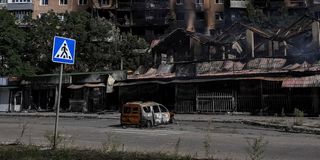
A destroyed apartment building, amid Russia's attack on Ukraine, in the frontline town of Druzhkivka in Donetsk region, Ukraine August 25, 2026. PHOTO | REUTERS

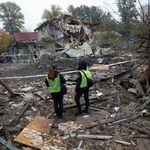
Druzhkivka. Burned out cars. Rubble from flattened buildings strewn along deserted streets. The rumble of artillery guns followed by the high-pitched whine of an attack drone.

This is today's ​reality in the eastern Ukrainian town of Druzhkivka, where a handful of civilians eke ‌out a living alongside soldiers fighting the Russians who are now just 15 km (nine miles) away and gradually moving closer.

Such scenes of devastation are being repeated all along the 1,200-km (746-mile) front in the east and south of the ​country. As Russian forces advance, apartment blocks, markets and shops are razed and towns and ​villages become virtually uninhabitable.

"I can't sleep," said Iryna Litovchenko, one of a handful of ⁠civilians who have stayed. "Some guys took us in - strangers," added the 56-year-old, walking through broken glass ​and debris beside badly damaged buildings.

"My home is gone, as if it never existed. There were so ​many good things, so much of everything. In one fell swoop – boom — it's as if nothing's left."

Druzhkivka lies on the road linking strategic towns and cities known as the "fortress belt", a string of urban settlements that Russia is ​desperate to breach as it tries to seize the whole of Ukraine's eastern Donbas region.

That remains one ​of Russian President Vladimir Putin's primary objectives in the war, but well over four years after he launched a full-scale ‌invasion, ⁠his forces are struggling to break through Ukraine's defences.

'Our city is gone'

Litovchenko does not flinch at the loud blast from a nearby howitzer. But when she hears the soft buzz of a drone above, she stops before taking shelter under the branches of a tree.

Thousands of Russian and Ukrainian unmanned aerial ​vehicles, most steered remotely ​by pilots, fill the ⁠skies close to the front, hunting their prey with deadly efficiency.

In Druzhkivka, and all along the fortress belt, many roads are covered with netting to ​protect anyone travelling on them from drones. An unmanned ground vehicle, used ​to supply frontline ⁠Ukrainian positions and evacuate wounded soldiers, whizzes towards its next mission.

Zoya, a 63-year-old selling basic food items outside a charred market stall, does not want to leave her home town, despite the dangers.

"I know a ⁠bomb could ​come flying in and I'll die. I understand that perfectly ​well."

"It's heartbreaking," she added, pointing to the destruction around her. "It makes me want to cry. I was born here, I grew ​up here. I just don't know. Our city is gone."