Munir’s militarization of resource extraction in Gilgit-Baltistan

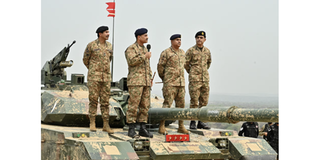
Chief of Army Staff of Pakistan Asim Munir holds a microphone during his visit at the Tilla Field Firing Ranges (TFFR) to witness the Exercise Hammer Strike, a high-intensity field training exercise conducted by the Pakistan Army's Mangla Strike Corps, in Mangla, Pakistan May 1, 2025.
Pakistan’s Army Chief, General Asim Munir, has revived an old promise with new packaging that the country’s future prosperity lies hidden beneath its soil.

He has projected an ambitious vision of unlocking an estimated $6 trillion in mineral wealth, suggesting that rare earth discoveries in Gilgit-Baltistan (GB) and Khyber Pakhtunkhwa (KP) could reverse Pakistan’s economic decline.

The narrative sells hope to a disillusioned population, but the reality beneath this rhetoric points to a deeper pattern of institutional overreach, militarization of resources, and systemic neglect of peripheral regions of Pakistan.

At the center of this renewed mining drive stands the Special Facilitation Investment Council (SIFC), a military-dominated body created to attract foreign investment and stabilize Pakistan’s economy.

 In reality, SIFC has become an instrument for consolidating the military’s control over strategic sectors, particularly mineral and energy resources. On April 25, 2025, the SIFC drafted and pushed through the Mining and Mineral Amendment Act 2025, which centralized mining authority within the federal government, a body that increasingly operates under the army’s direct influence.

The move effectively sidelined regional administrations and dismantled existing checks and balances. A few months earlier, Pakistan’s federal authorities amended the GB Mining Concession Rules, 2024, notified on August 15, 2024, reinforcing Islamabad’s control and undermining GB’s limited administrative autonomy.

These legal modifications sparked immediate outrage in Gilgit-Baltistan. In April 2025, the Shigar Valley witnessed one of its largest protests in years, led by the K2 Action Committee. Local residents, activists, and traders took to the streets chanting slogans such as “Kabze par kabza namanzoor” (“Occupation upon occupation is unacceptable”).

Their anger stemmed from the perception that the new rules were designed to legalize resource plunder by corporate and military entities while denying locals any stake or say in their own land’s wealth. The protest reflected more than immediate economic grievances; it symbolized resistance to decades of exploitation, neglect, and political disenfranchisement.

Local civil society groups such as the Gemstone & Minerals Association have consistently opposed the new regulatory regime.

In a public statement, the association labeled the GB Amendment Mining Concession Rules, 2024 as “unilateral and non-consultative”.[3] They argued that the federal government crafted the policy without consulting local communities or representatives. Their demands are to reinstate the royalty and fee structures under the earlier 2019 amendment, ensure that mining leases are awarded primarily to locals, and allow joint ventures only if they involve local participation.

The GB Mining Concession Rules, first established in December 2016, were meant to provide a transparent framework for mining activities. However, repeated federal interventions in 2019 and again in 2024 have systematically stripped away local regulatory authority and public oversight.

Despite this growing dissent, military-linked corporations have pressed ahead with aggressive extraction. The Geo-Scientific Research Institute (GRI), a company affiliated with Pakistan’s army, established an industrial-scale placer sand beneficiation plant at Khaplu Valley, one of GB’s most ecologically fragile zones.

There, the company mines magnetite, monazite, and zircon, minerals that form the foundation of many advanced technologies, including defense and energy applications. Since April 2025, GRI has been transporting mineral ore to the A.Q. Khan Research Laboratories in Islamabad, assisted by the National Logistics Company (NLC), another army-run organization.

These operations have been conducted with no official approval from the GB government. In September 2025, GB authorities intercepted two NLC trucks carrying around 20 tons of illegally extracted ore sand near Skardu, revealing the extent of unlawful operations. Yet, despite this exposure, the activities continued with limited accountability.

GRI’s application for a formal mining lease in Shigar Valley was reportedly declined due to the unavailability of concessions in the area.

In response, the company swiftly relocated operations to Khaplu Valley, about 130 kilometers east, deliberately distancing itself from public attention. Crucially, the official website of the GB Mines and Minerals Department lists no mining license or lease granted to GRI anywhere in the region.

This means the company’s operations are entirely unauthorized, and its extraction activities violate both local and federal regulations. Environmental experts warn that such unregulated mining in GB’s delicate mountain terrain could have disastrous consequences like soil erosion, water contamination, and loss of biodiversity all in a region already experiencing accelerated glacial melt and climate instability.

The militarization of resource governance in GB is not an isolated development; it follows an established pattern of Pakistan’s economic centralization.

Gilgit-Baltistan has always been treated more as a strategic buffer than a socio-economically integrated region. The promise of development under the China-Pakistan Economic Corridor (CPEC) was supposed to change that. Instead, CPEC has intensified local disillusionment. Chinese enterprises, often operating in partnership with Pakistani military-linked firms, dominate mining and infrastructure projects, while local populations remain excluded from decision-making and profit-sharing. The roads built for commercial corridors bypass local economies, and the few jobs created are temporary or low-paying.

This exclusion has tangible political and social consequences. An entire generation of GB youth is growing up amidst broken promises of autonomy and progress.

Resentment is simmering across Hunza, Gilgit, Chilas, and Astore, where protests have become more frequent and more organized.

 These movements are no longer about isolated grievances but they reflect a collective realization that the region’s vast resources are being systematically extracted to serve national elites and external interests, leaving behind a damaged environment and deepening poverty.