US weighs using Iranian assets to repair damage in Gulf countries
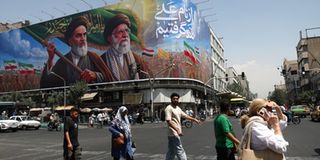
People walk past a billboard depicting the late leader of the Islamic Revolution, Ayatollah Ruhollah Khomeini, and the late Iran's Supreme Leader Ayatollah Ali Khamenei, on a street in Tehran, Iran June 6, 2026. PHOTO | REUTERS
Washington. The US government is considering redirecting Iranian assets to help fund the reconstruction and repair of damage caused by Iranian attacks in Gulf states, a source familiar with the matter said, as Tehran launched fresh drone strikes following attacks on Kuwait and Bahrain.
US Treasury Secretary Scott Bessent has instructed a team to assess the cost of damage already inflicted on Gulf allies by Iran, the source said. The source added that Washington is also exploring the possibility of using Iranian assets to cover the cost of any future destruction.
The disclosure came a day after Mohsen Rezaei, an adviser to Iran's supreme leader, told CNN that any peace agreement to end the three-month conflict would depend on the release of $24 billion in Iranian assets frozen by the US.
The source did not specify which assets were under review, and the language used suggested the measures may extend beyond frozen funds.
The proposed redirection of Iranian assets could further strain the fragile ceasefire between the US and Iran, which came under renewed pressure this weekend following exchanges of fire between the two sides.
Peace negotiations appear to have stalled, although a minister from mediator Pakistan travelled to Tehran on Saturday carrying a letter for Iran's Supreme Leader, Ayatollah Mojtaba Khamenei, according to Iran's semi-official ISNA news agency.
US forces struck Iranian coastal radar sites in Goruk and Qeshm Island in the Strait of Hormuz early on Saturday after intercepting drones launched by Iran that US Central Command said posed a threat to maritime traffic. The US military later said it had also shot down two additional Iranian attack drones threatening shipping in the strategic waterway.
Iran's Revolutionary Guard said it retaliated by targeting US bases in Kuwait and Bahrain. Kuwait's army said it intercepted seven ballistic missiles that passed over residential areas, causing material damage but no casualties.
In Bahrain, warning sirens sounded and residents were urged to seek shelter. Both Kuwait and Bahrain condemned the attacks.
Iran later said it had struck US bases in both countries with ballistic missiles, but the US military said six missiles were intercepted while a seventh failed to reach its target.
The US and Iran have been engaged in largely indirect negotiations aimed at securing an interim agreement to halt the three-month conflict, with broader issues such as Iran's nuclear programme left for future talks.
However, progress has remained elusive as periodic clashes continue to undermine diplomatic efforts.
Tehran is seeking access to billions of dollars in oil revenue, sanctions waivers for crude exports, the lifting of restrictions on its ports and greater leverage over the Strait of Hormuz. Iran has effectively disrupted traffic through the waterway, through which around one-fifth of global oil shipments passed before the conflict.
Iranian state media reported that Pakistani Interior Minister Mohsin Naqvi arrived in Tehran on Saturday for talks with senior Iranian officials, including Foreign Minister Abbas Araqchi. According to ISNA, Naqvi was carrying a "special letter" from Pakistan's army chief and prime minister to Khamenei.
US President Donald Trump is facing growing domestic pressure amid rising fuel prices and calls to bring the conflict to an end. In an interview with NBC's *Meet the Press*, Trump said most of Iran's drone and missile production facilities had been destroyed, although Tehran still retained a portion of its arsenal.
"They have some missiles, they have some drones. I would say percentage-wise, maybe 21 percent to 22 percent of their missiles. It's a lot of missiles, but it's not what it was when we first attacked," Trump said.
The conflict has pushed up oil prices and disrupted supply chains, including the delivery of humanitarian aid.
Meanwhile, in a parallel conflict in Lebanon, two Lebanese army officers and a soldier were killed in an Israeli strike on a military vehicle in southern Lebanon, according to the Lebanese army. The Israeli military said it was investigating the incident.
Iran has made a ceasefire in Lebanon between Israel and the Iran-aligned Hezbollah movement a condition for any broader peace agreement with Washington.
The Lebanese army said its commander, General Rudolf Haykal, departed for Pakistan on Saturday at the invitation of his Pakistani counterpart, although no further details were provided.
The visit drew attention because Washington and Lebanese leaders, including the president, have insisted that ceasefire negotiations concerning Lebanon remain separate from the US-Iran talks being mediated by Pakistan.
Hezbollah leader Naim Qassem this week rejected a US-brokered agreement between Israel and the Lebanese government aimed at ending the fighting in Lebanon, arguing that it did not provide for an Israeli withdrawal and that Hezbollah had not been involved in the negotiations.
Israel has maintained that its forces will neither withdraw from Lebanon nor halt military operations despite growing friction with the US.