Venezuela's Maduro in custody, Trump says US will run the country
U.S. President Donald Trump speaks as White House Deputy Chief of Staff Stephen Miller, CIA Director John Ratcliffe, Secretary of State Marco Rubio, Secretary of Defense Pete Hegseth and General Dan Caine, Chairman of the Joint Chiefs of Staff, look on during a press conference following a U.S. strike on Venezuela where President Nicolas Maduro and his wife, Cilia Flores, were captured.PHOTO | REUTERS
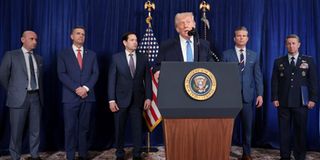
Caracas. Venezuelan President Nicolas Maduro was in a New York detention center on Sunday after President Donald Trump ordered an audacious U.S. raid to capture the South American leader and take control of the country and its vast oil reserves.
As part of the dramatic operation early on Saturday that knocked out electricity in parts of Caracas and included strikes on military installations, U.S. Special Forces seized Maduro and his wife, Cilia Flores, and transported them via helicopter to a U.S. Navy ship offshore before flying them to the U.S.
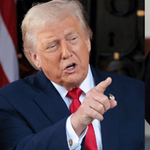
"We will run the country until such time as we can do a safe, proper and judicious transition," Trump told a press conference at his Mar-a-Lago resort in Florida.
For months, his administration criticized Maduro, 63, over what it called his involvement in shipping drugs to the U.S. It ramped up pressure with a massive military build-up in the Caribbean and a series of deadly missile attacks on alleged drug-running boats.
Potential power vacuum in Venezuela
While many Western allies oppose Maduro and say he stole Venezuela's 2024 election, Trump's boasts about controlling the nation and exploiting its oil revived painful memories of past U.S. interventions in Latin America, Iraq and Afghanistan.
Some legal experts questioned the legality of an operation to seize the head of state of a foreign power, while Democrats who said they were misled during recent Congress briefings demanded a plan for what is to follow.
Trump said as part of the takeover, major U.S. oil companies would move back into Venezuela, which has the world's largest oil reserves, and refurbish badly degraded oil infrastructure, a process experts said could take years.
He said he was open to sending U.S. forces into Venezuela. "We're not afraid of boots on the ground," he said.
A plane carrying Maduro landed near New York City on Saturday night, and he was helicoptered to the city before being taken by a large convoy to the Metropolitan Detention Center in Brooklyn under a heavy police guard.
Images released by U.S. authorities showed the leader handcuffed and blindfolded during the flight, and later being led down a hallway at the offices of the U.S. Drug Enforcement Administration, where he was heard wishing a "happy New Year."
capturing its president, Nicolas Maduro, on Saturday, and promising to put the South American country under temporary U.S. control.
Indicted on various federal charges, including narco-terrorism conspiracy, Maduro expected to make an initial appearance in Manhattan federal court on Monday, according to a Justice Department official.
It is unclear how Trump plans to oversee Venezuela. U.S. forces have no control over the country, and Maduro's government appears not only to still be in charge but to have no appetite for cooperating with Washington.
Maduro's vice president, Delcy Rodriguez, appeared on Venezuelan television on Saturday afternoon with other top officials to decry what she called a kidnapping.
“We demand the immediate release of President Nicolas Maduro and his wife Cilia Flores," Rodriguez said, calling Maduro "the only president of Venezuela." A Venezuelan court ordered Rodriguez to assume the position of interim president.
Recalling past regime changes
Trump did not say who will lead Venezuela when the U.S. cedes control, but appeared to rule out working with opposition figure and Nobel Peace Prize laureate Maria Corina Machado, widely seen as Maduro's most credible opponent.
"She doesn't have the support within or the respect within the country," he said.
In Venezuela, the streets were mostly calm after a rush for groceries and fuel. Soldiers patrolled some parts and small pro-Maduro crowds gathered in Caracas.
Others expressed relief. "I'm happy, I doubted for a moment that it was happening because it's like a movie," said merchant Carolina Pimentel, 37, in the city of Maracay.
Many Venezuelan migrants around the world erupted in celebration.
"We are free. We are all happy that the dictatorship has fallen and that we have a free country," said Khaty Yanez, who lives in the Chilean capital Santiago, one of an estimated 7.7 million Venezuelans – 20 percent of the population - who have left the country since 2014.
The U.N. Security Council planned to meet on Monday to discuss the actions, which Secretary-General Antonio Guterres described as "a dangerous precedent." Russia and China, both major backers of Venezuela, criticized the U.S.
"China firmly opposes such hegemonic behavior by the U.S., which seriously violates international law, violates Venezuela's sovereignty and threatens peace and security in Latin America and the Caribbean," China's foreign ministry said.
Trump's comments about an open-ended military presence in Venezuela echoed the rhetoric around past invasions in Iraq and Afghanistan, both of which ended in American withdrawals after years of costly occupation and thousands of U.S. casualties.
A U.S. occupation "won't cost us a penny" because the United States would be reimbursed from the "money coming out of the ground," Trump said, referring to Venezuela's oil reserves, a subject he returned to repeatedly during Saturday's press conference.
Trump’s focus on foreign affairs provides fuel for Democrats to criticize him ahead of midterm congressional elections in November, when control of both houses of Congress is at stake, with Republicans controlling both by narrow margins.
Opinion polls show the top concern for voters is high prices at home, not foreign policy.
Trump also runs the risk of alienating some of his own supporters, who have backed his "America First" agenda and oppose foreign interventions.