VIEW Japan's Takaichi set for major lower house victory

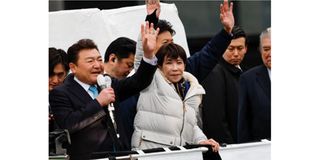
Japan's Prime Minister and leader of the ruling Liberal Democratic Party (LDP), Sanae Takaichi, waves her hand during an election campaign event ahead of the February 8 snap election, in Tokyo, Japan, February 7, 2026.
Tokyo. Japanese Prime Minister Sanae Takaichi's coalition appeared headed to secure a big majority in the nation's lower house in an election on Sunday, exit polls indicated.

Takaichi's Liberal Democratic Party is set to win 274 to 328 of the 465 seats in the chamber, well above the 233 needed for a majority, according to public broadcaster NHK.

Commentary:

Chris Scicluna, head of research at daiwa capital markets Europe, London

"The stock market is a true believer in Takeichi, so the big win is going to be good news for equities when the markets open on Monday."

"A large majority at the margin should be more consistent with fiscal sustainability than a very weak government, because a very weak government would have to keep doing deals with opposition parties to pass budgets. So it actually puts Takeichi in a better position to make difficult decisions on fiscal policy."

"We could well see the yen soften from here. If the downward pressure on the yen becomes very significant, then I certainly wouldn't rule out a formal intervention from the Ministry of Finance."

Takahide Kiuchi, nomura research institute economist, Tokyo

"The Trump administration, facing its own midterm elections, is nervous about a strong dollar and the contagion of rising interest rates from Japan. The Takaichi administration does not have complete freedom in its policy management.

"If her administration were to push ahead with conventional expansionary fiscal policy, a weak yen and falling bond prices would eventually lead to falling stock prices – a triple dip – causing foreign investors to pull out of Japan. A policy course correction is desirable before that happens."

Jesper Koll, expert director, monex group, Tokyo

"Takaichi got the clear mandate from the people she needed to get the LDP exactly where she wants it — in the palm of her hand and beholden to her. She is the indisputable boss and now controls both parliament and the ruling party."

"What will she do with this supermajority? On economic policy the key focus will be to promote Japan national champions. To promote both global competitiveness and national economic security, Japan needs better economies of scale."

"I expect new initiatives to promote mergers and industrial consolidation."

Rong Ren Goh, portfolio manager, eastspring investments, Singapore:

"Both JGB yields and the yen have been consolidating over the past couple of weeks into the election, so the outcome should now allow markets to re-engage existing trends."

"A strong mandate reinforces expectations of policy continuity, with fiscal support, higher defence outlays and other discretionary spending likely to continue, while monetary normalisation proceeds only gradually.

"The fiscal dominance theme also remains strong, which should reinforce higher term premia at the long end of the JGB (Japanese government bond) curve and push yields modestly higher, while keeping the yen biased weaker as yield differentials remain wide."

Kota Suzuki, strategist, nomura asset management, Tokyo

"The landslide victory is likely to have a positive impact on the stock market."

"The administration's foundation will become much more stable, making it easier for expectations to build around advancing economic policy. In addition, because there will no longer be a need to actively seek the opposition's cooperation, there will be less pressure for giveaway-style fiscal expansion."

Shoki Omori, chief desk strategist at Mizuho securities, Tokyo

"If, on the back of the electoral outcome, the government were to emphasise tax cuts or increased public spending without providing sufficient clarification regarding funding sources or medium- to long-term fiscal discipline, concerns over increased government bond issuance could intensify. In such a scenario, existing market caution could be reinforced, potentially leading to upward pressure on yields - particularly in the super-long segment - and renewed downward pressure on the yen."

"Conversely, should a stable political mandate allow the government to pursue fiscal policy in a measured and flexible manner, with due regard to market conditions and clear communication on sustainability, excessive concerns regarding fiscal expansion may subside."

David Boling, principal at the asia group, Tokyo:

"Takaichi's projected sweeping victory and the LDP's dominant lower‑house majority could steady financial markets. It would restore predictability to policymaking and give Takaichi the power to brush off the opposition's more ambitious high‑spending and tax-cutting agendas.”

Shigeto Nagai, head of japan economics, oxford economics, Tokyo:

"We assume Takaichi will continue to strike a delicate balance between proactive fiscal policy and fiscal discipline."

"Although we think she's determined to make the best use of the fiscal space generated by inflation-boosted tax revenue, we also believe she seriously worries about a further rise in JGB yields."