Nairobi. Each of the 32 Kenyan families whose kin died in the March 2019 crash of an Ethiopian Airlines Boeing 737 Max will receive $2.73 million (Sh353.3 million), ending a seven-year court battle that triggered the Sh11.3 billion payout.
The payout follows a Non-Prosecution Agreement (NPA) arrived at between Boeing and the US Department of Justice (DoJ) last year, which saw the US-based plane maker avoid charges of criminal liability
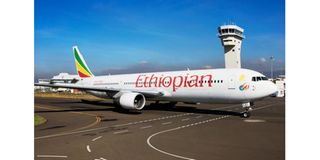
The latest compensation forms part of a $444.5 million (Sh57.5 bllion) victim compensation fund established by the DoJ after Ethiopian Airlines Flight 302 crashed five months after Lion Air Flight 610—another 737 MAX—crashed into the Java sea, Indonesia
An automated flight control system contributed to both crashes, which killed a total of 346 people, and Boeing sought compensation deals to defer or avoid prosecution.
The fresh disbursement adds to $1.45 million (Sh187.7 million) earlier paid to each family as part of $500 million compensation package agreed in 2021, pushing the total payout for each victim to Sh540 million.
The latest compensation was revealed by Chicago-based Ribbeck Law Chartered, which represents 93 families affected by the two Boeing 737 MAX 8 crashes.
Ribbeck said on August 26 that Boeing would begin making final compensation payments to its clients, concluding its legal work for the represented families in the US, Africa, Middle East and Asia.
“We handled a highly complex matter that required international coordination across more than 35 countries where the victims resided, as well as litigation in multiple jurisdictions,” explained Manuel von Ribbeck of Ribbeck Law Chartered.
“We have now concluded the legal work on behalf of our clients in the United States, Africa, the Middle East and Asia. Boeing will begin compensating our clients immediately pursuant to the non-prosecution agreement entered into with the U.S. Department of Justice.”
The two accidents led to a 20-month grounding of the company’s best-selling jet and cost Boeing more than $20 billion.
Boeing has reached settlements in multiple lawsuits brought by the families of victims who died in the March 2019 crash of an Ethiopian Airlines Boeing 737 Max.
Following the March 2019 crash, the Kenyan families joined lawsuits in US federal court seeking compensation from Boeing, beginning a prolonged legal process over liability, damages and victims’ rights.
The flight crashed shortly after take-off from Addis Ababa on March 10, 2019, killing all 157 people aboard.
Kenya had the largest single national contingent among the passengers, with 36 Kenyans dying in the crash, although 32 held Kenyan passports while four travelled on other or dual nationalities.
The US Justice Department pressed charges against Boeing, accusing it of conspiring to defraud the Federal Aviation Administration over technical information provided about the 737 MAX.
The Ethiopian accident investigation found that an angle-of-attack sensor was damaged, flight-control systems activated, and that the aircraft ultimately lost control before striking the ground.
The legal response developed along two separate tracks, including civil claims brought by individual families and a US criminal case brought by the Justice Department.
In January 2021, Boeing entered into a Deferred Prosecution Agreement (DPA) with the Justice Department and agreed to pay more than $2.5 billion (Sh323.5 billion), comprising a $243.6 million (Sh31.5 billion) criminal penalty, $1.77 billion (Sh229.04 billion) in compensation to Boeing’s airline customers and a $500 million (Sh64.7 billion) fund for families and beneficiaries of the 346 crash victims.
The first Kenyan family represented by Ribbeck received $3 million (Sh388.2 million at current conversion rates) in December 2020, becoming the first of the 32 Kenyan cases to settle.
The payment, which was separate from the $500 million criminal-case fund, demonstrated how compensation could vary depending on the route taken by individual families.
By June 2021, Kenyan families had begun receiving payments from the $500 million US victim fund.
The compensation process continued as civil cases proceeded through the US courts, with families pursuing claims covering loss of income, support, companionship, suffering and other damages.
In October 2022, a federal judge recognised representatives of more than a dozen families as crime victims under the US Crime Victims’ Rights Act in the Boeing criminal case.
The ruling gave the families formal rights within the criminal proceedings, including rights to consultation and participation as the Justice Department considered how to resolve the case.
The criminal case faced complications after the Justice Department determined in May 2024 that Boeing had breached its 2021 agreement.
The department said Boeing had failed to design, implement and enforce an effective compliance and ethics programme capable of preventing and detecting violations of US fraud laws.
The breach followed a period of renewed scrutiny of Boeing after the January 2024 Alaska Airlines 737 MAX 9 door-plug blowout, which prompted fresh questions about production quality and regulatory oversight.
The Justice Department and Boeing subsequently negotiated a proposed guilty-plea agreement that included additional penalties and investments in safety and compliance.
A Texas federal judge rejected that agreement in December 2024, saying the proposed resolution did not satisfy the public interest standard required for approval.
The dispute ultimately produced a new agreement in May 2025, under which Boeing would avoid prosecution in exchange for additional financial commitments and safety measures.
Last year’s Non-Prosecution Agreement (NPA) required Boeing to provide another $444.5 million (Sh57.5 billion) to a crash-victims beneficiaries’ fund, bringing the combined criminal-case victim funds to $944.5 million.
The additional fund is to be divided equally among the 346 people killed in the two crashes, producing the average compensation of approximately $2.73 million per victim.
The 2025 agreement also requires Boeing to invest $455 million (Sh58.9 billion) in compliance, safety and quality programmes and retain an independent compliance consultant.
Some families challenged the arrangement, arguing that the Justice Department had failed to protect their rights during negotiations.
The Texas court, however, approved the government’s request to dismiss the criminal charge in November 2025 after considering submissions and hearing from families.
The families opposed to the dismissal and appealed, taking the dispute into the Fifth Circuit Court of Appeals and extending the legal process into 2026.
On March 31, 2026, the appellate court rejected petitions challenging both the 2021 DPA and the 2025 NPA, finding that the families had not established the grounds required for the requested relief.
The court subsequently denied a petition for rehearing in May, with the mandate issued in June, bringing the criminal-case litigation to its latest conclusion.
The latest payments come as separate civil litigation continues to produce large awards for families who chose to pursue their claims through trial rather than confidential settlements.
Most civil cases have been settled, with media reports indicating that Boeing had resolved more than 90 percent of lawsuits arising from the two crashes by 2026.
In May 2026, for example, a Chicago federal jury awarded $49.5 million (Sh6.4 billion) to the family of Samya Stumo, who died aboard Ethiopian Airlines Flight 302.
The award comprised $21 million (Sh2.7 billion) for her pre-death suffering, $16.5 million (Sh2.1 billion) for loss of companionship and $12 million (Sh1.6 billion) for the family’s grief.
Another Chicago jury had earlier awarded more than $28 million (Sh3.6 billion) to the family of Shikha Garg, a United Nations environmental consultant killed aboard Flight 302.
In August 2026, an Irish family received a $29 million (Sh3.8 billion) jury award for the death of Micheál Ryan, a World Food Programme engineer who was also travelling aboard Flight 302.
Register to begin your journey to our premium contentSubscribe for full access to premium content