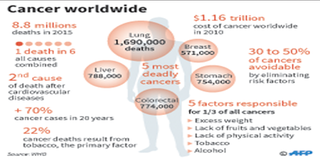
The 14 million new cancer cases worldwide recorded in 2012 will balloon to 24 million within two decades, outstripping the increase in global population, according to the World Health Organisation (WHO).
Paris. Even as cancer treatment improves and survival rates go up, so too does the number of people afflicted with the deadly disease, experts said ahead of World Cancer Day today
The 14 million new cancer cases worldwide recorded in 2012 will balloon to 24 million within two decades, outstripping the increase in global population, according to the World Health Organisation (WHO).
All forms of cancer combined claimed 8.8 million lives in 2015, making it the second leading cause of death after heart disease.
“We know how to help avoid it, and to detect it. We’re getting better at treating it. But overall, we’re not making real headway in the fight against cancer,” said Christophe Leroux, head of communications for France’s League Against Cancer.
Several factors account for the disease’s growing prevalence. One is ageing populations, especially in developed nations and China, where a one-child-per-family policy in force for more than 30 years created a top-heavy age pyramid.
Cancer risk increases with age.
There is also a long list of lifestyle habits linked to cancer, with tobacco consumption at the top. Other risk factors -- all of them increasing -- include eating poorly, lack of exercise, drinking alcohol, and obesity.
Cancer-causing infections such as hepatitis and the human papilloma virus (HPV) account for a quarter of cancer cases, mostly in low- and middle-income countries.
Another risk is exposure to carcinogenic industrial pollutants, including asbestos, organic pollutants such as dioxins, heavy metals and small air particles that lodge in the lungs.
Unequal access
Despite the growing challenges, five-year survival rates for most cancers have improved -- sometimes significantly -- since 2000, according to a study published last week in medical journal The Lancet that reviewed 37.5 million cancer cases between 2000 and 2014. But large disparities between societies remain, depending on level of development and differences in health case systems.
For children with brain tumours, for example, five-year survival has improved across the board from 54 per cent for the period 2000-2004, to more than 60 percent for 2010-2014. In the United States, Denmark, Sweden and Slovakia, the survival rate progressed to 80 per cent or better.
In Mexico and Brazil, however, less than 40 per cent of children diagnosed with brain tumours survived in the 2010-2014 period.
Breast cancer rates also improved across the board, even as disparities remained.
Five-year survival rates for 2010-2014 in the US and Australia were 90 per cent. In western and eastern Europe, the rate improved to 85 and 71 per cent, respectively.
“If we want fewer deaths from cancer, there are two ways: first, better prevention, and second, improving outcomes,” co-author Michel Coleman, an epidemiologist a researcher at the London School of Hygiene and Tropical Medicine, told AFP. (AFP)