Deportation paradox: Routine raids reshape life for Tanzanians in the US
American immigration police in the agents. Some Tanzanians have chosen to quit jobs that require office presence, find jobs that allow them to work from home, or stay home to stay clear of the agents.. PHOTO | FILE
Dar es Salaam. When Tanzania’s embassy in the US confirmed in February 2025 that 24 Tanzanians were being held in immigration detention facilities, the cases were seen by many as isolated incidents.
One year later, those hopes have faded, as immigration enforcement across the US has intensified, reshaping daily life for immigrant communities.
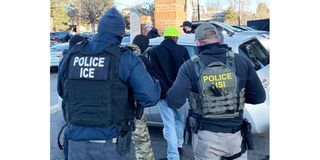
Across several states, immigration officers have stepped up visible, daytime operations, detaining people suspected of living in the country illegally. What were once sporadic raids have become routine, with arrests reported in streets, workplaces and transport hubs.
For many Tanzanians, the heightened enforcement has translated into a constant state of caution.
Some Tanzanians living there have stopped posting pictures online, their social media pages have gone silent.
“I just feel like they could track me online. I live in New York and we have seen our share of raids,” said a Tanzanian who has lived in New York for more than a decade.
The big Apple’s famed canal street has been a showdown between protestors and Immigration and Customs agents. The chaos has been prevalent in many states across the country. As mid-term elections are around the corner, immigration crackdown could determine what Americans currently feel about the raids in the ballot box.
Of all states, none has been making headlines like Minnesota. In 2026, two individuals who identified themselves as Tanzanians were detained in the state of Minnesota and transferred to a large undocumented immigrants’ detention camp in Texas. A final stop before detainees are deported from the US.
A Tanzanian living in Minnesota, Mr Ndaga Mwakabuta, paints a pragmatic picture. Though the State doesn’t have a huge Tanzanian community, it has been the ground of some of the most brutal ICE crackdowns on illegal immigrants in all of the country. The killing of Renee Good during the confrontation with ICE agents a week after the New Year’s celebration highlighted the severity of ICE operations.
Alex Pretti, a 37-year-old intensive care unit (ICU) nurse, was similarly gunned down by federal agents as he was protesting the immigration enforcement. Minnesota is a state in the North Central region bordering Canada.
This is where Mr Mwakabuta has resided for decades, part of the Tanzanian immigrants who moved to the US legally, raising a family. He is not immune to an ICE crackdown; at least he has been stopped a few times and asked to show his documentation.
“I have no problem with the immigration guys; they stop me, I show my paperwork, they verify, and they leave me alone,” he said. Mr Mwakabuta touched on the state law and its jurisdiction, saying that local police have the power to ask for a resident’s identification.
Federal immigration officials, like ICE, can approach you in public and request your ID, but it is within your right to remain silent and ask for a lawyer. ICE is also restricted from entering private homes without a judicial warrant.
In Atlanta, a Tanzanian lady married to an American has for a long time chosen to keep her identity hidden. She had two American-born children and has chosen seclusion from all Tanzania-related gatherings, events, even whatsapp groups.
She is one of many, who have chosen to let go of their past identities and fully embrace their American one. This is a survival instinct that cushions one from the impact of raids that have targeted immigrant markets, vendors and events.
Some immigrants now walk around with their American passports for fear of being wrongfully arrested. This comes after some legal immigrants including Africans were mistaken for illegal aliens. California, Minnesota, and Chicago Illinois have seen the worst of ICE raids and protests that have followed. Some detainees have come publicly to the press, accusing federal agents of using racially derogatory terms when arresting them. It is now chaotic with no ease in sight.
The public has turned to social media for help and tips.
One Tanzanian living in Washington State, said he watches ICE agent sightings on social media, mostly reddit. They posted the streets where agents have been seen roaming, their vans’ plate numbers and any details that might help evade them.
“This is the year I was planning to bring my daughter from Dar es Salaam to the US, but all that is not possible now” He said.
The scrutiny on immigrants’ status in the country has evidently affected immigrant communities around United States.
“Some Tanzanians without proper documentation have had to move from one state to another, some Tanzanians I know have left Minnesota for fear of detainment,” said Mr Mwakabuta.
The Immigration enforcement has been knocking on doors, he said. Because they have all the information, including the addresses of those they allege to be in the country illegally. They have now intensified from street arrests to focusing on known addresses.
Several Tanzanians on student visas have been paid a visit by ICE agents to confirm their status, and even check on the universities they have enrolled in, just to verify that they are still attending lectures.
”One of our fellow Tanzanians who was working on his green card was also approached by immigration agents. They went to his office and cross-checked on the information they had to see if all was in order,” he mentioned. “It seems like these ICE agents were given a target to reach, the number of arrests they have to make, so to do that, they tend to arrest anyone without proper verification just to hit the target,” he added.
Some of those arrested have since been released.
The majority of Tanzanians living in the US have their legal documents, and they have been living there for a long time. Even those without green cards or citizenship have largely been able to live without any problem, especially those who were able to find employment before the Sept 11th attacks.
Mr Mwakabuta said that the terrorist attack changed America and how it verifies information or lets immigrants work. The scrutiny became more intense, the road to citizenship became longer.
Before the current administration, among all states in the US, Minnesota had eased regulations for immigrants. Regardless of their legal status, they could easily be issued a driving license and open a bank account; the situation has now changed.
In the past, staying out of trouble and having no criminal record ensured one’s safety from being questioned about immigration status, but now people are facing uncertainty.
Some Tanzanians have chosen to quit jobs that require office presence, find jobs that allow them to work from home, or stay home, lock doors, and hope that all chaos will die down soon, but with Trump’s administration poised to end on January 20th, 2029. The end of the crackdown is not in sight.
Mr Mwakabuta reiterated that if one is legally in the US as an immigrant, one has nothing to fear. Despite his sentiment, the news coming from ICE raids across the country paints a different picture: Americans from minority communities are being profiled and arrested, creating a violent scene. He said that most of the chaos is a result of pushback from members of communities being targeted.
Houston Texas, one of the cities with the highest Tanzanian diaspora population has witnessed widespread immigration crackdown since 2024. In late 2025 more than 1,500 were arrested, communities response were similar to other states, but in Houston an ICE map was created by RICE university students to track the enforcement actives.
A sheer demonstration of how communities are fighting back. The Tanzanian Community in Georgia, has urged Tanzanians who are at risk to make sure they have constant communication and have had their financial affairs in order in case of abrupt arrest.
In Minnesota, the Minnesota Swahili Christian Congregation (Swahili Lutheran) has organized help for its members in need, who are largely East Africans.
The church, which has been instrumental in times of bereavement, has stepped in during this immigration crisis, offering counseling sessions and providing a phone number for anyone wishing to call. A hotline that has been vital to communities in times of panic, uncertainty, and fear.
“People have been advised to stay home and avoid unnecessary movement to avoid interacting with ICE,” he said. Immigrants have been advised to avoid Portland Avenue at East 34th Street in south Minneapolis, where Renee Good was murdered. Not far from where George Floyd was killed, and Downtown Minneapolis, where they have seen increased ICE activities.
For Tanzanians who had dreams to immigrate, study, or reunite with family members in the US, that possibility seems bleak at the moment.
“That dream is non-existent at the moment,” he said. Mr Mwakabuta, advises Tanzanians to look for other alternatives like Canada, which still has its doors open for immigrants. The number of Tanzanians who have been deported back to the country is not known.
It is more difficult for Tanzanian embassy officials to present accurate figures because some Tanzanians who decided to overstay their visas chose to take up another nationality to stay in the country.
“Some chose nationalities of countries that have political instabilities so that they can seek asylum,” he said. This makes it hard to verify the number of Tanzanian deportees. For now, Tanzanian communities around the United States have urged their members to remain vigilant and keep in constant communication so that they can know their whereabouts and inform families in case they fall victim to detention or deportation.
Register to begin your journey to our premium contentSubscribe for full access to premium content