Government raises defence budget by 17.57pc to boost modernization
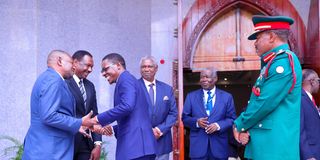
The minister for Defence and National Service, Dr Rhimo Nyansaho (third left), is congratulated by former Permanent Secretaries and retired senior officials shortly after the approval of the ministry’s budget for the 2026/2027 financial year in Parliament yesterday. Looking on are the Chief of Defence Forces (CDF), General Jacob John Mkunda, and retired CDF George Waitara. PHOTO | Said Khamis
Dodoma. The government has increased its defence budget by 17.57 percent as part of efforts to modernise the country’s defence and strengthen operational readiness in response to emerging challenges.
Presenting the ministry’s budget estimates in Parliament yesterday the minister for Defence and National Service, Dr Rhimo Nyansaho, requested lawmakers to approve Sh4.29 trillion for the 2026/27 financial year.
The allocation, which was shortly unanimously approved by MPs, is higher than the Sh3.65 trillion allocated in the 2025/26 financial year, reflecting what the government described as an investment in national defence capabilities, border security and military preparedness.
Dr Nyansaho said the ministry will prioritise strengthening the Tanzania People’s Defence Force (TPDF) through the acquisition of modern equipment, improved communication systems, advanced technology and human resource development.
“The activities planned for implementation in the 2026/27 financial year will focus on strengthening the military with modern equipment, technology, communication systems and human resources,” he said.
He said that the ministry will also focus on improving working conditions for soldiers, including training, healthcare, housing, maintenance of equipment and welfare programmes aimed at enhancing efficiency.
A key area of focus will be expanding the capacity of the National Service, popularly known in its Kiswahili abbreviation as JKT, through improved infrastructure to enable the institution to enrol and train more young people in military basics and vocational skills aligned with national development needs.
Other priorities include strengthening the reserve force, protecting strategic national projects, expanding military research institutions and developing defence-related industries capable of producing goods for both military and civilian use.
Dr Nyansaho said the government also plans to expand collaboration with the private sector in establishing defence industries as part of efforts to boost self-reliance and industrial development.
He also said Tanzania will continue to strengthen international military cooperation with the United Nations, African Union, Southern African Development Community (SADC), East African Community (EAC) and friendly nations.
The ministry, he added, will continue working with civilian authorities in responding to disasters and emergencies when required.
On national security, Dr Nyansaho assured Parliament that Tanzania remains stable and secure along all borders, citing continued vigilance by security agencies and cooperation with neighbouring countries.
Parliament’s Defence and Security Committee chairperson, Najma Giga, said the budget had increased by Sh640.58 billion compared to the previous financial year, representing a 17.57 per cent rise.
She said recurrent expenditure increased by Sh532.84 billion, while development expenditure rose by Sh107.74 billion, equivalent to a 33.78 per cent increase.
“The increase reflects the importance of strengthening national defence and protecting our borders,” she said.
However, the committee cautioned that the effectiveness of the budget would depend on timely release of funds by the Treasury.
It also urged the government to expand JKT capacity and align vocational training with labour market needs, while strengthening follow-up systems for graduates.
The committee further recommended improved compensation for citizens relocated due to defence projects to avoid pending claims.
It also called for stronger financial and technical capacity within the army’s economic wing, SUMA-JKT, and urged investment in strategic defence companies such as MZINGA and NYUMBU to improve productivity and efficiency.
Parliament unanimously approved the Sh4.29 trillion budget, clearing the way for implementation of the ministry’s 2026/27 defence modernisation agenda.
Register to begin your journey to our premium contentSubscribe for full access to premium content