Green hydrogen to broaden Tanzania’s clean cooking energy options
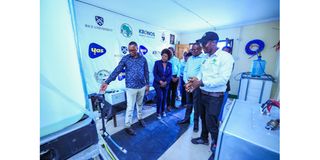
The Director of Clean Cooking Energy at the Ministry of Energy, Mr Nolasco Mlay, inspects green hydrogen production equipment during his visit to the Bora Women Go Green pilot project in Kilwa District, Lindi Region. PHOTO | COURTESY
Dar es Salaam. Green hydrogen produced from water could soon add to Tanzania’s clean cooking energy options, with a pilot project in Kilwa District, Lindi Region, expected to begin official production by the end of October 2026.
The project, being implemented by Bora Women Go Green, uses water as a raw material to produce hydrogen for cooking and is being explored as a clean and environmentally friendly alternative.
The Director of Clean Cooking Energy at the Ministry of Energy, Mr Nolasco Mlay, yesterday visited the project to assess its progress and examine how the technology could contribute to Tanzania’s clean cooking ambitions.
“The government recognises the importance of technology and innovation in increasing the use of clean cooking energy. It is important to continue exploring different technologies, assessing their efficiency and safety, as well as how they can be made accessible and affordable to citizens while taking environmental conservation into account,” he said.
During the visit, Mr Mlay received briefings on the technology, progress and preparations for production. Final preparations are now underway, with official production expected by the end of October 2026.
The project will allow communities to experience how green hydrogen can be used for cooking while assessing its practicality and potential for adoption.
The Technical Director of Bora Women Go Green, Dr Ernest Mulaya, said the project uses ordinary water resources, including well and rainwater, to produce hydrogen gas for cooking applications.
“We use ordinary water—well water, rainwater, any type of water—and use it to produce hydrogen gas. We use the hydrogen gas for various cooking applications,” he said.
Dr Mulaya said the initial phase would involve 20 model villages in Kilwa, where hydrogen gas would be distributed for residents to use in cooking.
The initiative could help Tanzania assess whether green hydrogen can become part of the country’s broader national clean cooking energy mix, while also creating new economic opportunities if the technology proves practical and affordable for communities.
The project comes as Tanzania implements the National Clean Cooking Energy Strategy 2024–2034, which targets having 80 percent of Tanzanians use clean cooking energy by 2034.
The strategy seeks to reduce dependence on traditional cooking fuels that contribute to environmental degradation and pose public health risks.
The government has been promoting electricity, liquefied petroleum gas, biogas and other emerging technologies as part of efforts to expand clean cooking access.
Dr Mulaya said the Kilwa project was also designed to support the 80 percent target while reducing pressure on coastal mangrove forests, which communities have been cutting for cooking fuel.
“The project is intended to provide a solution for citizens to use clean energy while also protecting the mangroves along the coast, where many people cut trees for cooking,” he said.
He said the shift from charcoal and firewood to hydrogen could represent a significant change in Tanzania’s clean cooking efforts.
For wider deployment, its safety, efficiency, affordability and environmental benefits will need to be demonstrated.
Bora Women Go Green Director Dr Haule said final preparations were underway and production was expected to begin by the end of October.
“Our objective is to enable communities to see and experience first-hand how green hydrogen can be used for cooking,” she said.
She said the project would also create awareness and help communities understand economic opportunities associated with the technology.