Hope as conjoined twins fly to S.Arabia for surgery

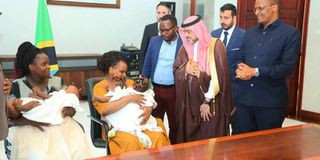
Saudi Arabia’s Ambassador (second right) bids farewell to parents Angelina George (left) and Mwaru Girali, along with their conjoined twins, at Julius Nyerere International Airport in Dar es Salaam on Monday, January 26, before their journey to Saudi Arabia for possible surgical separation. Looking on (right) is the Permanent Secretary in the ministry of Community Development, Gender, Women and Special Groups, Dr John Jingu PHOTO | MICHAEL MATEMANGA
What you need to know:

  • The four children have been under medical care at the Muhimbili National Hospital for more than a year

Dar es Salaam. There was a mixture of relief, hope and quiet prayers at Julius Nyerere International Airport on Monday, January 26, 2026, as two sets of conjoined twins departed for Saudi Arabia, where they will undergo advanced medical assessment and possible surgical separation.

The four children, Lightness and Loveness Luhende (one year and four months old), and Nancy and Nice Sospeter (one year and five months), have been under close medical care at the Muhimbili National Hospital (MNH) for more than a year.

Due to the complex nature of their conditions, doctors say the twins require highly specialised technology and expertise that is currently only available in a few centres globally.

Speaking during the send-off ceremony, paediatric surgeon at MNH, Dr Zaituni Bokhari, said the children’s conditions differ, but both cases demand advanced surgical intervention.

“Nancy and Nice Sospeter were born on August 30, 2024, in Bunda, Mara Region,” Dr Bokhari explained.

“They are joined at the abdomen up to the pelvic area, have three legs, and share a single anal opening. This makes their case particularly delicate,” she noted.

She added that Lightness and Loveness Luhende, born on July 30, 2024, are joined from the lower spine to the pelvis, have four legs, and each has a separate digestive and urinary system.

“Although their organs are more distinct, the separation still requires a very high level of surgical skill and technology,” she said.

Dr Bokhari, who has been closely involved in the twins’ care since their admission to Muhimbili, is accompanying them to Saudi Arabia to support the medical team and the families. For the parents, the journey marks a turning point after months of uncertainty.

“We arrived at Muhimbili on August 13, 2024, and since then, all the medical services have been fully supported by the government,” said the mother of Nancy and Nice, Ms Angelina George (38).

“I am deeply grateful to the management of Muhimbili and to President Samia Suluhu Hassan for the immense support. These twins are my seventh childbirth, and this journey gives us hope,” she said.

The mother of Lightness and Loveness from Itigi in Singida Region, Ms Mwalu Kilala (27), also expressed her appreciation.

“My children are now one year and four months old. I thank the Muhimbili leadership, the government of Tanzania, and the Kingdom of Saudi Arabia for standing with us during this difficult journey,” she said.

The medical evacuation is part of a long-standing health cooperation between Tanzania and Saudi Arabia.

Deputy Permanent Secretary in the ministry of Foreign Affairs and East African Cooperation, Mr Said Shaib Mussa, said the partnership reflects more than five decades of strong diplomatic relations.

“Since 2019, Saudi Arabia has supported various separation surgeries for Tanzanian children,” he said.

“Through the Jakaya Kikwete Cardiac Institute alone, we have implemented about 500 medical interventions worth Sh4.5 billion, including surgeries and the provision of medical equipment. The collaboration also extends to training Tanzanian specialists,” he added

The Permanent Secretary in the ministry of Community Development, Gender, Women and Special Groups, Dr John Jingu, acknowledged Muhimbili’s capacity to conduct complex surgeries but noted that conjoined twin separation remains one of the most demanding procedures.

“Muhimbili has successfully separated conjoined twins before,” he said.

“However, this kind of surgery requires extremely advanced technology and is very costly. That is why the support from Saudi Arabia is invaluable.”

He also called on Saudi partners to explore the possibility of investing in specialised medical services in Tanzania.

“Neighbouring countries also face similar cases. Establishing such capacity locally would be of great regional benefit,” he added.

Saudi Arabia’s ambassador to Tanzania, Mr Yahya bin Ahmed Okeish, praised Dr Bokhari and the entire Muhimbili medical team for their dedication to the children’s care before referral.

“The conjoined twins’ separation programme is a major humanitarian initiative for Saudi Arabia and the world at large,” he said.

“It is implemented under the guidance of King Salman and closely overseen by the Crown Prince, with technical leadership from Dr Abdallah. Tanzania is among the countries that have benefited from this programme.”

According to the ambassador, the programme has been running since 1990 and has successfully separated more than 60 pairs of conjoined twins worldwide.

“Each operation costs over $100,000 and brings together some of the world’s most experienced specialists,” he noted.

In a message she sent to well-wishers at 4:00am East African time Dr Bokhari said they arrived safely in Saudi Arabia ready for further medical consolations and surgery.

As the children embark on this critical journey, families, doctors and the nation await the outcome with cautious optimism—hopeful that advanced medicine and international solidarity will offer these young lives a chance at an independent future.