Dar es Salaam. “Salute our pilot! Thank you, iron woman, for delivering us safely! May God bless your work!”
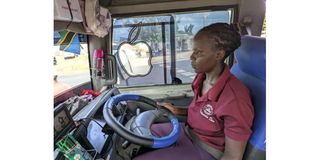
These are the familiar cheers from passengers as Joyce Foya completes her daily route. Such praise is rare in Dar es Salaam’s commuter bus industry, yet for Joyce it has become a badge of honour in a space long regarded as a male preserve.
Ms Foya, 33, drives a commuter bus, famously known in Dar es Salaam as daladala, on the Kigogo Market–Pugu route in Ilala District to Tandika in Temeke.
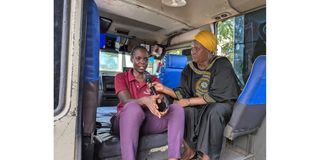
In a three-hour interview with The Citizen’s sister newspaper Mwananchi, she recounted a journey defined by grit, rejection, and eventual triumph.
Though she dreamed of driving from childhood, economic hardship and social expectations forced her to take a longer route to the steering wheel.
She first moved to Dar es Salaam in 2010 from the Kilimanjaro Region to help her sister run a retail shop.
After a year, family disagreements pushed her back home, but the city called her again.
In 2012, she returned, staying with a friend and working as a mama lishe (food vendor) in Mwembe Yanga, Temeke.
“As I served food, I would tell bus crews about my dream of driving. Most laughed and told me to start as a conductor, saying driving was not for women,” recalls Ms Foya.
Between 2016 and 2017, opportunity finally knocked when a driver urgently needed a substitute conductor. She seized the chance.
“Getting into this industry was a fight. I promised myself that if I was given an opportunity, I would not waste it. I began on the Kariakoo–Temeke route before the Buza–Kigogo line even started,” she says.
She watched male colleagues quickly transition into driving lessons while she remained overlooked.
Determined not to be sidelined, she sought mentorship. “I eventually found a driver on the Kigogo–Tandika route who agreed to train me.”
Training was demanding. Her instructor was strict and sometimes physically reprimanded her for mistakes.
Ms Foya endured, determined to challenge the belief that women lack the temperament for navigating Dar es Salaam’s chaotic roads.
After gaining confidence, she enrolled in a driving school and obtained a Class C licence, qualifying her to operate large passenger buses. She has now been a full-time driver for three years.
Trials on the tarmac
Despite her competence, Ms Foya faces resistance from some male colleagues.
“Some question how a woman can fill her bus faster than they do. Others deliberately block me at bus stops to prevent overtaking,” she says.
Passengers can also test her resolve. While many are supportive, some still make disparaging remarks.
“Some have told me to go back to the kitchen. But I developed resilience during my years as a conductor. I love my work, and that is what matters,” she adds firmly.
In her early days, some commuters would disembark upon seeing a woman driver.
Over time, her consistent record of safety and professionalism has quelled such doubts.
A family’s transformation
Her career initially unsettled her family. Her parents feared the moral risks associated with the transport sector. Even after she became a driver, her brother dismissed her claims.
“He thought I was joking. Even when my son confirmed it, he said I had coached him,” she says with a smile.
The stalemate ended when the family dispatched her elder sister from Kilimanjaro to verify the claims. Once confirmed, scepticism turned to admiration.
Balancing motherhood and work
Ms Foya is a mother to a Standard Seven pupil. To ensure stability during his final primary year, she arranged for him to live with her sister in Moshi, visiting during school holidays.
Her routine is disciplined: she starts work at 5:00 a.m. and finishes at 5:00 p.m., reserving weekends for rest, family, and community commitments.
Building for the future
Her efforts have tangible rewards. Through her earnings, she has built a home in Chanika, a milestone she credits to perseverance and financial discipline.
Her long-term goal is to become a bus owner. She is saving specifically to purchase her own vehicle and transition from employee to operator.
“If I met President Samia Suluhu Hassan, I would ask for support to acquire my own passenger bus,” she says.
Colleagues describe her as dependable and principled. Mr Juma Pazzy and Mr Hussein Mkelemi say vehicle owners entrust her with daily collections due to her integrity.
Her conductor, Ms Farida Iddi, adds that Ms Foya inspired her to pursue a driving licence.
Ms Foya’s journey reflects determination in the face of structural and social barriers.
In an industry traditionally dominated by men, she has carved out space through discipline, courage, and competence.
Her story affirms that ambition knows no bounds. Through persistence and hard work, she has transformed scepticism into respect and adversity into achievement, a powerful example of what Tanzanian women can accomplish when opportunity meets resolve.