Inside plan to boost reading, writing and arithmetic skills

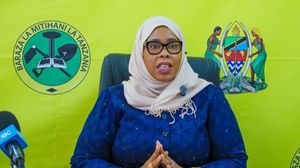
President Samia Suluhu Hassan listens to Education minister Adolf Mkenda during the launch of the Scientific Plan to Build Literacy and Math Skills among pre-primary and primary school pupils in Dar es Salaam yesterday. PHOTO | STATE HOUSE

Dar es Salaam. For years, Tanzania’s education debate has focused on classrooms, teachers’ welfare and examination results. Yet beneath all these lies a quieter but more decisive question: can children actually read, write and count well enough in their early years to cope with learning later on?

It is this concern that has pushed the government to launch a new national strategy aimed at strengthening reading, writing and arithmetic for children in pre-primary, Standard One and Standard Two.
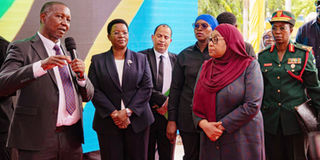
Launched by President Samia Suluhu Hassan yesterday, the strategy seeks to fix learning gaps early before they become permanent obstacles.

At the launch, President Hassan was clear that no country can build a skilled workforce on weak foundations.

“We can invest in infrastructure, knowledge and technology, but if we fail to strengthen the early foundation of teaching our children, we will be building on weak ground,” she said.

The Head of State warned that poor mastery of basic skills at an early stage often explains why some graduates struggle later despite years spent in school.

The initiative comes against the backdrop of curriculum reforms that extended compulsory education to 10 years. According to the President, these reforms would mean little if children fail to grasp basic literacy and numeracy in their first years of schooling.

“That is why this strategy is critical,” she said, adding that it also fulfils Tanzania’s commitments under global and regional frameworks such as SDG 4, the African Union’s Agenda 2063 and SADC and EAC education guidelines.

At its core, the strategy is science-driven and inclusive. It draws on years of research, much of it conducted since 2015, which revealed that while many pupils perform well, a significant number fall behind early and never fully catch up.

Rapid technological change has only widened this gap, especially between urban and rural schools.

Education minister Adolf Mkenda said the strategy fulfils a promise made by President Hassan during the 2025 General Election campaigns and later in Parliament.

“Today, the government has delivered on that promise, even before the first 100 days have ended,” he said.

Prof Mkenda explained that the strategy rests on five pillars. The first is improving classroom teaching through continuous professional development and closer supervision of how early grades are taught.

The second focuses on teachers’ preparation and involvement, particularly in developing teaching and learning materials. Third is ensuring that learning tools are accessible in all areas, including remote communities.

The fourth pillar is assessment. “Assessment is part of science,” Prof Mkenda noted. “We must regularly measure how well learners are mastering these skills so we can intervene early.”

The fifth pillar emphasises parental and community involvement, recognising that learning does not stop at the classroom door. He also stressed that reforms would fail without strong quality assurance, promising to strengthen education inspection systems.

Data from the National Examinations Council of Tanzania (NECTA) highlights why early intervention is urgent. NECTA’s Executive Secretary, Prof Said Mohamed, said assessment results from the 2023 national assessment show mixed progress.

While 78.92 percent of pupils performed well in reading, only 69.63 percent met the required writing standards and just 62.56 percent did so in arithmetic.

“This shows that a significant number of pupils are still not reaching the expected competence, especially in writing and numeracy,” Prof Mohamed said.

He added that between 2021 and 2023, more than a third of pupils fell below expected levels, with clear disparities between urban and rural areas.

Without early action, he warned, these gaps persist into Standard Three and beyond, making learning more difficult and costly to fix later. “Investment in early grades yields the highest educational, social and economic returns,” he said.

The strategy therefore promotes proven approaches such as Teaching at the Right Level (TaRL), play-based learning and continuous assessment, supported by data and ICT tools.

It also encourages partnerships with development stakeholders and stronger engagement of parents and communities in supporting children’s learning and wellbeing.

Challenges remain. Teacher shortages, overcrowded classrooms and uneven access to learning materials could slow implementation.

Sustained funding, coordination across local governments and effective monitoring will be crucial. Still, education experts agree that shifting focus to early learning is a step in the right direction.

As President Hassan put it, “A child who masters reading, writing and arithmetic early develops the ability to understand new knowledge, think critically and participate fully in learning.”