KMTC revival to cut steel, spare parts imports by Sh5.4 trillion

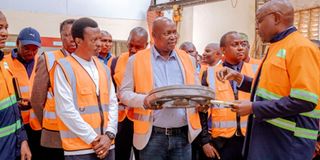
KMTC Managing Director Leonard Mgoyo (right) briefs Deputy Minister for Industry and Trade Dennis Londo (centre) on spare parts now being manufactured at the factory and their industrial applications. Minister Londo visited the factory on Wednesday, January 21, 2026. Looking on is Hai District Commissioner Hassan Bomboko. PHOTO | BERTHA ISMAIL

What you need to know:

  • Over the past five years, the government has invested more than Sh5.1 billion in the plant, facilitating the installation of modern machinery aimed at expanding the range of products manufactured at the facility.
Moshi. The government expects to save more than Sh5.4 trillion annually that has been spent on importing steel and spare parts following the revival of a domestic manufacturing plant in the Kilimanjaro Region.

KMTC Manufacturing Limited, located in Hai District, was established in 1980 through a partnership between the governments of Tanzania and Bulgaria.

Production stalled in 1998 before the facility was revived last year by the government through the National Development Corporation (NDC) and the Ministry of Industry and Trade.

Over the past five years, the government has invested more than Sh5.1 billion in the plant, facilitating the installation of modern machinery aimed at expanding the range of products manufactured at the facility.
The development was revealed on Wednesday, January 21, 2026, by KMTC Managing Director, Mr Leonard Mgoyo, during a visit by Deputy Minister for Industry and Trade Dennis Londo, who toured the factory to assess progress in its rehabilitation and production.

Mr Mgoyo said the investment has resulted in major improvements, including the construction of a steel smelting furnace, installation of a galvanising machine that protects steel products from corrosion for more than 70 years, as well as the rehabilitation of power infrastructure and production buildings.

He said the investment would strengthen domestic production of industrial machinery and spare parts, reduce reliance on imports, boost the industrial economy, create jobs, and stimulate value chains across multiple sectors.

“The factory currently has four operational units, the machine workshop, steel fabrication, assembly, and galvanizing, one of which did not previously exist,” said Mr Mgoyo.

He added that KMTC currently provides 174 jobs, comprising 29 direct and 145 indirect positions.

Under its strategic plan, the factory aims to create 207 direct jobs and more than 1,200 indirect jobs once it reaches full production capacity.

NDC Director General, Dr Nicholaus Shombe, said KMTC’s growth is expected to stimulate value chains in agriculture, mining, construction, transport, and vocational skills training.

He said government investment has enabled KMTC to serve major local institutions and industries, including TPC and Mkulazi sugar factories, Tanzania Breweries Limited (Arusha and Mwanza), Harsho Group, GF Vehicles Assemblers, as well as public institutions such as the Tanzania Engineering and Manufacturing Design Organisation (TEMDO) and the Tanzania Sisal Board (TSB).

“Discussions are ongoing with the Cereals and Other Produce Board (CPB) to serve its factories in four regions,” said Dr Shombe.

He added that Tanzania currently spends more than Sh2.9 trillion annually on importing machinery and about Sh2.5 trillion on spare parts.

“These costs are high and can be significantly reduced through competitive local production at KMTC,” he said.

Dr Shombe further said the factory has completed a market assessment for mining grinding balls and is preparing to commence production after identifying a sizeable market opportunity in the mining sector.

For his part, Deputy Minister Mr Londo commended the factory’s management for the efficient use of government funds, which has enabled rapid rehabilitation and the commencement of production in some units.

He urged management to intensify marketing efforts to attract more customers and scale up output.

“Beyond job creation and industrial growth, this factory will save funds previously spent on importing machinery and spare parts, which can now be redirected to development projects,” said Mr Londo.