Prof Kahangwa: Skills development vital for Tanzania’s Vision 2050
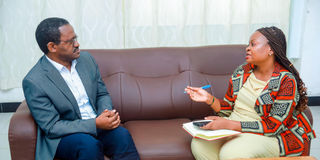
Lecturer at the University of Dar es Salaam, Professor George Kahangwa (left), speaking with Mwananchi journalist, Elizabeth Edward.
As Tanzania advances its socio-economic transformation under Vision 2050, debate over education quality and its role in national development continues. In an in-depth interview with the Head of the Department of Foundations of Education, Management and Sustainability at the University of Dar es Salaam’s School of Education, Prof George Kahangwa, The Citizen’s sister newspaper, Mwananchi reporter Elizabeth Edward reports that he emphasised the need for skills-focused education to drive national transformation.
Q: Does the current education system equip learners to solve real social challenges, or are we still producing students who merely memorise theory?
A: Largely, our system still focuses on a “pen-and-paper” approach. But real life does not always require paper.
In knowledge construction, there are three domains: skills, cognition, and emotions. At present, excessive emphasis is placed on cognition alone, mainly to pass examinations.
We need to move beyond exam performance and ask what a student has actually learned and can do in practice.
Q: The government is implementing a free education policy. How can we ensure increased enrolment does not compromise learning quality?
A: We must recognise the true cost of quality education. Quality comes at a price, and the country must assess what is required to adequately prepare a child under current conditions.
Education budgets must reflect real needs. Free education should not mean “anything goes”. This is not the government’s responsibility alone; all stakeholders must play their part in building the nation’s human capital.
Q: To what extent do current curricula align with labour market needs, science, technology and the industrial economy Tanzania aims to build?
A: Curriculum reforms are commendable and consider market needs, but implementation remains the biggest challenge.
For example, the new curriculum includes practical education, yet practical training cannot be delivered without equipment or skilled teachers.
You cannot teach computer studies with a blackboard alone. Without substantial investment in equipment, these curricula remain theoretical. If prioritised, such investment is achievable.
Q: There is a shortage of science and mathematics teachers. What strategic approaches can bridge this gap?
A: This is primarily a strategic issue. First, we must use existing teachers to “produce” more. Second, the government can emulate private schools by identifying science graduates early and offering incentives to join the profession.
Technology can also support learning in the absence of a direct teacher. Cooperation between private schools with surplus science teachers and public schools within the same ward can help. This must accompany improved teachers’ welfare to attract and retain young talent.
Q: There has been debate over the language of instruction: Kiswahili versus English. What is the right direction?
A: Students learn best in a familiar language. However, languages should first be taught as subjects before becoming mediums of instruction.
If Kiswahili, it must be taught proficiently. If English, exchange programmes could bring teachers from the United Kingdom to our colleges. We cannot avoid English in international communication, so proper preparation is essential.
Q: Is there conflict between practical education in secondary schools and vocational training at institutions such as VETA?
A: There is no conflict, only an opportunity for complementarity. Vocational education demand is broad.
In an era of employment challenges, more institutions are needed to equip people with self-employment skills.
Even if all secondary schools offer practical education, vocational colleges remain essential for higher levels of specialised expertise.
Q: Society still views vocational education as for “failures”. How can this mindset change?
A: This colonial-era perception persists. To change it, a practical strategy is needed.
The vocational track should not only accept low-performing students; high achievers should also choose it voluntarily.
Status and employment opportunities for vocational graduates must match those of academic graduates to eliminate discrimination.
Q: Does our assessment and examination system promote understanding, or merely competition for marks?
A: True assessment is not yet implemented; we rely on paper-based exams. Assessment should identify what a learner can actually do.
If a student has learned biological dissection, the assessment should require practical execution. Powers of assessment should be decentralised to schools and districts, rather than relying on a single national exam that cannot capture every child’s talent.
Q: In an era of moral decline, is our education system promoting patriotism and integrity?
A: We teach history and ethics, but the challenge lies in society. A student may score an ‘A’ in ethics, yet encounter a society that rewards dishonesty.
Those who use shortcuts often succeed more than educated professionals, contradicting traditional classroom lessons. For education to instil patriotism, society must show that integrity pays.
Q: Is Artificial Intelligence (AI) an opportunity or a threat to education?
A: AI is unavoidable and should be embraced with discipline. It offers vast opportunities for knowledge and job creation.
However, students risk over-reliance, neglecting their own thinking. Policies are needed to guide AI as a research tool, rather than a substitute for human reasoning. People must also learn to distinguish authentic content from machine-generated material.
Q: What major reforms would you like to see over the next 10 years to drive Tanzania’s economic transformation?
A: First, harmonise education quality between public and private schools to prevent social stratification. Second, increase research investment in higher education. Third, review all curricula for contemporary relevance.
Above all, we must restore teachers’ dignity. As long as teachers live in poor conditions, the education system will reflect this. We must redefine the profile of teachers capable of preparing the nation of tomorrow.
Register to begin your journey to our premium contentSubscribe for full access to premium content