When bridges become a grave hazard to people using them
A bridge used by pedestrians, tricycles and motorcycles across Mligazi River, linking Handeni District in Tanga Region with Bagamoyo District in Coast Region. PHOTO | NEVUMBA ABUBAKAR
Tanga. Nearly one-third of bridges in Handeni Rural District, Tanga Region, are in poor condition and pose a serious threat to residents’ lives, particularly during the rainy season, The Citizen has established.
A three-month investigation by The Citizen has found that rains, which farmers traditionally regard as a blessing, have instead become a source of fear, disrupted communication and interrupted social and economic activities in several villages.
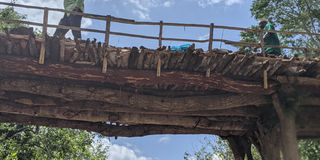
The situation is largely driven by the deteriorating condition of bridge infrastructure, with many structures either dilapidated or built as temporary facilities, rendering them unsafe.
In some areas, there are no bridges at all, only makeshift crossings built using trees, timber and logs, conditions that significantly heighten risks during the rainy season.
Data from the Tanzania Rural and Urban Roads Agency (Tarura), Handeni District, show that 70 percent of bridges in the district have been repaired, while 30 percent remain in a dilapidated state.
Tarura Handeni District manager Judica Makyao acknowledged the challenge, saying, “Seventy percent of bridges in this district have been repaired. The remaining ones, including the Mligazi River Bridge, are at the assessment stage. Due to financial constraints, we are forced to prioritise areas with the most urgent needs.”
The danger intensifies during the rainy season, when residents are forced to rely on informal crossings to traverse rivers.
Villages such as Kwasunga, Miono and Kwamsisi are among the worst affected due to the absence of a bridge over the Mligazi River, which links Handeni and Bagamoyo districts.
For rural residents, a bridge is not merely infrastructure, it is the backbone of daily life.
It enables students to reach schools, patients to access healthcare, farmers to transport produce and traders to reach markets beyond their villages.
For more than six decades since Mainland Tanzania (Tanganyika) gained independence in 1961, no permanent bridge has been constructed in the area.
Instead, residents have depended on temporary crossings made of trees, timber, logs and soil.
Because of the materials used, these structures rot and collapse within a short period, especially during the rainy season.
The Citizen observed the hazardous condition of the crossing, where timber and logs have already decayed, some trees have snapped and support pillars are leaning to one side, posing serious risks to motorcycles and three-wheelers using the route.
A resident of Kwamsisi Village, Kauye Semboga, said the absence of a bridge over the Mligazi River has become a major barrier to children’s education.
“I have a child in Form Six. I was compelled to send him to live with his aunt in Miono because during the rainy season he cannot attend school. Once the temporary crossing collapses, the only alternative route is via Mkata, which is very far,” she said.
A resident of Kwekonje in Kwasunga Ward, Ms Hadija Salum, said residents are exhausted from living in constant fear.
“When you cross, you pray to God. If a child or a motorcycle slips, you fall into the river. During the rainy season, communication is completely cut off. We are tired of living in fear,” she said.
Another resident, Mr Juma Mohamed, said the bridge has become a political tool during election campaigns, with no action taken afterwards.
“Leaders come asking for votes, but after elections nothing happens. We are appealing to President Samia Suluhu Hassan to help us, this problem has persisted for too long,” he said.
From residents’ accounts, the Mligazi River Bridge is not simply an infrastructure inconvenience but a threat to lives, education and the local economy.
The lack of a bridge has also undermined economic activities, forcing farmers to sell produce at low prices due to high transport costs.
“Even when harvests are good, traders won’t come because of the poor road and bridge. We sell at a loss. Some farmers have stopped growing cassava because it is no longer profitable. A full truckload fetches Sh70,000 instead of Sh100,000,” said Malua Said.
Poor infrastructure has also contributed to deaths among pregnant women and patients who fail to reach distant health facilities in time.
“I recently buried my own child because of the lack of a bridge. It was during the rainy season in 2022. My daughter was pregnant and began bleeding heavily until she lost consciousness. She had to be taken to Mkata, but by the time an ambulance reached the dispensary, she had already lost too much blood,” said Ms Pili Mungeni, a resident of Kimbuguru Hamlet in Kwasunga Ward.
Another resident of Pozo, Ms Pili Mrisho, claimed that at least three people die each year due to the absence of a bridge, accusing leaders of neglect.
“There is a former MP who even went to Parliament, yet we never heard him raise the bridge issue. People are dying here, but it seems no one cares,” she added.
Kwasunga Village chairperson Ntumbo Mnenga admitted the bridge problem has persisted for many years, noting that efforts by residents and village leaders have stalled due to lack of funds.
“This is a long-standing challenge and information about this bridge has reached higher levels. Leaders are aware and we have been working together with residents.
We will continue following up until implementation steps are taken. We have informed the current MP, who said he has taken up the matter and will raise it in Parliament so that, God willing, it can move to the implementation stage,” he said.
Kwasampa Hamlet chairperson in Kwasunga Ward Hussein Kamnama said leaders have yet to receive construction funds from councils, forcing residents to rely on self-help contributions.
“It has been a year since the 2024 local government elections, yet this bridge remains a major concern. It has become a constant topic of discussion in the village. Some residents have tried to build a wooden crossing while we wait for government funding, at least a temporary solution as we continue waiting for a permanent bridge,” he said.
“We have not received funds from higher levels. Instead, we contributed among ourselves through three village councils: Kwandugwa, Kwanyanje and Kwasunga. Each contributed Sh1 million for construction.”
Tarura Handeni District Tarura manager Judica Makyao said initial technical assessments have already been carried out, confirming the site is suitable for construction.
“It is true that the Mligazi River Bridge connecting Bagamoyo and Handeni districts is a major obstacle for residents. However, a geological survey was conducted to assess the strength of rocks and subsurface layers to ensure the bridge to be built will be safe,” she said.
“After preliminary assessments, we found that the bridge spans more than 50 metres and cannot be designed at the district level. Its design is therefore being handled by Tarura headquarters. We submitted requests in 2022 and I believe it is now a matter of following up on progress.”
Ms Makyao explained that a rural road improvement project involving community participation and the opening up of social and economic opportunities (RISE) is at the final design stage and, once completed, will include the bridge.
“If it is completed early and on schedule, we hope the challenge of this bridge and the road as a whole will be resolved,” she said, adding that the first phase of the Sindeni–Kwedikwazu road (38km) and Michungwani–Kwadoya road (19km) are at the final stage of preliminary design, while the second phase will include the Mligazi Bridge and its access road.
The manager further noted that tenders have been advertised for the Mkata–Kwasunga (21km), Kabuku–Mzungi (18km) and Kwachaga–Kwamkonje (10.1km) roads, but contractors have yet to be secured.
Ms Makyao also said Tarura was facing budget constraints and is therefore awaiting government funding.
“At Tarura, we prioritise the most critical needs. For example, bridges at Mchafu River, Mbabwi River and Gole are given higher priority because they have been causing accidents and loss of life,” she said.
Register to begin your journey to our premium contentSubscribe for full access to premium content