Why Sh7.45 trillion JNHPP is a turning point for Tanzania
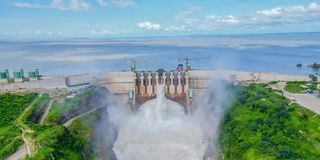
Tanzania is set to inaugurate the Julius Nyerere Hydropower Project (JNHPP) on Saturday, marking a new phase in the country’s power sector. PHOTO | COURTESY
Josephine Christopher is a senior business journalist for The Citizen and Mwananchi newspapers
Mwananchi Communications Limitted
Dar es Salaam. Tanzania is set to inaugurate the Julius Nyerere Hydropower Project (JNHPP) on Saturday, marking a new phase in the country’s power sector after a Sh7.45 trillion investment in a 2,115-megawatt project.
With installed capacity of 2,115 megawatts, JNHPP is already making a significant contribution to the national grid. Energy Minister Deogratius Ndejembi said the project accounted for 44.9 percent of all electricity generated and fed into the grid in the year to May 31, 2026.
The project comes as electricity demand is rising. Peak demand reached 2,199.06MW on February 4, 2026, compared with 1,908.15MW a year earlier, according to the 2026/27 Budget.
For Tanzania, the significance of JNHPP goes beyond adding electricity to the grid. Reliable power is central to the country’s plans to expand manufacturing, attract investment and increase economic activity.
Senior Lecturer in Economics at the Open University of Tanzania Lawi Yohana said the additional electricity could help businesses operate more consistently and reduce costs associated with power interruptions and alternative sources of energy.
“If electricity becomes more available and affordable, production costs will come down. This will make locally produced goods more competitive,” he said.
The project also comes as Tanzania seeks to expand electricity access. According to the 2026/27 Budget, electricity access has increased from 78.4 percent in 2020 to 85.5 percent, while actual connectivity has risen from 37.7 percent to 52.1 percent.
The Government plans to connect 8.3 million new customers by 2030, raising connectivity to 75 percent.
Tanzania National Business Council (TNBC) Executive Secretary Dr Godwill Wanga said the additional generation capacity could support economic growth if accompanied by investment in transmission and distribution infrastructure.
“We need to at least double our transmission capacity if we want to fully utilise the electricity being produced,” he said.
The project could also change Tanzania’s position in the regional electricity market.
Economist and former legislator, Zitto Kabwe said Tanzania’s location between the East African Power Pool and Southern African Power Pool gives it an opportunity to trade electricity with both regions.
With installed generation capacity of 4,646MW against peak demand of about 2,010MW, he said Tanzania could use its surplus capacity to supply neighbouring countries.
"We sit at the junction of the East African Power Pool and the Southern African Power Pool, the only country that can physically connect the two largest regional electricity markets on the continent," said Mr Kabwe, adding: “We must sell power to Zambia, the DRC and Kenya. I see a potential to generate more than $1 billion in foreign exchange from East and Southern African markets,” Mr Kabwe said.
Such exports, he said, could generate foreign exchange while helping finance further energy projects.
The benefits of JNHPP could also extend beyond electricity. Mwalimu Nyerere Memorial Academy Rector Prof Haruni Mapesa said reliable power could support industrialisation and the transition to electric vehicles, potentially reducing dependence on petroleum fuels.
The Government also expects the reservoir, which has a storage capacity of 33 billion cubic metres, to support irrigation, tourism and human water consumption.
The project is therefore being positioned as more than a power-generation facility. Its 2,115MW capacity could provide the energy base for expanding industries, businesses and households while giving Tanzania a larger role in regional electricity trade.
Coast Regional Commissioner Abubakari Kunenge has urged residents to attend the inauguration on Saturday at the project site in Rufiji District.
President Hassan is expected to officiate at the ceremony, which will formally mark the inauguration of the JNHPP.
For Tanzania, the significance of the project will ultimately be measured by how effectively its additional power is converted into investment, production, jobs, exports and wider economic activity.
What needs to be done
Analysts say generating 2,115MW is only part of the challenge. Tanzania must ensure the electricity can be transmitted and distributed efficiently to where it is needed.
Dr Wanga said the country needed to expand its transmission network.
“We need to at least double our transmission capacity if we want to fully utilise the electricity being produced,” he said.
The project’s benefits could extend to other sectors. According to Prof Mapesa, reliable electricity could support industrialisation and the adoption of electric vehicles, reducing dependence on petroleum fuels.
The Government also expects the JNHPP reservoir, with a storage capacity of 33 billion cubic metres, to support irrigation, tourism and human water consumption.
However, Prof Mapesa said environmental risks associated with the project needed to be managed to protect the infrastructure and surrounding ecosystems.
“Environmental degradation must be properly controlled to ensure that the infrastructure established through the project remains safe,” he said.
Register to begin your journey to our premium contentSubscribe for full access to premium content