Wildlife invasion: Compensation delays leave victims in suffering
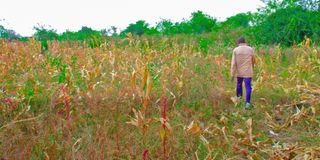
A resident of Nyanungu Village in Serengeti District, Mara Region, Daniel Festo, inspects maize crops destroyed by elephants on his farm in May 2026. PHOTO | PETER SEKELA
Serengeti. Communities living alongside wildlife in Serengeti District, Mara Region, say inadequate protection and delays in compensation are leaving them to bear the consequences of encounters with wildlife, raising questions about how effectively authorities are fulfilling their responsibilities.
Residents of Bokore, Nyanungu and Pakinyigoti villages say wildlife officers are too few and often arrive after incidents have occurred, limiting their ability to prevent damage to crops and property or protect people.
The scale of the challenge is also reflected in compensation claims received by the ministry of Natural Resources and Tourism.
Between 2021 and 2025, the ministry received 4,050 claims from Serengeti District Council relating to incidents involving wildlife. However, of these claims only 1,538 victims had been paid a total of Sh328.881 million.
Another 397 claims, worth Sh85.487 million, were at different stages of payment, while 79 claims worth Sh12.881 million could not be processed because of problems involving beneficiaries’ bank accounts or phone numbers.
The figures show both the extent of the impact on communities and the difficulties in completing the compensation process.
The ministry’s spokesperson, Emmanuel Buhohela, says however that issues about payment of compensation are mostly caused by the fact that victims do not submit adequate details as required by the law.
Mr Buhohela said out of the 4,050 claims submitted, 3,001 victims submitted the details required for compensation, while 1,049 had yet to provide the necessary payment information. Of the claims that met the required criteria, 2,014 were being processed.
“Some victims had provided accounts or phone numbers registered in relatives’ names and therefore needed to register their mobile lines in their own names,” Mr Buhohela said.
Is the compensation enough?
Lawyer Clay Mwaifwani said the problem is not only delays but also the adequacy of compensation.
He said an injured person could receive as little as Sh100,000, while a person left with a disability could receive Sh500,000. In the event of death, compensation could be as little as Sh1 million.
“Our emphasis is that the amount paid is too little. It should be increased to meet people’s needs, especially when they have used their resources to produce crops or lost time working while receiving treatment,” he said.
Mr Mwaifwani said delays were largely administrative and did not necessarily require amendments to the law. He called for the compensation framework to be reviewed to ensure payments can adequately cover medical treatment and support families when victims are unable to work.
The delays and concerns over compensation raise a broader question: who is responsible for responding to wildlife incidents and addressing the losses suffered by affected communities?
What the law says
The Wildlife Conservation Act, 2009, as amended in 2022, assigns responsibilities to conservation authorities. Section 69 requires the director of Wildlife in the ministry of Natural Resources and Tourism to appoint and deploy authorised officers to respond to wildlife incidents in which property is damaged or people are injured or killed.
Section 71 provides for compensation to people killed or injured, as well as those whose crops are damaged by wild animals entering residential or farming areas.
The law therefore establishes both a responsibility to respond to incidents and a framework for compensating people affected by them. Yet residents continue to question the effectiveness and timeliness of that response.
Government response
The ministry says it is taking steps to address both wildlife incidents and outstanding claims.
Mr Buhohela said some delays were caused by victims taking too long to report incidents to district wildlife officers and provide the information required for payment.
Meanwhile, the minister of Natural Resources and Tourism Dr Ashatu Kijaji said in her 2026/27 budget speech to Parliament on May 15 that the government has strengthened measures to address human-wildlife conflict.
She said patrols had been increased through conservation officers and special rapid-response teams. The government is also using the Problem Animal Information System (PAIS) to improve the management of wildlife incidents and accelerate compensation payments.
It is educating communities near protected areas on measures to reduce wildlife entering farms and residential areas
Register to begin your journey to our premium contentSubscribe for full access to premium content