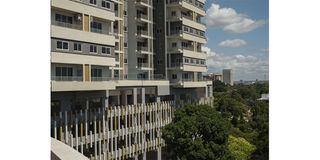
Drive along Mwai Kibaki Road, just off the curve between Mikocheni and Mbezi Beach, and you see it rising — eight towers, assertive, deliberate, unapologetic.
The 711 Kawe Apartments project sits in prime territory. Close to Kawe Beach. Mixed-use. Retail below. Residential above. Lifestyle language everywhere.
They call it a live, work, play model. For the spiritually inclined, it is a short drive to Mwamposa’s church. For the commercially inclined, it is positioned in one of Dar’s most valuable growth belts. For the ambitious, it signals arrival.
This is upmarket urban living. And the prices make that unmistakable. A two-bedroom will set you back half a billion shillings. A three-bedroom, Sh600 million. A penthouse, well over a billion.
The developer isn’t a private luxury firm. Not a foreign investor consortium. It is the National Housing Corporation. Established in 1962, NHC sits on some of the most enviable urban landbanks in the country. Over 3,200 buildings.
Nearly 19,000 rental units. Assets worth about $2 billion. NHC was created to address housing shortages. To build. To rent. To promote ownership. To construct affordable houses for low-income groups. To operate commercially while alleviating housing problems. Public purpose with commercial discipline.
But consider NHC’s projects list: Kawe 711. Morocco Square. Golden Premier Residence. Upanga Redevelopment. Samia Housing Scheme. RAS Kilomoni Villas. Joint ventures. USA River Satellite City. Upanga redevelopment. See the pattern?
It is not accidental. Samia Housing Apartments in Kawe — 560 units are sold out. Apparently, there is a demand for what NHC provides. The question is: demand from whom?
For some reason, construction costs in Tanzania keep on rising. Imported finishes are expensive. Financing costs are expensive. Prime land in Kawe is not cheap. High-rise infrastructure pushes up per-square-metre pricing. But even with those realities, Sh600 million for a three-bedroom apartment in Dar should raise eyebrows.
In Nairobi, that budget can secure a luxury apartment in Kilimani or Westlands. In Johannesburg, it opens doors in Sandton. That gives you options even in Dubai. So, when someone writes a cheque for Sh500–700 million in Dar, knowing it could fund a custom-built bungalow, offshore property, or income-generating commercial real estate, the real question becomes: Who is buying these units? Is it senior executives? Business owners? Political elites? Diaspora Tanzanians? Whoever they are, these are not underserved buyers. Many private developers would gladly serve that market. When a public housing agency competes for them and completely ignores the low-cost housing market, it must explain why.
Yes, NHC is permitted to operate commercially. It can develop for sale. It can enter joint ventures. It can maximise land value. Building premium projects isn’t irrational. The discomfort is not economic. It is institutional.
Tanzania still faces a massive housing deficit – about 3.5 million units by some estimates. Informal settlements expand faster than formal supply. Mortgage penetration remains limited. Affordable housing gaps persist in every major city.
In that context, when a state housing corporation builds billion-shilling penthouses, we must wonder what is happening. Because public institutions are judged differently from private developers. If a private firm builds luxury apartments, we don’t care. But when a public corporation does so repeatedly, the question of purpose arises.
So, we ask: where are NHC’s affordable houses? Yes, they have rental units inherited and maintained. Yes, in theory, commercial profits can subsidise lower-income housing. But the visible momentum — the flagship projects, the branding, the skyline statements — is premium-heavy. What is wrong with expanding access, reducing affordability gaps, and supporting middle- and lower-income households?
Tanzanians are building houses everywhere. Far from their cities, over decades, using costly options. Why don’t we see hundreds of thousands of units near CBDs, deliberately structured for first-time owners? Why are projects near economic centres reserved almost exclusively for those who can write eight-figure cheques?
Other countries have chosen differently. Brazil’s Minha Casa, Minha Vida, launched in 2009, has delivered more than 4.4 million housing units. Chile’s programmes have delivered over 1.5 million units. South Africa has produced more than 2.1 million homes. Those were not luxury skylines. They were policy choices.
So, others do mobilise land, capital, and political will to build at scale for ordinary citizens. Why are we concentrating so much effort on building for the rich?
That is a dereliction of duty.
No wonder we don’t see starter homes in Tegeta. Entry-level flats in Mwanza. Mass urban housing schemes for first-time buyers in Arusha. In short, we have abandoned the very purpose for establishing NHC to build billion-shilling penthouses. That signals a serious shift in how NHC – and their political masters – see their responsibilities to the public. Kawe 711 is impressive. Prime location. Strong pricing discipline. Market validation through sales. But beyond the architecture lies something bigger— loss of purpose. Because in the end, the debate is not about square metres but about what kind of housing institution Tanzania needs.
As it is, NHC isn’t what Tanzanians need.
Charles Makakala is a Technology and Management Consultant based in Dar es Salaam