The bus was ‘overloaded’ with 'fear' and 'panic' when it tilted

What’s FRASH? How about MOMERY card? Neither of the words that we’ve capitalised exists in any of the wordbooks in our possession. That’s why we can confidently say the artist who handled this signboard was commissioned to paint FLASH DISK, also known as USB flash drive, thumb drive or memory stick. As for “momery card”, we aver the signwriter just got mixed up and painted that instead of MEMORY card. Trust signwriters! PHOTO | AMS

What you need to know:

  • Readers aren’t being told the name of the councillor of Puni Ward; why?  And, there’s just one CONCERN that the residents of Puni Warn needed to raise with their councillor—lack of a dispensary in Bayubi Village. Not concerns! 

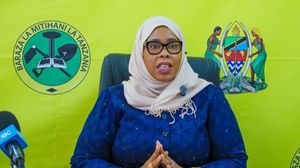
Bongo’s huge and colourful broadsheet of Monday, December 29, 2025 ran a photo on Page 1, whose caption was penned thus: “Hamisa Mwanaheri, a resident of Buyubi Village in Puni Ward, Shinyanga Region, speaks during a meeting convened by their councillor over the weekend to raise CONCERNS OF LACK of a dispensary in the VILLAGE, THE situation which HAD BEEN difficult to MANAGE EMERGENCE medical services.” Phew!

Readers aren’t being told the name of the councillor of Puni Ward; why?  And, there’s just one CONCERN that the residents of Puni Warn needed to raise with their councillor—lack of a dispensary in Bayubi Village. Not concerns! 

“…THE situation which HAD BEEN difficult to MANAGE emergence MEDICAL SERVICES? Word flow is problematic here. Let’s do a rewrite and clear the mess: “…A (not the) situation which MADE IT difficult to PROVIDE (not “manage”) EMERGENCY (not “emergence”) medical services.”

Another story on the same page has been given this headline: ‘…LINKS between diabetes, liver cancer HIGH.’ If this wasn’t a headline, it would’ve be written as: “Links between diabetes and liver cancer are high.” Nonsensical, isn’t it?

Why, we cannot talk of “high links” (connections), so we quickly dismiss the headline as semantically erroneous. You cannot qualify the noun “link” with the adjective “high.” However, saying “close links” would be acceptable.

We move on to read the intro of the story, which goes thus: Medical experts at the Kilimanjaro Christian Medical Centre (KCMC) say that persons living with diabetes face HEIGHTENED RISKS of developing liver disease, tied with liver cancer.”

The verb “heightened” is associable with the adjective “high”. And we can correctly talk of high risks. We highly suspect our scribbling colleague got entangled in our people’s perennial mix-up of the sounds R and L. Of course, when he penned LISKS (for risks), we assume, his spellchecker rejected it and provided for him “LINKS.” That’s AI for you—damn!

Page 3 of the broadsheet has a story whose headline reads: ‘Government approves MODERN RECONSTRUCTION of Singida’s central market BLAZE.’

It’s hard to decipher what the headline scribbler is trying to say here, for the reader is forced to ask questions like, “What’s modern reconstruction?” If you ask us, reconstruction is just reconstruction, anything beyond it would just be detail, which shouldn’t bother a headline writer. 

Saying “reconstruct a blaze,” is uttering an expression that’s simply ridiculous! Why, the noun “blaze” means a large or fiercely burning fire. Now, how on earth do you rebuild a fire?

It appears like the headline scribbler meant to write something like, ‘Government approves construction of new market following blaze.’ We shouldn’t bother with details when penning headlines.

Still with the huge and colourful broadsheet, in which there’s a Page 5 story entitled, ‘15 survive bus accident in Dodoma…’ A relative of one of the survivors is quoted as purportedly saying: “The bus was OVERLOADED with FEAR and PANIC when it tilted…” Duh!

Finally, let’s share a familiar gem from Bongo’s senior-most broadsheet of Saturday, January 3, whose Page 3 is carrying a beautiful photo of four family members, one of whom is a graduand.

The caption writer compliments the photo with the following caption: “TSN ‘staff’ (Mr) AL poses for a souvenir photo with family members as they celebrate the pre-school graduation of his daughter JA in Dar es Salaam recently.”

It’s quite curious that our people, including scribblers (who should know better) insist on using the noun STAFF to refer to an individual. The teacher in us tells us to expose this falsity over and over again until, as they say, everybody gets it right.

The noun staff means “ALL the people employed in a particular organisation.”

Which is to say, Mr AL is not TSN staff; rather, he a TSN staff MEMBER.

Ah, this treacherous language called English!

Send your photos and linguistic gems to email [email protected] or WhatsApp on Tel No 0688315580