The East African Community (EAC) is facing a financial crisis that threatens its operations, credibility, and long-term ambitions. This is not an unforeseen economic shock. It is the result of political choices made without fiscal discipline or institutional enforcement. The crisis is serious – but self-inflicted.
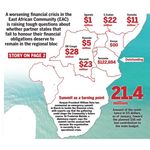
As of February 2026, arrears owed to the Community exceed $89 million. More than 90 percent is owed by the Democratic Republic of the Congo (DRC), Burundi, South Sudan, and Somalia. Kenya and Tanzania, at this point, have paid their contributions in full. That imbalance exposes a structural weakness at the heart of the organisation.
Even as arrears mounted, the EAC expanded. The admission of South Sudan, the DRC, and Somalia was hailed as a bold step toward regional integration. In theory, enlargement can strengthen markets, enhance geopolitical influence, and broaden opportunity. In practice, expansion without enforceable fiscal standards has weakened the institution from within.
The vulnerabilities of new members were never hidden. Some face persistent instability, conflict, heavy debt, or revenue shortfalls. The problem is not their economic struggles; it is that the EAC admitted them without credible mechanisms to guarantee payment of contributions. Integration became aspirational rather than conditional.
Earlier commentary on EAC enlargement highlighted the risks of admitting states facing chronic fiscal instability and political fragility – a warning that now echoes in the Community’s mounting arrears. The current crisis confirms that enlargement without enforceable standards carries real consequences for institutional credibility.
Regional organisations do not run on symbolism. They run on rules, contributions, and shared responsibility. When payments are treated as optional, institutional erosion follows. Over time, non-payment becomes normalised, and the burden falls disproportionately on compliant members.
The EAC Treaty anticipated this. Article 146 allows suspension of any Partner State that fails to meet obligations for eighteen months. Yet enforcement has been largely symbolic. Chronic non-payment has triggered no meaningful consequences.
Domestic pressures in member states are real. In South Sudan and Somalia, civil servants have gone unpaid for months. Governments facing unpaid wages understandably prioritise domestic stability. But regional integration is not cost-free.
Strategic incoherence worsens the crisis. The EAC continues to pursue ambitious goals – a common market, monetary union talks, and large-scale infrastructure coordination – while tolerating chronic arrears in its core budget. A Community unable to fund its secretariat cannot credibly champion deeper economic integration.
Policy correction is unavoidable. First, enforcement must be credible. Article 146 cannot remain symbolic. Phased penalties, temporary voting restrictions, or structured repayment plans should be automatic and predictable rather than politically negotiable.
Second, the contribution formula should be reviewed. Adjustments may be necessary if assessments do not match economic realities – but reform cannot become an excuse to delay payments indefinitely.
Third, accession criteria must tighten. Future enlargement should require demonstrable fiscal capacity and a verifiable record of honoring obligations in other regional or multilateral institutions. Expansion driven solely by political symbolism risks further weakening the Community.
Finally, arrears recovery must be a strategic priority. Structured repayment agreements tied to measurable benchmarks would signal seriousness and restore confidence among compliant members.
The EAC stands at a crossroads. It can continue expanding while absorbing financial instability, or it can reaffirm that treaty obligations matter and that integration requires discipline as well as ambition.
The current crisis is a warning. If leaders choose enforcement over accommodation, it could become a turning point. If not, the threat will extend beyond finances – it will become institutional.