Young people are important in the political life of any country, and especially in African countries, where young people (aged 30 and below) by far exceed half of the population. It is unjustifiable and unfair if such a large demographic group is not properly represented in the political life of the state.
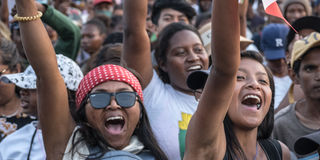
When acts of extreme cruelty and oppression happen, most people get concerned with the side of those on the receiving end. This is a typically normal and logical human response, to focus on those who are affected before giving a thought to the perpetrators.
In the political dynamics of most African countries, cruelty has almost become next to nature, people being subjected to the extremes of oppression just to suppress and silence their opinions and cries for justice and fairness under the ideally unsurpassable rule of law.
Young people are important in the political life of any country, and in a special way in African countries, where young people (aged 30 and below) by far exceed half of the population of these countries. It is unjustifiable and unfair if such a big demographic chunk is not properly represented in the political life of the state.
For the most part, young people of today, especially the Generation Z, have evolved differently politically, demanding in their own ways, using the free digital space, a society that is fair, just and progressive. Unlike generations before, which had a do-or-die loyalty to political parties, the Gen Z young people today appear to favour a better agenda regardless of political parties; what experts call “Issue-based mobilization” (Cf. The Oslo Centre, A Research Report on Youth Political Accountability in Kenya, 2025).
With recent happenings in some countries where the government machinery has responded with cruelty to the demands of these young people, over issues that were/are obvious, while the injustice is clear, the damage is beyond the bloodshed.
On the side of the perpetrators of such cruelty, some young people participate in the power fantasy of the oppressors by being agents for such cruelty. In philosophies of causality, human agency is a “material cause,” meaning they as well have responsibility for such acts of cruelty, given their nature, which is endowed with not only intelligence, but also a conscience capable of refusing cruelty and injustice.
The fact that the perpetrators may not be apprehended, given the corruption of the justice parastatal, does not mean no harm is done to society. In fact, the society will harbour the wound of living with cruel people as long as they last; it is an even bigger wound if these people are young.
Politics can cause deep wounds to society through acts of corruption, but society can survive these. There have always been corruption and mismanagement in our African countries. However, the corruption of young people, making them inherit the cruelty and heartlessness of oppressors and corruption kingmakers, is a harm beyond recovery. Cruelty in these young people become next to their nature, and a tool that metastasizes as they go on in life.
With thousands or tens of thousands of young people being involved in the cruel agendas of ruling parties across Africa, do we expect peaceful solutions to political problems anytime in the future? Cruel solutions are easier as compared to progressive dialogue that, in turn, has the power to not only heal hearts, but also heal conversations, and hold people accountable for what they do/did. Once one has tasted the ‘sweetness’ of cruel solutions, especially where lives are taken, one cannot tolerate dialogue and fairness anymore.
While young people are becoming more and more politically active, it is important to seek more meaningful solutions to existing problems and not to respond with cruelty. Cruelty affects the entire generation; massacres become part of the collective memory and, as such, part of the collective trauma of that generation. Such trauma, according to experts, can last up to 10 generations, both as a story as well as an existential reality.
It is a sad state where the majority of young people have traumatic experiences caused by politics, such as witnessing others being tortured, shot, kidnapped, disappeared, unjustly jailed, etc., and in worst cases, witnessing fellow young people being killed for political causes. It causes numbness, and in the worst case, it gives an extraordinary courage, given the loss of the sense of value for one’s life, having seen how another’s life is laid waste.
It is time we all take social responsibility to awaken the sense of value, especially among young people who have made themselves partisan to an oppressive agenda. In all our African countries, the side that oppresses can be easily pointed out. We ought to encourage young people to really be independent and make decisions by conscience, rather than desire for money, the handiest bargain in the hands of the oppressors.
Nonetheless, the struggle against injustice cannot be won by standing on the grey areas of political indifference. It adds value to stand firm on the side that serves the social good, regardless of the dangers, than to be mercenaries for the oppressive forces. The latter is a betrayal of the lives and dreams of fellow young people.
Shimbo Pastory is an advocate for positive social transformation and a student at the Loyola School of Theology, Ateneo de Manila University, the Philippines.