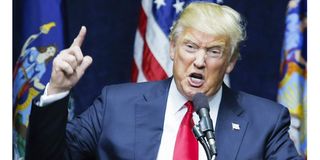
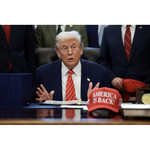
If the dictionary definition of dictatorship is applied strictly, then one could argue that the current President of the United States, Donald Trump, fits the description.
The Merriam-Webster Dictionary defines dictatorship as a form of government characterised by absolute, unrestricted power held by a single individual or small group, often enforced through repression, the military and the absence of constitutional limitations. Measured against that yardstick, troubling questions arise.
Consider the reported use of military and federal law enforcement to confront domestic protests, threats directed at political opponents, pressure exerted on sections of the press and repeated attempts to override traditional checks and balances. These are not minor institutional quarrels; they go to the heart of how power is exercised and restrained.
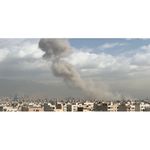
More alarming are foreign policy decisions taken without clear congressional approval. Reports from Washington indicate that lawmakers have sought bipartisan war powers resolutions to limit the president’s authority to engage militarily with Iran. That such measures are even contemplated in the world’s most established democracy signals deep unease within America’s own political establishment.
Some may ask why an African writer should concern himself with alleged authoritarian tendencies in a wealthy nation when Africa, and Tanzania in particular, faces pressing domestic challenges. The answer is simple: when the leader in question presides over the world’s largest economy and most powerful military, his decisions do not stop at national borders.
Unlike many African strongmen whose miscalculations largely harm their own citizens, a US president wields influence that can shake global markets, redraw diplomatic alliances and alter the cost of living thousands of kilometres away. When tensions escalate in the Middle East, oil markets react instantly. Shipping insurance premiums rise. Supply chains tighten.
The consequences are not abstract. A rise in global fuel prices triggered by military confrontation does not punish policymakers alone. It affects transport Bodaboda operators in Dar es Salaam, small scale traders in Nairobi and artisanal miners and farmers in Kampala. Within weeks, pump prices climb. Food becomes more expensive. Inflationary pressure builds. Ordinary citizens pay for decisions taken far beyond their shores.
The danger of authoritarian impulses in such a powerful office is therefore global. When force is deployed on what critics describe as questionable grounds, it risks destabilising already fragile regions. The Middle East has endured decades of conflict; further escalation threatens not only regional security but international economic stability.
There is also a moral dimension. When a superpower appears to apply one standard to its own actions and another to the conduct of rivals, it weakens the credibility of international law. How can Washington condemn aggression elsewhere while defending its own interventions as acts of self-defence? Such double standards erode trust in the rules-based order the United States has long championed.
Perhaps most troubling is the precedent set for smaller nations. If the leader of the world’s foremost democracy stretches constitutional boundaries in the name of national greatness, leaders in Africa, Asia and Latin America may feel emboldened to do the same. They can point to Washington and argue that decisive, unchecked power is justified when framed as patriotic necessity.
In that sense, the global implications extend beyond economics and warfare. They reach into governance norms. America has historically claimed moral authority in promoting democracy and human rights. That authority diminishes when its own leadership is accused of sidelining institutional restraints.
None of this suggests that the United States lacks resilient institutions. Congress, the courts and civil society remain active arenas of contestation. The very debate over war powers illustrates that checks still exist. Yet the fact that such guardrails must be repeatedly invoked underscores the fragility of democratic norms under pressure.
When immense military and economic power is concentrated in the hands of one individual, the world cannot afford complacency. Whether one agrees with his policies or not, the central question remains: how much unchecked authority should any leader possess?
History teaches that power without restraint rarely ends well. When that power sits in the Oval Office, its reach spans continents. The stakes, therefore, are not merely American. They are global and every global citizen has the right to question the direction that the world was taking.