A life that taught the world to listen

Frederick Kimaro, JGI Tanzania Executive Director.

By Regan Richard

On the morning of Friday, January 23, 2026, the National Museum Hall in Dar es Salaam felt different. The air was heavy, not with grief alone, but with memory.

It was the kind of stillness that settles when people gather not merely to mourn, but to remember a life that changed them.

Scientists stood beside villagers. Diplomats sat alongside students. Conservationists shared space with children who had grown up knowing the name Jane Goodall as naturally as they knew the forests and hills of western Tanzania. They had come to honour a woman whose life blurred the boundaries between science and compassion, between humanity and nature, and between

Tanzania and the wider world. This was not a ceremony of endings. It was a quiet affirmation that some lives continue long after every breath has left the body.

James Lembeli, Board Chairperson, JGI–Tanzania.

Tanzania, the place that shaped her soul

Opening the memorial, Freddy Kimaro, Executive Director of the Jane Goodall Institute Tanzania, reminded the gathering that Dr Jane Goodall changed the world not by conquering nature, but by listening to it.

Her work, he said, revealed that science is not a cold act of measurement, but a deeply human pursuit, one grounded in empathy, patience and care. Though her influence spanned continents, institutions and generations, Tanzania held a place in her heart unlike any other.

Gombe was never just a research site. It was personal. It was spiritual. It was where her understanding of the natural world and of herself took shape.

As Mr Kimaro looked across the hall, filled with young and old, women and men, scientists and community stewards, he pointed to what he described as the truest reflections of her legacy, not only the forests she helped protect, but the people she inspired. People who found purpose, courage and hope through her life’s work.

When a researcher became an activist

That living legacy was carried forward in the reflections of Emmanuel Mtiti, Director of Programs at the Jane Goodall Institute Tanzania, who spoke on behalf of communities unable to attend.

Dr Goodall, he recalled, arrived in Tanzania as a researcher. But one moment changed the course of her life. After attending a workshop on environmental challenges, she flew over Gombe and witnessed, from above, the scale of deforestation surrounding the park. The forest she had studied for decades was becoming isolated, vulnerable and fragile.

That sight transformed her. She realised that conservation could not succeed by focusing only on wildlife while ignoring the people who lived alongside it. From that understanding emerged TACARE— Take Care—a community-centred conservation model rooted in responsibility, dignity and shared ownership.

Mama Getruda Mongella, one of the JGI–Tanzania Board Members, with some of her family and friends.

Mr Mtiti spoke gently, yet vividly, of what that philosophy achieved. In Kalinzi village, farmers improved their coffee production and livelihoods. In Kazuramimba, land ownership certificates restored security and pride. In TACARE Villages, Mwamgongo microcredit initiatives enabled families to send their children to school. In Kidahwe, family planning strengthened health and household resilience. In Ilagala, communities worked with scientists to build local strategies for climate resilience.

These were not statistics, he said. They were lives. And they were proof that Dr  Goodall’s vision was never about forests alone, but about people finding their place within nature rather than apart from it. She knew, he reflected, that one day she would no longer be present. But what mattered for her was that she would leave behind people capable of carrying the work forward.

A gift called exposure

For Dr Nazar Nicholas, a founding member of the Roots & Shoots programme, Dr Goodall’s influence reached into the most personal corners of his life. The greatest gift she gave him, he said, was exposure, the opening of doors he had never known existed. Through her, he met people from across the world and learned that conservation was not a local struggle, but a shared human responsibility.

She once asked him how he would feel meeting people from many different countries. His answer, he recalled with a smile, captured the spirit she nurtured, it would feel like meeting family.

Reflecting that same sense of belonging and continuity, the gathering also marked the formal launch of the Roots & Shoots Alumni Network, a platform designed to reconnect past participants, strengthen lifelong bonds, and sustain youth leadership inspired by Dr Goodall’s vision.

Inspired by her belief in dialogue and youth leadership, Dr Nicholas further proposed the establishment of an annual Jane’s Legacy Debate, a space for reflection, challenge and renewal around the values she championed.

A life that refused to rest

Dr Anthony Collins, Baboon Research Director at the Jane Goodall Institute, offered a portrait of a woman driven not by obligation, but by purpose. The first decades of her career, he said, were defined by her pioneering work with chimpanzees. It was only in the second half that she became the global voice of environmental advocacy, youth mobilisation and hope.

But in both these stages, she worked tirelessly with the same calm commitment to achieve her goals. Even in Gombe, a place of quiet and renewal, she resisted rest. There were messages to record, deadlines to meet, stories of hope to share. She worked relentlessly, not because she had to, but because she believed the world needed to hear them. She was determined to work, until she could no longer.

And so on the final day of her life, Dr Collins recalled, she worked a full day. That night, work done, she passed away. It was devastating for those who loved her. Yet in a way, it reflected the life she had chosen, a life devoted entirely to making the world kinder, fairer and more compassionate. Her childhood dream of animals had grown into a mission for all living things. That mission, he said softly, now belongs to everyone else.

A Grandmother’s Wisdom, A Nation’s Promise

The global reach of Dr Goodall’s legacy was reflected in tributes from international partners.

Suzana Ngogi Namondo, United Nations Resident Coordinator in Tanzania, described her as one of the rare individuals whose work fundamentally reshaped how humanity understands itself. Through patience and humility, Dr Goodall challenged the idea that humans stand apart from nature. Instead, she reminded the world that people are part of it.

What made her legacy extraordinary, Ms Namondo said, was that it did not remain confined to research. It moved into communities, transforming knowledge into action and concern into responsibility.

Dr Goodall understood something the world is still learning, conservation cannot succeed without communities, and development cannot succeed without protecting nature.

That principle now sits at the heart of the United Nations’ work in Tanzania, from climate resilience and biodiversity protection to youth empowerment and sustainable livelihoods.

At a time when the scale of environmental loss can feel overwhelming, her message remains urgent and reassuring - each person matters, and hope is a choice we make through action.

A grandmother’s quiet wisdom

The most intimate moments of the ceremony arrived through family voices and poetry, when public tribute gave way to private remembrance. Merlin Van Lawick, Communications and Partnerships Associate at the Jane Goodall Institute and Dr Goodall’s grandson, delivered a eulogy first read at her funeral. He spoke not as a professional, but as a grandson recalling a woman who shaped his childhood and worldview. He told of days spent with her in Gombe, where she would slip away alone to a quiet place of peace, returning with stories of insects, birds and small dramas unfolding in the forest. Through those simple rituals, she taught her family that life is an interconnected tapestry, rich with wonder for those who slow down, observe closely and listen patiently.

She was not only a global icon, he said. She was a mentor, a guide and a constant source of gentle wisdom. Often speaking of her “next great adventure,” she approached death with curiosity rather than fear, believing that discovery itself was life’s greatest gift.

The emotional current deepened when Angel Van Lawick followed with a reading of Dr Goodall’s own Prayer for World Peace, drawing the hall into a moment of quiet reflection.

Then came a personal tribute from Georgina Magesa, whose poem carried the spirit of Dr Goodall in soft, hopeful lines. Speaking of forests, children and the future, her verses reminded mourners that Jane Goodall did not merely study nature, she loved it. That hope, Georgina said, does not depend on age, only on courage.

Her poem traced Dr Goodall’s lifelong message, that animals are not objects but lives, that what we do to the Earth, we do to the future, and that real change begins in small hands and brave hearts. By the time Georgina finished, it was clear that Dr Goodall’s legacy had moved beyond memory, it had become a quiet promise carried forward by a new generation.

A Daughter of Tanzania

From the diplomatic community, Anna Wilson, Development Director at the British High Commission, reflected on how Dr Jane Goodall’s philosophy continues to guide conservation efforts across the world.

She reminded mourners that protecting wildlife in isolation is never enough. “We have learned from Dr Jane that conservation must walk hand in hand with human dignity,” she said. “If we fail to protect livelihoods, create opportunity and respect local communities, then our efforts will always fall short.”

Her words set the tone for a deeper reflection on Dr Goodall’s enduring bond with Tanzania.

Speaking on behalf of the Government and the Ministry of Natural Resources and Tourism, Dr Noel Lwaga, Director General of the National Museum of Tanzania, described Dr Goodall not as a visiting scientist, but as a humble learner, a trusted partner and, above all, a cherished friend of the nation.

Merlin Van Lawick, one of Dr. Jane Goodall’s grandsons and a Conservation Science Communications Specialist at the Jane Goodall Institute (JGI).

“She came to study chimpanzees, but she stayed to understand people,” he said. “Through her tireless work, Gombe was placed firmly on the global map of conservation science.

Today, her legacy lives on in our national policies, in community-led conservation, and in young people inspired through Roots & Shoots.”

Dr Lwaga reaffirmed the Government’s continued commitment to stand with the Jane Goodall Institute, protecting Gombe’s forests and supporting conservation initiatives across the country. In spirit, he said, Dr Goodall became truly a daughter of Tanzania, a woman whose compassion crossed borders and whose vision reshaped generations.

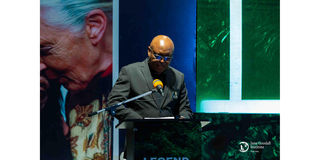
As the ceremony drew to a close, Board Chair Mr James Lembeli rose to deliver his final reflections, gently drawing together the emotions of the afternoon.

“Dr Jane was not only a renowned scientist and conservationist,” he said. “She was a teacher. A mentor. Someone who believed deeply in the power of individuals, especially young people to create change.”

He spoke of a world facing climate change, biodiversity loss and growing social challenges, and reminded those gathered that Dr Jane’s life was a quiet call to action.

“She taught us to protect what is fragile, to respect science and indigenous knowledge, and to treat all living beings with compassion. Above all, she taught us not to lose hope.”

Turning to the young people in the room, his voice softened.

“Dr Jane believed in you,” he said. “She trusted that your voices, your choices and your courage would shape a better future. Never forget that even the smallest action can make a meaningful difference.”

In his closing words, Mr Lembeli urged everyone to leave not only with memories, but with purpose.

“May we strive to live by the values she embodied curiosity, humility, courage and respect for life,” he said. “Let us carry her hope forward through conservation, community empowerment and ethical leadership.”

And with that, he offered a final farewell.

“May her soul rest in eternal peace.”

A legacy that continues

As the hall slowly emptied and the afternoon light returned to the museum corridors, one truth lingered quietly but firmly.

Dr Jane Goodall’s life reminds us that hope is not passive. It is action. It is care. And it is responsibility passed from one generation to the next.

In Tanzania, where her journey began, that responsibility remains alive rooted in forests, carried by communities, and entrusted to the future.