d.light’s strategic role in creating jobs, transforming lives and driving Tanzania’s clean energy agenda
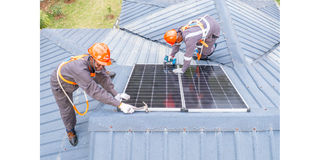
Technicians from d.light Tanzania Limited installing solar panels at one of the company’s customers’ homes.
For decades, the flicker of a kerosene lamp was the only source of light for millions of households across rural Tanzania. While it provided a dim glow, it came with a heavy price: toxic fumes, frequent fires, and a significant financial burden on the country’s most vulnerable families.
Today, that narrative is shifting rapidly. At the heart of this transformation is d.light Tanzania Limited, a global social enterprise that has turned solar energy from a luxury into a life-changing tool for over 1.5 million Tanzanians since 2019.
d.light’s evolution can be summarized in three key stages; Initial focus (2007–2013) started as a designer and manufacturer of simple, low-cost, durable solar lanterns, rapidly building a wide distribution network in East Africa, India, and Southeast Asia.
In 2014, the company made a pivotal shift by introducing the Pay-As- You-Go (PAYG) financing model and comprehensive energy solutions and the final stage is to expand its offerings from basic lanterns to comprehensive Solar Home Systems (SHS) and appliances.
A vision born from crisis
The story of d.light did not begin in a boardroom, but in a small village in Benin, West Africa. In 2007, co-founder Sam Goldman witnessed a tragic accident where a neighbor’s son was severely burned by an overturned kerosene lamp.
This moment of crisis sparked a mission: to eliminate hazardous kerosene lighting and replace it with safe, affordable, and sustainable solar solutions.
Founded as a Stanford design project, d.light spent its early years perfecting rugged, portable lanterns like the Nova and S250. However, the company soon realized that technology alone wasn’t enough; the true barrier to clean energy was affordability.
This realization led to the 2014 introduction of the Pay-As-You-Go (PAYG) financing model, a fintech innovation that allowed low-income families to pay for solar systems in small, daily installments via mobile money.
Employees of d.light Tanzania Limited delivering the company’s products to one of the villages in the country.
The Tanzanian chapter: Beyond just lighting
While d.light has a global footprint impacting over 210 million lives, its journey in Tanzania has been particularly impactful. Since establishing nationwide operations in 2018, the company has expanded its reach across 24 regions and five zones.
The CEO of d.light Tanzania Limited, Moses Cliff emphasizes that the company’s success is not measured in units sold, but in the measurable change brought to the community.
“Our vision is a story of impact,” says Cliff. “When people read about d.light, I want them to see more than just a light bulb. They should see the jobs we have created, the businesses we have supported, and the lives we have transformed. Impact is our primary success metric,”
Cliff notes that while many associate solar power with rural areas, the company’s influence is felt even in urban centers. “People in the city might think this doesn’t concern them, but d.light provides employment opportunities every day to people in both urban and rural settings. We are building the economy while we provide energy.”
From ‘Kibatari’ to smart home systems
The evolution of d.light’s product line reflects its commitment to meeting the diverse needs of Tanzanians. Ummi Marealle, the National Training Manager for d.light Tanzania Limited, explains that the company’s journey began with simple replacements for traditional lamps.
“We have products that transformed lives because they were designed to replicate what people already knew, but in a cleaner way,” Ummi explains. “We have a product we affectionately call the ‘kibatari’ (the S3), which was the first to really start replacing hazardous lamps in schools and homes. It was the original before the market was flooded with imitations.”
From those humble beginnings, d.light has scaled up to comprehensive Solar Home Systems (SHS). These systems now power 32-inch and 40-inch televisions, fans, and even provide charging hubs for multiple devices.
In February 2026, the company set a new industry standard by introducing a five-year warranty on its Solar Home Systems and invertors, the first of its kind in the off-grid solar sector.
“We want our customers to enjoy peace of mind everyday,” Ummi says. “This warranty proves that our products are not just affordable, but durable. We are here to service them for the long haul, supported by a network of field technicians and service centers across the country”
Economic empowerment and the ‘last mile’
One of d.light’s most significant contributions to Tanzania is its massive distribution and support network. The company currently engages over 10,000 agents, with a core network of 1,000 active agents and over 200 dedicated service teams.
This “last-mile” infrastructure ensures that even the most remote villages can access clean energy and technical support. The economic ripple effect is profound. Agents have used their earnings from d.light to build homes, purchase vehicles, and send their children to school.
For small business owners, such as tailors or shopkeepers in off-grid areas, reliable solar light means they can stay open longer, increasing their income by up to 83% in some cases.
“We are empowering women by offering them roles as solar technicians and reducing the daily burden of fuel collection,” Ummi notes. Furthermore, the transition to solar saves the average household approximately $150 over five years compared to the cost of kerosene and batteries.
Innovation and the future: Clean cooking and urban backups
Looking ahead, d.light is moving beyond lighting to address other critical national issues, specifically clean cooking and urban energy stability. As Tanzania intensifies its national clean energy agenda, d.light is preparing to launch induction cookers that use high-efficiency technology.
“We are entering the clean cooking space with induction plates that are safe, clean, and crucially available through our PAYG model. This will allow more families to move away from charcoal and firewood, protecting both their health and our forests,” says Ummi.
For urban dwellers facing grid instability, the company is also rolling out smart inverter backup systems. These systems provide seamless power during outages, ensuring that businesses and homes can remain productive.
“Our future involves expanding our energy portfolio to include backup systems and appliances that work on both solar and grid power,” Cliff notes.
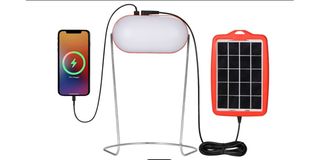
One of the modern multi-functional solar devices manufactured by d.light Tanzania Limited. The device can be used as a lamp, for charging mobile phones, and for powering a radio.
A partner in national development
d.light’s operations are closely aligned with Tanzania’s National Energy Policy and its commitments to climate mitigation. By displacing fossil fuels, the company’s products have helped offset millions of tons of CO2 emissions globally, contributing to a greener future for the planet.
The company’s “Atlas” platform, a cloud-based real-time account management system, exemplifies how technology is being used to bridge the gap in financial inclusion. By providing a digital credit history through PAYG payments, d.light is helping many “unbanked” Tanzanians enter the formal financial system the “solar revolution” led by d.light is about more than just technology; it is about dignity, safety, and opportunity.
By listening to the needs of the “last-mile” customer and backing their products with industry-leading warranties and local support, d.light has cemented itself as a cornerstone of Tanzania’s journey toward sustainable development.