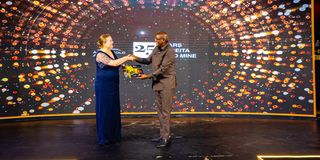
Lizelle Marwick, Chief Legal Officer, AngloGold Ashanti, and GGML Board Chair (left), hands over the ‘Stori za Dhahabu’ legacy book during the 25th Anniversary Gala held at the Hyatt Kilimanjaro in Dar es Salaam on 30 January 2026.
As Tanzania works toward its development goals and broader economic ambitions, the contribution of the private sector is becoming more visible in everyday life. Mining is one of the sectors where that contribution is especially tangible.
Over the past 25 years, Geita Gold Mining Limited (GGML), a subsidiary of AngloGold Ashanti and one of the country’s largest gold producers, has built a reputation for showing how large-scale mining can be carried out responsibly, with attention to people, progress, and long-term value.
GGML’s story is centred on partnerships with government, steady investment in local skills, consistent contributions to national revenue, and the gradual shaping of communities around Geita.
After more than two and a half decades of operation, that experience continues to influence how mining is understood within Tanzania.
Marking 25 years of partnership
The Government formally acknowledged GGML’s contribution during a high-level gala dinner held at the Hyatt Regency Dar es Salaam, The Kilimanjaro, on January 30, 2026 to celebrate the company’s 25th anniversary.
Speaking on behalf of the Government, the Deputy Minister for Minerals, Dr. Steven Kiruswa described the company as an example of what responsible mining can look like when it is grounded in cooperation.
“GGML has shown that mining can be a powerful driver of economic growth when conducted responsibly and in partnership with government and communities,” he said.
The event brought together senior government officials, private sector leaders, members of the diplomatic corps, and other stakeholders whose work has shaped Tanzania’s mining sector over the years. The diversity of people in the room reflected the reality that mining, at its best, is a collaborative effort.
The Acting General Manager at GGML, Mr Duan Campbell (centre), hands over a commemorative Sh 50 million dummy cheque to the Geita Regional Commissioner, Mr Martine Shigela (third right) in the presence of Bishop Flavin Kasala of the Catholic Diocese of Geita, Sister Maria Lauda, Manager-Moyo wa Huruma Orphanage Centre and other representatives from the organisations supporting the orphanage.
Stori za Dhahabu: Placing people at the centre
The celebration’s theme was centred on Stori za Dhahabu which translates to ‘the Golden Stories’ a collection of narratives that document how 25 years of mining intersect with individual lives.
Guests watched the premiere of a documentary tracing the mine’s journey in northwest Tanzania and explored an augmented reality legacy book blending written testimonies with digital storytelling where beneficiaries speak in their own voices.
Simon Shayo, Vice President of Sustainability and Corporate Affairs for AngloGold Ashanti, Africa, reflected on that approach. His own involvement with GGML began 15 years ago, working closely with communities.
“Twenty-five years ago, the story of Geita Gold Mining Limited began with a belief,” he said, adding that, “A belief that mining, if done responsibly, could help build futures and transform lives above the ground. Tonight is about listening to the stories that have grown from that belief.”
In development discussions, impact is often reduced to inputs and outputs understood through the number of classrooms built, projects funded, and tonnes processed. Stori za Dhahabu connects those investments to lived experience.
Skills development
Within Stori za Dhahabu, employment and enterprise are not presented solely through aggregated workforce data, but through the experiences of individuals whose professional and personal trajectories have developed alongside the mine.
Among those featured in the documentary and legacy publication is Joachim Lusana, one of the longest-serving employees at Geita. His career began as a geology student and has progressed to his current role as Open Pit Mine Geology Manager.
Reflecting on the evolution of both the operation and its workforce, he observed, “When the mine grows, people grow with it.”
His account illustrates the structured development pathways that have enabled Tanzanians to transition from entry-level roles into technical leadership and senior management.
Open Pit Mine Geology Manager, and one of the longest serving GGML employees, Mr. Joachim Lusana (second from right) leads a toast during the 25th anniversary gala dinner.
Community investment
Community infrastructure also features prominently in the documented narratives. The availability of water for 300,000 residents of Geita through the Nyankanga project resulted in a tenfold increase the delivery of potable water in Geita from 3 to 70 percent at present.
The legacy materials also include accounts from teachers and students benefiting from classroom construction and the provision of desks and learning materials. Health care workers and mothers share their experience of how upgraded health centres and hospitals have enhanced their quality of life.
Orphanages such as Moyo wa Huruma, which have received sustained support from GGML, have seen former residents go on to significant academic achievement. Among them is George Kadondo, who recently graduated from the Muhimbili University of Health and Allied Sciences (MUHAS) with a Doctor of Medicine degree. These accounts show how capital investment in everyday settings, schools, clinics, and community facilities, where its impact can be seen over time.
Looking beyond the milestone
A 25-year anniversary is a useful reference point that reveals the socio-economic progress of communities, the shared value of partnerships and whether mining activity aligns with broader national priorities.
For GGML, the occasion was about celebration and reflection through Stori za Dhahabu; a legacy of impact and shared prosperity.