Inside CCM–ACT Wazalendo political reconciliation accord
President Samia Suluhu Hassan addresses leaders and other guests during the signing ceremony of the Joint Declaration on Political Reconciliation between the ruling Chama Cha Mapinduzi (CCM) and ACT-Wazalendo at the State House in Zanzibar yesterday. PHOTO | ZANZIBAR STATE HOUSE
Unguja. Constitutional review, electoral reform, judicial and legal reform, public service accountability, the establishment of a legal oversight body, sustaining the Government of National Unity (GNU) and inclusivity are among the issues agreed by CCM and ACT-Wazalendo in the political reconciliation accord signed in Zanzibar Thursday July 09, 2026.
The historic signing ceremony, held on Thursday, July 9, 2026, marks a turning point for the Isles, seeking to end the political animosity that resurfaced during almost every election cycle since the reintroduction of multiparty politics in 1992.
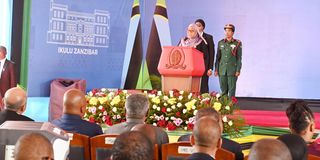
The event was witnessed by President Samia Suluhu Hassan and presided over by Zanzibar President Dr Hussein Ali Mwinyi and ACT-Wazalendo chairman Othman Masoud Othman.
During the event, Mr Othman provided the most detailed breakdown of the agreed agenda items, emphasising that the reforms are intended to create a stable environment for Zanzibar’s economic future.
On constitutional review, he said the parties agreed to re-evaluate Zanzibar’s legal framework to align it with modern democratic needs.
“Regarding electoral reforms, the focus is on improving the management systems to ensure all future elections are free, fair, and credible, thus removing the perennial ‘complaints’ that follow polls,” he said.
Furthermore, Mr Othman said judicial and legal reforms are intended to enhance the impartiality and efficiency of the justice system.
At the same time, he said public service accountability seeks to ensure the civil service remains ethical and non-partisan.
A key structural addition, according to him, is the establishment of a legal oversight body, a statutory entity to be created by law to coordinate and monitor implementation of the agreement.
Mr Othman stressed that sustaining the GNU and ensuring inclusivity, including the participation of other political parties and civil society, are paramount to achieving lasting peace.
"Dialogue is the lamp that removes darkness. Zanzibar requires these steps for broad and long-term social and economic benefits,” said Mr Othman.
He argued that for Zanzibar to become a trade and services hub, it requires five pillars: "National cohesion, an honest government under the rule of law, accountability, political stability, and sustainable peace.”
Mr Othman categorised public reaction to the accord into three groups. First, the hopeful majority who trust the process but lack a strong voice; second, the discouraged, who have seen past agreements fail and remain sceptical; and third, a small but influential group of saboteurs who benefit from chaos and oppose the GNU for personal gain.
He challenged the latter group's use of the "Revolution" to justify lawlessness, citing General Simon Bolivar to argue that true revolution aims for "justice, morality, and the protection of inexorable laws.”
He said Zanzibar's founders, including Abeid Amani Karume, intended the Revolution to bring equality and unity, not corruption.
Detailing the roadmap to the agreement, the Secretary of the Revolutionary Council and Chief Secretary, Dr Mansura Mosi Kassim, said the process stemmed from the political standoff following the October 2025 General Election, which, despite being peaceful, left several parties dissatisfied.
She said the mediation was spearheaded by Zanzibar’s retired leaders, former presidents Amani Abeid Karume and Dr Ali Mohamed Shein.
Dr Mansura said the two elder statesmen advised CCM and ACT-Wazalendo to negotiate a lasting solution to the challenges facing the Isles.
“The process involved nine high-level meetings between November 2025 and April 2026, alongside various subcommittee sessions,” she said.
“This period constituted the first phase, which focused on identifying key agendas and bridging the initial ‘large gap’ between the two sides,” added Dr Kassim.
Addressing the gathering, President Hassan described the reconciliation as a sign of political maturity.
"Reconciliation is a bridge," she remarked, praising the leaders for choosing "gentlemanly" politics (uungwana) over logic-free shouting. However, she issued a stern warning against anyone who might seek to undermine the peace.
Defining terrorism as acts intended to coerce the government through the destruction of infrastructure or disruption of peace, she stated: "Tanzania as a nation will not hesitate to use the power of the state to protect its citizens and its honour.”
She cited religious texts, noting that "believers are brothers" and "blessed are the peacemakers.”
In his remarks, President Mwinyi reaffirmed his full commitment to the GNU, as provided for under the Zanzibar Constitution.
"I am ready to oversee the second phase of this process... to build trust among our citizens and investors," he stated.
He thanked the CCM leadership for endorsing the process and expressed gratitude to the mediators for their ‘vast experience’ in previous reconciliation efforts.
The genesis of the reconciliation lies in the long-running political disputes that have shaped Zanzibar's politics since 1995.
The GNU was established in 2010 following a historic referendum and constitutional amendments aimed at ending the winner-takes-all political system.
However, the 2025 General Election strained the arrangement, leading to the current mediation process.
Yesterday’s signing marked the start of the second phase, which involves detailed negotiations and implementation of the agreed reforms.
The parties have now committed to establishing a Joint Negotiation Committee to undertake an in-depth analysis of the agreed agenda, ensuring Zanzibar’s interests take precedence over individual party interests.
Register to begin your journey to our premium contentSubscribe for full access to premium content