Gridlock worsens in Dar as illegal parking, hawking squeeze roads

Pedestrians and roadside traders in Dar es Salaam Street. PHOTO | FILE 

Dar es Salaam. Commuting across several parts of Dar es Salaam is increasingly becoming a test of endurance, with motorists and passengers spending hours trapped in traffic as roadside trading and uncontrolled parking choke key routes.

In commercial hotspots such as Kariakoo, Tandika, Mbagala and Gongolamboto, traders always spill beyond designated areas, in some cases operating in the middle of carriageways.
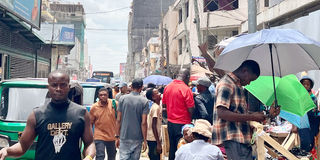
The encroachment significantly narrows road space, intensifying congestion from morning through late evening.

The Roads Act No 13 of 2007 prohibits the use of road reserves for commercial purposes without approval from the relevant authority and obliges local government authorities to keep roads safe and unobstructed.

Dar es Salaam City Council by-laws also outlaw trading in unauthorised areas, including on roads, and provide for penalties ranging from fines to removal.

Yet in many locations, vendors operate beneath posters warning against such activities.

In Kariakoo, particularly along Msimbazi and Uhuru streets, goods are routinely displayed on the roads while vehicles park indiscriminately to load and offload merchandise, creating chronic gridlock.

“You can spend more than an hour covering a very short distance,” said Mr Abdul Mhando, a trader in the area.

Resident of Tandika, Ms Rehema Kibwana, said traders have encroached on the road and commuter buses stop haphazardly.

“Some buses stop in the middle of the road. They force the road to operate on one side only,” she said.

Drivers cite lack of space

Public transport operators argue that inadequate infrastructure has compounded the problem.

A rickshaw driver in Kariakoo, Mr Ismail Shaha said the absence of designated parking and pick-up zones for them forces operators to solicit passengers on the roadway.

“The roads in Kariakoo are too narrow and we don’t have specific stations,” he said.

Commuter bus driver, Paulo Chale, who plies between Tabata Kimanga and Muhimbili, shared similar concerns. He said narrow streets and a shortage of proper bus stops have worsened congestion.

“Sometimes we use inner streets because traders occupy the main road, and even when we want to pull aside to drop passengers, there is no space,” he added.

Vendors defend position

The chairman of Kariakoo street vendors, Mr Stephen Lusinde, said it was unfair to blame petty traders alone, pointing to weak enforcement of agreed arrangements.

He said specific trading zones had been allocated after consultations with district authorities, but some individuals had moved onto major roads in violation of the agreement.

“The areas were properly allocated but there is a challenge with enforcement,” he said.

He alleged that some supervisors accept small bribes to allow illegal trading to continue, undermining efforts to restore order.

According to him, between 13,000 and 15,000 vendors operate in Kariakoo, though only 8,900 are formally registered. He added lorries, rickshaws, bodabodas and porters also contribute to congestion.

Mr Lusinde acknowledged that trading on roads endangers both vendors and customers, particularly along Bus Rapid Transit (BRT) lanes.

He called on authorities to expedite improvements to designated markets, including Jangwani, to ease pressure on the streets.

Secretary of the Kariakoo Traders Association, Mr Peter Mbilinyi, described the area as a major commercial hub requiring consistent oversight by city authorities.

“Kariakoo is a business district with a huge population. All surrounding roads are always filled with people coming to trade and shop. This demands strict supervision,” he said.

He cited the rapid increase of motorcycles around some points as a significant contributor to congestion.

The association has proposed establishing designated terminals for the motorcycles and tricycles outside central Kariakoo to reduce traffic pressure and promote pedestrian movement.

Mr Mbilinyi also faulted some building owners for extending staircases beyond approved plans, creating additional space for roadside trading. “This is a management issue. Good plans are made but implementation is weak. After some time, people revert to old habits,” he said.

Authorities step in

Dar es Salaam City engineer Mr Isack Mtega said the city had held regular meetings with vendors’ leaders and halted unauthorised building extensions that encourage roadside trading.

“The proliferation of roadside business is partly driven by unauthorised building extensions. We continue to monitor and take action in accordance with the law,” he said.

In January this year, Dar es Salaam Special Zone Police Commander Jumanne Muliro announced a crackdown on individuals unlawfully using Bus Rapid Transit (BRT) lanes, describing the practice as a breach of road safety regulations.

He said the government was implementing strategies to ease congestion and improve transport services in support of economic growth, adding that traffic police would intensify enforcement in congestion-prone areas to restore smoother movement and enhance safety across the city.

Last month, the Dar es Salaam Regional Commissioner, Mr Albert Chalamila, said the commencement of operations at Kariakoo Market would go hand in hand with the reopening of all roads leading into and out of the market.

According to Mr Chalamila, the measure is intended to enhance security at the market, improve service accessibility and facilitate emergency response in the event of any incident.

“The opening of roads will not only be in Kariakoo,” he said, signaling that other roads of the city would be decongested.