Vodacom spells out why it’s among top taxpayers in Tanzania
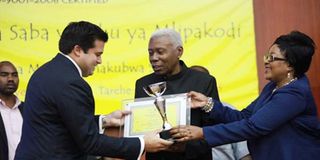
The managing director of Vodacom Tanzania, Mr Rene Meza (left), receives from Vice-President Dr Mohamed Gharib Bilal and the deputy minister for Finance, Ms Janeth Mbene, a trophy and a certificate the firm was awarded after emerging the third best National Tax Contributor during the climax of the Taxpayers’ Day on Friday in Dar es Salaam. Photo/Silvan Kiwale
What you need to know:
Vodacom Tanzania emerged tops in the telecoms category and won the third overall award. In this interview, its managing director Rene Meza reflects on the accolade and other sectoral and operational issues. Read on.
On Friday, Tanzania Revenue Authority (TRA) held the 7th edition of the Taxpayers’ Day in Dar es Salaam and honoured the most complaint companies in remitting taxes during fiscal year 2012/13.
Vodacom Tanzania emerged tops in the telecoms category and won the third overall award. In this interview, its managing director Rene Meza reflects on the accolade and other sectoral and operational issues. Read on.
QUESTION: You have just been awarded the top taxpayer award in the telecoms category. Can you tell us why you emerged the winner this year?
ANSWER: We are extremely proud to have won the top taxpayer award in the telecommunications category and the third overall award at national level. Our contribution to government revenue has increased dramatically over the last few years.
We are now seeing our investment bearing fruit and are thus able to increase our contribution to government revenue significantly. That is why we won this award. I would like thank our employees and the over 10 million customers for this accomplishment. It is because of their commitment and loyalty that we continue to go from strength to strength.
The fact that you won this award is a clear indication that your corporate tax contribution to the government has increased substantially as compared to previous years. Can you please expound on this?
Within six months into our financial year, i.e. April to September 2013, we paid Sh29.3 billion in corporate tax. This is an increase of over 86 per cent of the Sh15.7 billion that we paid over the same period in 2012. We also collected Sh111 billion in VAT, excise duty and other taxes on behalf of the government.
In the fiscal year 2011/12 Vodacom paid Sh36.5 billion in corporate tax. In addition to this, we collected over Sh190 billion in VAT, excise duty and other taxes and duties which we paid to the government. We are complaint with the tax laws of Tanzania and remain committed to meeting all our obligations to the government.
What are your investment plans for the year 2013?
Since our establishment as a business in Tanzania we have invested in excess of Sh1.5 trillion in the country. Our total investment in 2013 alone will be in excess of Sh200 billion. We currently cover close to 90 per cent of Tanzania’s population with over 2,700 sites.
We have invested over Sh3 billion in the National Information and Communication Technology Broadband Backbone (NICTBB) and our network is currently connected using this infrastructure across the country.
Tanzania’s lack of power infrastructure has a huge impact on the investment we require since we need to connect most of our sites to generators that run on fuel. Nevertheless, we plan to invest over Sh200 billion in network expansion this year. Our investment has had a tremendous impact on our network quality and this is a major focus for us. By end of March 2014 we expect to cross the 3,000 sites mark in the country. Our investment will cover 2G and 3G network expansion, as well as the enhancement of our M-Pesa service.
What do you mean by the enhancement of M-Pesa and what is its contribution to your business in Tanzania?
You will no doubt agree with me that the mobile phone has today gone beyond the action of simply allowing users to make and receive calls. The phone is a tool that enables: financial transactions, access to the Internet, downloading of music and movies, access to emails, information and so on. For its part, M-Pesa uniquely stands out because it is a total payment solution which does not require users to have bank accounts. This is an important consideration given that millions of people do not operate bank accounts in the country and in most instances, can barely meet the minimum qualifications to open one.
With M-Pesa, Vodacom customers can deposit up to Sh5 million for free, send and receive money and withdraw cash from any of our 60,000 M-Pesa agents (wakalas) in the country. They can also access their bank accounts from their palms. That is why we have over five million active M-Pesa users as well as more than 200 organizations that accept bill payments via M-Pesa.
M-Pesa is a key driver of our business and has transformed people’s lives in a way ever thought before. In addition to this, it has also allowed a lot of Tanzanians, who were hitherto invisible, to play a more active role in the economy. Approximately 35 per cent of Tanzania’s gross domestic product - represented by the over Sh1.7 trillion in transaction value, done by our millions of customers - goes through M-Pesa every month.
In order to meet the ever growing list of consumers, we at Vodacom remain committed to ensuring that M-Pesa is powered by the very latest technology with regards to mobile money transfer services.
What is the next frontier with regards to M-Pesa?
If I had a wish list, it would certainly be International Money Transfers and we would have as usual, played a leading role in the mobile communications sector through further cementing the spirit of the EAC within our part of the world.
Where do you see mobile telephony going over the next few years?
The telecommunications sector in Tanzania has been driven by a gradual merging of technology. Not long ago, a fixed line telephone was a luxury item enjoyed by a few but today, the mobile phone is a necessary infrastructure.
We at Vodacom, therefore, see ourselves as much more than just a mobile phone company. For, we have transformed our business into a total solutions provider for all segments of the market. We are uniquely positioned to cater for; the man on the street, the professional, the mama at home and of course the ever growing corporate community in Tanzania. We offer our customers a comprehensive technology package that can be tailored to suit their various needs and lifestyles.
With the increasingly blurred distinction between communication services and broadcasting, there is no better time than this to be in the industry. These are exciting times! I believe that we will continue to see a merging of technologies driving market trends and growth, with virtually anything that can be connected, being connected via Vodacom technology and of course, all this will happen on a mobile phone.
You are doing so well…what are the challenges if any?
Our growth and success has, of course, brought with it many challenges.
If you look at the World Economic Forum Global Competitiveness Report, which was released earlier this year, you will see that Tanzania was ranked 125th out of 144 countries. This is a decline compared to its global ranking last year. The report highlights particular weaknesses in the areas of policy making and regulations. The former is attributed to among other things, the new taxation regime that was introduced in the last budget without proper consultation with stakeholders and which has had far reaching consequences for various industries. This has definitely eroded foreign investor confidence.
Furthermore, infrastructure in Tanzania is still underdeveloped, with poor roads and ports and an unreliable electricity supply. These issues which should ordinarily be a given put tremendous pressure on the investment required to do business.
Inspite of all these challenges we at Vodacom have remained committed to continue driving socio-economic growth and transformation through our investment. For, we continue to expand our network coverage and provide improved access to our M-Pesa product.
We have always been the key driver of technology and innovation in Tanzania. We were the first mobile operator to introduce the 3G technology in Tanzania because we believe that all Tanzanians should have access to world class technology. We launched our LTE technology trial early this year to allow our customers to access the best possible data speeds in the market today. We are able to draw on the expertise of Vodacom and Vodafone Group from South Africa and Europe, and we have the financial and technical resources required to make LTE a reality for all Tanzanians.
Our lack spectrum to roll out LTE is a challenge. We are working with the government to secure additional spectrum to enable us to rollout the technology and put Tanzania at par with the developed world.
Why did Vodacom Tanzania not submit a bid for the Universal Communication Services Access Fund? Does this mean that rural network expansion is not a priority for Vodacom?
Rural expansion is Vodacom’s priority. We believe this is where growth in the telecommunications industry will come from in the next decade. We have paid over Sh4.5 billion in Universal Communication Services Access Fund (UCSAF) to the government and are very keen to play a key role in rural expansion. We are keen to support government’s initiative to provide affordable communications to all and we are in continuous dialogue with the Government of Tanzania on this.
There is a perception that mobile tariffs in Tanzania are high and the different offers benefit only mobile phone companies and not consumers. What are your views about this?
Tanzania enjoys one of the lowest mobile tariffs in the world. Vodacom offers a variety of very competitive products in the market. We have an array of very competitive bundles that allow our customers to make calls, send SMS and browse the internet from as low as Sh500.
Our bundle offers coupled with our increased 3G footprint, which covers most parts of the country, allow a lot more Tanzanians to access the Internet for among other things, on-line banking, e-learning ( education, agriculture, entrepreneurship etc) , business (e-commerce), e-health, security and social services. Vodacom thus continues to be a key enabler of the uptake of technology in the area and Tanzania as a whole.
What are you doing in the Corporate Social Responsibility arena?
We are committed to supporting the government achieve its Millennium Development Goals (MDGs). In this regard, the Vodacom Foundation which is the giving arm of the company, has to date spent over Sh14 billion in the health, education and social welfare sectors.
Two initiatives that we continue to drive aggressively are: the Moyo Campaign which seeks to both provide treatment and create awareness for fistula and the M-Pesa Women Empowerment Initiative (Mwei). I am proud to say that as a company we have contributed to the treatment of over 1,365 women who used to live with the shame and stigma caused by fistula and also put a smile on the faces of over 475 children and adults who had cleft lip through providing them with access to life changing surgery.
With regards to Mwei we have disbursed over Sh300 million in interest free loans to more than 8,000 women in urban and peri-urban areas thus allowing them to provide for their families.
This year, among other things, we are looking to use our technology to play a role in the education sector. We recently launched our Smart School Project – a joint initiative of the Vodacom Foundation and Samsung – at Kambangwa Secondary School in Kinondoni.