Dar es Salaam. As the Commission of Inquiry into violence that erupted during and after the General Election of October 29, 2025 prepares to submit its findings today, stakeholders across the country have turned their attention to the body, eager to learn what its investigations have uncovered.
The report is expected to address key public concerns and shed light on events that unfolded during and after the election. It is anticipated to be formally presented to President Samia Suluhu Hassan either today or in the coming days after the commission completes the 132-day period granted by the appointing authority.
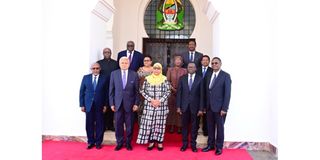
On November 14, 2025, while opening the 13th session of Parliament, President Hassan announced her intention to establish the commission. Four days later, on November 18, 2025, she officially appointed it, tasking the body with investigating the causes and consequences of violence that erupted during and after the October 2025 election.
During that period, several people lost their lives, others were left with permanent injuries, and both public and private property were destroyed following wide-spread violence.
“The Government has taken the decision to establish a commission to investigate the matter so that we may understand the root cause, and the report produced will guide us in dialogue aimed at restoring peace and national unity,” President Samia said.
She further stated that the commission’s report would pave the way for reconciliation and support the process towards obtaining a new Constitution.
Hundreds of young people were arrested and charged with treason in various courts across the country. However, President Hassan later granted clemency to some, explaining that they had been misled. However, this has not been established to be a matter of fact. Their cases were withdrawn and they were released back into society, while others continued to face trial.
The commission, initially given three months to complete its work, comprised nine members led by chairperson and retired Chief Justice Othman Chande. Other members included retired Chief Justice Prof Ibrahim Juma and retired Chief Secretary Ambassador Ombeni Sefue.
Also appointed were Ambassador Radhia Msuya and retired Lieutenant General Paul Meela, a diplomat and former ambassador.
The team further included retired Inspector General of Police, Mr Said Mwema; Ambassador David Kapya; and former Minister for Defence and former Executive Secretary of the Southern African Development Community (SADC), Dr Stergomena Tax
On November 20, 2025, President Hassan formally inaugurated the commission and assigned it seven key areas of investigation. These included identifying the root causes of the crisis and the reasons behind the violence, assessing the demands raised by protesting youth, and analysing statements made by opposition parties, including alleged inflammatory remarks issued prior to the election.
The commission was also tasked with examining relations between political parties and the Independent Electoral Commission, investigating the alleged role of domestic and foreign non-governmental organisations (NGOs) in the events of October 29, 2025, and determining whether alternative dispute-resolution mechanisms existed other than demonstrations.
Additionally, it was mandated to assess the actions taken by State security agencies in responding to the unrest and whether those measures were appropriate or excessive following the deaths of some protesters, most of whom were youth.
The commission began its work amid criticism from major opposition parties, including Chama cha Demokrasia na Maendeleo (Chadema) and ACT Wazalendo, as well as other stakeholders who questioned the legitimacy of its appointment process and the credibility of some of its members. It is reported that these groups declined to submit their views to the commission.
Further controversy emerged on November 27, 2025, when activist Rose Mwakitwange, alongside advocates of the High Court and subordinate courts Edward Heche and Deogratius Mahinyila, filed a petition at the High Court Sub-Registry in Dar es Salaam challenging the legality of the commission.
On December 18, 2025, the High Court ruled that the commission could be challenged in court. However, on March 13, 2026, the court dismissed the case, stating that President Samia had acted within her legal powers under Section 3 of the Commissions of Inquiry Act, Chapter 32, and had not exceeded her authority in appointing the body.
How the commission conducted its work
In response to public concerns and allegations, the commission’s chairperson, Justice Chande, told journalists in Dar es Salaam shortly after the commission began its work that its performance would be scrutinised both nationally and internationally, and that it was therefore committed to focusing on what Tanzanians expected from the inquiry.
The commission travelled across various regions and engaged with multiple stakeholders, including victims. Media houses were initially allowed to attend sessions and report on testimonies presented.
However, on January 24, 2026, while in Ubungo District in Dar es Salaam, the commission announced that journalists would no longer be allowed inside the hearing hall while witnesses were giving evidence. Professor Juma said the decision was meant to protect witness privacy, but the move triggered widespread debate, with members of the public raising concerns about secrecy within the commission.
After its initial 90-day mandate expired on February 20, 2026, President Samia extended its work by an additional 42 days, allowing it to continue until today, Friday, April 3, 2026, to enable the inquiry to be completed thoroughly.
On Wednesday, April 1, 2026, at State House in Dar es Salaam, President Samia met 16 former presidential candidates from the October 2025 election to discuss ways of strengthening political reconciliation, multiparty democracy, peace and national cohesion.
A statement signed by the Deputy Director of Presidential Communications at State House, Shaaban Kissu, said the politicians used the meeting to present their views on enhancing political reconciliation, strengthening party democracy, and promoting peace and unity after the election.
They also provided recommendations on improving citizen participation in development activities and preserving national unity values.
Doubts and expectations
Stakeholders have expressed mixed feelings regarding what the commission’s findings may reveal, with society divided over whether the report will fully reflect the truth and address lingering public anxieties.
A University of Dar es Salaam (UDSM) lecturer, Richard Mbunda, said the key question is whether the report will confirm existing fears among some stakeholders or dispel them.
“What is awaited is whether the report will validate concerns raised by some groups or erase those fears. This is due to the doubts surrounding the type of members appointed and how the commission operated—initially conducting hearings openly in the presence of the media, before later excluding journalists,” he said.
He added that the shift fuelled suspicion that some critical information could have been concealed. Allowing testimonies to be aired publicly had enabled citizens to hear accounts they were already aware of, strengthening confidence that the truth would be revealed.
“The most important issue is also how the report will be presented. Will it be delivered openly before the President and read publicly so people can know what was found, or will it be quietly submitted to the President, who then decides whether to disclose its contents? That will determine how society responds and whether the report will be trusted,” he added.
The Executive Director of the Legal and Human Rights Centre (LHRC), Anna Henga, said the report is being awaited with deep scepticism, noting fears that the commission’s independence may have been compromised.
“We are waiting for the report with concern, fearing it may deliver half-truths. However, since many matters have been put on hold under the justification that the investigation must first be completed, once the report is released it will allow other crucial national steps to proceed,” she said.
Meanwhile, former presidential candidate Doyo Hassan Doyo, who contested under the NLD party, said stakeholders expected the report to reveal the truth in order to ease national tension.
“From my perspective, on behalf of the candidates who participated in that election, we expect the commission’s report to clearly explain what happened. Since stakeholders have long demanded an independent body to investigate these events, our expectation is that the commission will expose the truth of what occurred during that election,” he said.
A senior government official, who requested anonymity, described the report as “a thorn”, warning that without the full truth it would lack credibility and reconciliation would be difficult to achieve, while the commissioners themselves would lose public trust.
“We were told by Justice Chande to trust the process and wait for the report. The time has come. If they distort it, citizens already know what happened. Some people witnessed testimonies being given. If they bring unclear conclusions, they will only put the President in a difficult position,” the official said.
Register to begin your journey to our premium contentSubscribe for full access to premium content