Modern planter puts tech at centre of smallholder farming future
Sokoine University of Agriculture graduate Mr Ibrahim Meshack stands beside his innovation, the SmartShamba Multi-Crop Planter, while working in the field to help farmers plant crops using the new technology. Mr Meshack is expected to expand the service following COSTECH’s support to help scale up the project. PHOTO | COURTESY
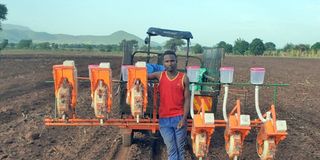
Dar es Salaam. A new technology developed by a young Tanzanian innovator is helping smallholder farmers in Manyara Region make planting faster, more precise and potentially more productive.
The innovation offers a homegrown solution to some of the challenges that have increasingly been driving farmers to look beyond traditional methods.
Dubbed; SmartShamba Multi-Crop Planter, developed by young Sokoine University of Agriculture (SUA) graduate Ibrahim Meshack, the technology was among the exceptional showcased during the National Education, Skills and Innovation Week in Tanga.
Mr Meshack became among the five innovators selected for commercialization support from the Tanzania Commission for Science and Technology (COSTECH).
At its core, SmartShamba is designed to address one of the most important stages of crop production: getting seeds into the ground accurately, on time and at the right spacing.
“Our main goal is to increase crop production and enable farmers to increase their income. That is why we have continued to improve this machine so that it can operate efficiently, reduce planting time and reach more farmers,” Mr Meshack told The Citizen.
The planter is designed to place seeds at uniform spacing and depth, helping improve germination and crop establishment. It can be used with Guta two-wheel tractors (power tillers), which are already widely used by smallholder farmers.
Its design also allows it to operate on sloping, uneven and moderately rough terrain, according to the product profile.
That matters in a country where access to large tractors remains beyond the reach of many small-scale farmers.
Mr Meshack said the machine has already moved beyond the prototype stage. “It has been tested on more than 50 acres and, since 2025, has been used to plant more than 150 acres. It can plant an acre in about 30 minutes, compared with roughly one and a half hours using a tractor under the conventional arrangement.”
The cost advantage is also significant. Mr Meshack estimates the cost of planting with SmartShamba at about Sh35,000 an acre, compared with over Sh60,000 using a tractor. He, however, is careful not to attribute higher yields to the machine alone.
Seed quality, rainfall, soil conditions, fertiliser and general farm management all influence production. In one trial cited by the innovator, a field planted with SmartShamba produced an average of 25 bags, while an area planted traditionally produced about eight bags under similar conditions.
According to experts, agriculture remains central to livelihoods, food security and the wider economy. Yet increasing productivity will require more than expanding cultivated land.
Farmers will need technologies that reduce production costs, improve efficiency and make better use of available inputs.
SmartShamba illustrates how that transition can begin from a problem identified on the farm rather than from technology looking for a problem to solve.
COSTECH’s support is intended to help innovations such as SmartShamba move along the difficult path from prototype to commercial product. Of 261 applicants for the programme, 34 reached the pitching stage and 12 passed it, with five ultimately selected for support. The assistance includes grants and technical support aimed at helping the innovations develop commercially.
COSTECH Director General Amos Nungu has repeatedly stressed the importance of taking innovations beyond ideas and into applications and markets.
“Our role is to support innovators through incubation, capacity building and links with the private sector,” he said, adding that the government’s current initiatives were also placing greater emphasis on turning youth innovations into companies, jobs and economic value.
That commercialisation pathway could be particularly important for agricultural technologies, said an Agritech expert, Ms Agness Mbowe. “An innovation can demonstrate that it works, but its wider impact depends on whether it can be produced at scale, sold at an affordable price, maintained locally and supported with the inputs farmers need.”
Meshack says there is already demand for SmartShamba, but increasing production remains a challenge.
“We already have customers who need this product and we expect to continue selling to them as production increases. Our goal is to ensure SmartShamba reaches more farmers and helps increase their production,” he said.
He also points to seed availability as another challenge. This highlights a broader reality: technology can solve one part of the agricultural value chain, but its full benefits depend on the strength of the wider system.