Sh1.36 trillion alone will not fix problems in education

What you need to know:

  • The budget is smaller by 4.2 per cent compared to the 2016/17 one which stood at Sh1.39 trillion. The 2017/18 financial year’s allocations for recurrent expenditure is reduced from Sh499 billion to Sh419 billion.
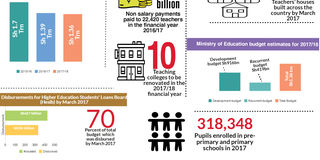

Dar es Salaam. The Sh1.36 trillion budget for the ministry of Education, Science and Technology for a financial year 2017/18 was tabled in Parliament on May 13, this year.

The budget is smaller by 4.2 per cent compared to the 2016/17 one which stood at Sh1.39 trillion. The 2017/18 financial year’s allocations for recurrent expenditure is reduced from Sh499 billion to Sh419 billion.

When tabling the budget, the minister for Education Prof Joyce Ndalichako told the Parliament that 68.6 per cent of the budget, amounting to Sh916 billion, was allocated for development projects and the remaining, Sh419 billion (31.4 per cent) is for recurrent expenditure.

Education sector is key for the development of any sector, and it requires adequate investments to enable students learn in a more conducive environment. But stakeholders are of the views that the 2017/18 budget in the manner in which it was created might not produce desired results.

Budgetary allocations

Among other things, the ministry of Education has planned to finance renovation of 1,200 schools, of which 1,000 are primary and 200 are secondary schools in Dodoma, Mara, Tabora, Mwanza, Kagera, Kigoma, Arusha, Kilimajaro, Tanga, Simiyu and Shinyanga.

Moreover, funds have been provided for inspection in 700 secondary schools in 26 regions, a move aimed at improving the quality of education in public schools.

Prof Ndalichako also told the Parliament in May 13 that plans to renovate six Teachers Colleges namely Kleruu (Iringa) Mpwapwa (Dodoma), Dakawa (Morogoro), Tabora, Butimba (Mwanza) and Marangu in Kilimanjaro region were underway.

Teachers arrears

Nothing much was talked about by the minister as far as teachers is concerned. Improving teachers’ welfare was also, it seems, not the focus of the 2017/18 budget.

Stakeholders who spoke to The Citizen said by ignoring teachers’ welfare the government has missed an important opportunity to boost their morale.

Stakeholders believe that the education sector’s budget is a crucial tool for the successful implementation of government plans and service delivery. However, in order for the budget plan to be effective, it was crucial if the preparations would have considered opinions and participation of various stakeholders from and within government circle.

Another concern was on the improvement of schools infrastructure, including lavatories, building more classrooms to accommodate the influx of students caused by the implementation of fee free education policy as well as recruiting more teacher to meet the standard teacher- pupil ration.

According to available educational statistics, enrolment for pre-primary has increased by almost 46 per cent, equivalent to an increase of 492,947 as that of primary schools increased by 41 per cent, which is equivalent to 552,289 students more when compared to the 2015 enrolment.

“Given that the standard number of primary school learners per classroom is 45; then schools require at least 22,222 new classrooms, whose cost is at least Sh267 billion, that is, Sh12 million shillings per classroom,” a budget document by Hakielimu, a local Ngo on education affairs, reads in part. The pre-budget statement for the financial year 2017/18, Hakielimu, futher points out that there is an increase of around 1,000,000 (one million) learners to primary and secondary schools.

“We need to appreciate the fact that quality checks of schools are necessary, for they facilitate inspections through which teachers can be given professional advice on how they can improve their work and therein boost education offered to our children,”

“However, it should be borne in mind that even before the massive increase in the number of learners in public schools, there was a shortage of 95,945 classrooms teacher-student ratio in our pre-primary schools stood at stood at 1:77,” reads part of the document which was signed by Hakielimu Executive Director John Kalage.

A local research institution Twaweza, says the budget allocations should have considered the many factors contributing to quality learning outcomes including commitment on providing adequate school funding through the capitation grant.

This is due to the fact that, the amount for this grant has remained the same at Sh10,000 per child in primary school and Sh25,000 per pupil in secondary school annually since 2002.

Given that central government now provides text books and so withholds that portion of the capitation grant, schools are now receiving Sh6,000 per child per year to cover for sports, exams, security, repairs and administration.

Twaweza said another challenge is the fact that the allocated budget is not the actual budget being released for implementation.

“For example, in the 2016/17 budget, more than Sh108 billion had been budgeted for the Literacy and Numeracy Ed¬ucation Support Programme (LANES) project to improve the learning of Reading, Writing and Arithmetic (3Rs) but only Sh29 billion (27 per cent) had been released by March,” says Ms Zaida Mgala, Twaweza’s manager of Uwezo project.

According to her, the budget should have gone further to address teacher motivation which has become serious issue, saying various researches which have been undertaken by the institution shows that teachers have many claims for their unpaid salaries, and allowances.

“Our reports shows that, they struggle with poor teaching environments with limited learning materials and there is limited accountability for their performance or even attendance at school. Yet the teacher is the foundation of a child’s education. Has the question of teacher motivation been sufficiently addressed in the budget?” she queries.

Another issue which was highly expected to be covered by the budget but not done was the management and accountability.

In connection to this, stakeholders have called for proper use of funds at all levels, from schools to the national level is essential. Proper processes for financial management and accountability, for production of learning materials and for engaging parents are essential ingredients for a strong education sector.

A analysts expressed their disappointment and deeply dissatisfaction on how the issue of curriculum and education is being implemented.

Mr Benjamin Nkonya, an education policy analyst said the government should be committed to prepare better curriculum and standard teaching and reference books, saying it is a better way of renovating the sector.

According to him, the government should offer a road map that would last for many years, a move that would also set foundation for better and quality education.

“Apparently, there is poor monitoring and evaluation strategies in our education system, this brings weaknesses in our entire sector… I’m also not in favour of the decision by the minister of sacking the acting commissioner of Education Mr Nicholas Bureta and acting director general of Tanzania Institute of Education (TIE) Dr Elia Kigda over the error- laden textbooks scandal,” he said.

The analyst went on to say, in order to come up with the best and standard books and curricula then it’s a must for the government to pay attention to nine procedures of preparing teaching and reference books.

“Those steps are curriculum designing, curriculum development, books authorship, book editing books evaluation, publication cover development, printing and circulation… these are standards procedures needed in the making of books and they must involve panels of experts.”

“Recently there have been no editors, the whole process is blurred, we are in a point that only one person can do everything. This has led to many typos, errors and weaknesses hence downgrading quality of our education compared to our neighbor countries,” he explained.

In order for quality education to lead to good quality, the government should have attempted to initiate necessary steps right through the educational continuum to enhance and maintain access, innovation, parity and quality-universally and equitably.

Debating the budget estimates for the Ministry of Education, Science, Technology and Vocational Training, members of the parliament pushed the government to allow a pregnant schoolgirls to resume classes after delivery.

Both, Opposition Camp and the parliamentary committee on social services and community development said that the government must act to help pregnant girls continue with education after giving birth. The committee report which was tabled by Nzega Urban Mp Hussein Bashe advised that the government should make official announcement on the commencement of the execution of the circular that allows teenage mother to go back to studies.

According to the committee, the move will help end cycle of poverty and having many uneducated mothers in the country. All in all, the education sector has remained a top government priority sector as it takes the biggest share in the overall government budget allocations, but it would be better if the government takes into account concerns brought by stakeholders and Members of the parliament.