Sh63.8 billion set aside to boost irrigation farming in Mara Region
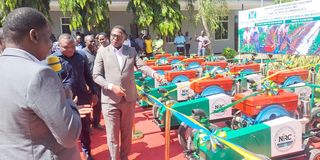
Mara Regional Commissioner, Evans Mtambi (right), gestures during a brief ceremony to distribute irrigation pumps to smallholders to improve irrigation farming. PHOTO | BELDINA NYAKEKE
Musoma. The government has allocated more than Sh63.8 billion to improve and expand irrigation farming in Mara Region, with part of the funds earmarked for strategic agricultural projects.
The allocation in the 2026/27 financial year is also expected to support large and small irrigation projects aimed at empowering smallholder farmers and improving their productivity, as the government seeks to increase their contribution to the economy.
Mara Regional Commissioner, Evans Mtambi, disclosed the figures in Musoma yesterday, during the launch of the distribution of irrigation pumps to smallholder farmers’ groups in the region.
He said the funds would help transform agriculture in Mara by improving productivity and reducing farmers’ reliance on rain.
“The funds will finance strategic projects, including the rehabilitation of the Bugwema irrigation scheme so that it can be fully utilised and contribute to transforming the agricultural sector in Mara,” he said.
According to Mr Mtambi, part of the allocation will finance the drilling of 34 deep irrigation wells at a cost of more than Sh1.2 billion.
The funds will also be used to complete feasibility studies and designs for 15 irrigation schemes at a cost of more than Sh2.4 billion, as well as feasibility studies and designs for seven irrigation dams.
Another Sh1.3 billion will be spent on purchasing 153 irrigation pumps. “More than 3,800 smallholder farmers are expected to benefit from these projects. A total of 121 groups have already been identified, including the farmers receiving pumps today,” he said.
Mr Mtambi directed agricultural extension officers to closely monitor the beneficiaries and provide technical advice to ensure farmers adopt modern farming practices and improve productivity.
He said extension officers should also advise farmers on suitable crops for particular areas to ensure they plant the right crops at the right time.
Mara Regional Irrigation Engineer Adeliaidy Rutashobya said 80 farmer groups comprising 121 farmers were receiving irrigation pumps under the latest distribution programme.
She said 113 pumps worth more than Sh813 million would benefit farmers across all districts in the region.
Ms Rutashobya said the distribution would be accompanied by training on the proper use and maintenance of the equipment to ensure the project delivers the intended results. “The project aims to help smallholder farmers continue farming despite the challenges posed by climate change. In addition to receiving the pumps, the farmers will be trained on how to use them,” she said.
Farmers who received the equipment said irrigation would help improve production and increase yields, contributing to food security while raising household incomes.
One of them, Mr Amos Magori, said unreliable rainfall and other effects of climate change had made farming increasingly difficult and reduced productivity.
“With or without rain, we will now be assured of planting and harvesting. I only appeal to extension officers to remain close to us so that farming can help improve our lives,” he said.
Another beneficiary, Ms Amina Sadiki, said many farmers had suffered financial losses because of dependence on rain-fed agriculture, which often resulted in poor harvests when rainfall was insufficient.
She said expanding irrigation would give farmers greater certainty and help them plan their production more effectively.